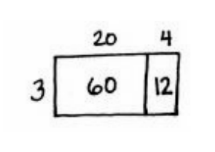
Tony drew the following area model to find an unknown length. What division equation did he model?
Lesson 14
Use the RDW process to solve the following problem. Fifty-three students are going on a field trip. The students are divided into groups of 6 students.
How many groups of 6 students will there be?
If the remaining students form a smaller group and one chaperone is assigned to every group, how many total chaperones are needed?
Lesson 15
Solve using an array and area model.
Lesson 15
Solve using an array and area model.
Lesson 16
Show the division using disks. Relate your work on the place value chart to long division. Check your quotient and remainder by using multiplication and addition.
Lesson 16
Show the division using disks. Relate your work on the place value chart to long division. Check your quotient and remainder by using multiplication and addition.
Lesson 17
Show the division using disks. Relate your model to long division. Check your quotient by using multiplication and addition
Lesson 17
Show the division using disks. Relate your model to long division. Check your quotient by using multiplication and addition
Lesson 18
Solve using the standard algorithm. Check your quotient and remainder by using multiplication and addition. 93 ÷ 7
Lesson 18
Solve using the standard algorithm. Check your quotient and remainder by using multiplication and addition. 99 ÷ 8
Lesson 19
Molly’s photo album has a total of 97 pictures. Each page of the album holds 6 pictures. Use place value disks to solve.
How many pages can Molly fill?
Will there be any pictures left?
Lesson 19
Marti’s photo album has a total of 45 pictures. Each page holds 4 pictures. She said she can only fill 10 pages completely. Do you agree? Explain why or why not.
Tony drew the following area model to find an unknown length. What division equation did he model?
Lesson 20
Solve 42 ÷ 3 using the area model, a number bond, and a written method.
Lesson 21
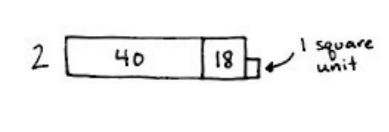
Kyle drew the following area model to find an unknown length. What division equation did he model?
Lesson 21
Solve 93 ÷ 4 using the area model, long division, and the distributive property.
Lesson 22
Record the factors of the numbers as multiplication sentences and as a list in order from least to greatest. Classify each as prime or composite.
Multiplication Number Sentences:
9 =
9 =
Factors of 9 (in order from least to greatest):
9 is a
Lesson 22
Record the factors of the numbers as multiplication sentences and as a list in order from least to greatest. Classify each as prime or composite.
Multiplication Number Sentences:
12 =
12 =
12 =
Factors of 12 (in order from least to greatest):
12 is a
Lesson 22
Record the factors of the numbers as multiplication sentences and as a list in order from least to greatest. Classify each as prime or composite.
Multiplication Number Sentences:
19 =
Factors of 19 (in order from least to greatest):
19 is a
Lesson 23
Explain your thinking or use division to fill in the blanks:
2 (is/is not)
Lesson 23
Explain your thinking or use division to fill in the blanks:
3 (is/is not)
Lesson 23
Explain your thinking or use division to fill in the blanks:
4 (is/is not)
Lesson 23
Explain your thinking or use division to fill in the blanks:
3 (is/is not)
Lesson 23
Use the associative property to explain why the following statement is true:
Any number that has 9 as a factor also has 3 as a factor.
Lesson 24
Fill in the unknown multiple of 11.
5 × 11 =
6 × 11 =
7 × 11 =
8 × 11 =
9 × 11 =
Lesson 24
Complete the pattern of multiples by skip-counting.
7, 14,
Lesson 24
List the numbers that have 18 as a multiple (in order from least to greatest).
What are the factors of 18 (in order from least to greatest?
Are the two lists the same?
Why/why not?
Lesson 25
Use the calendar to complete the following:
1. Cross off all composite numbers. 2. Circle all of the prime numbers. 3. List any remaining numbers.