Lesson 28
One of the students read 3/4 hour on Friday, 3/4 hour on Saturday, and 3/4 hour on Sunday.
How many hours did that student read over the weekend (mixed number)?
The student read
Name that student.
Lesson 22
Complete the subtraction sentence using number bonds. Draw a model if needed.
6 -
Lesson 22
Complete the subtraction sentence using number bonds. Draw a model if needed.
8 -
Lesson 22
Complete the subtraction sentence using number bonds. Draw a model if needed.
7 -
Lesson 23
Multiply and write the product as a mixed number. Draw a number line to support your answer.
8 x
Lesson 23
Multiply and write the product as a mixed number. Draw a number line to support your answer.
7 copies of
Lesson 23
Multiply and write the product as a mixed number. Draw a number line to support your answer.
13 times
Lesson 24
Rename the fraction as a mixed number by decomposing it into two parts. Model the decomposition with a number line and a number bond.
Lesson 24
Convert the fraction to a mixed number. Model with a number line.
Lesson 24
Convert 1
Lesson 25
Convert 3
Lesson 25
Convert 2
Lesson 25
Convert 4
Lesson 26
Compare the fraction given below by writing >, ˂, or =.
3
3
Lesson 27
Compare the pair of fractions using >, <, or = using any strategy.
4
3
2
10
Lesson 28
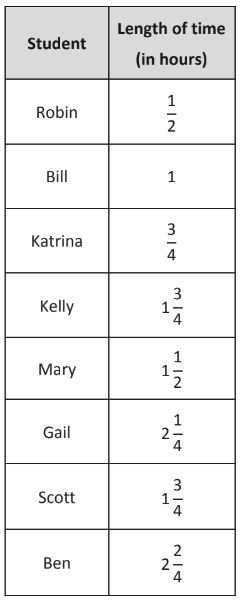
Mr. O’Neil asked his students to record the length of time they read over the weekend. The times are listed in the table. Make a line plot of the data.
Lesson 28
One of the students read 3/4 hour on Friday, 3/4 hour on Saturday, and 3/4 hour on Sunday.
How many hours did that student read over the weekend (mixed number)?
The student read
Name that student.
Lesson 29
Estimate 2
Lesson 29
Estimate 11
Lesson 30
3
Lesson 30
3
convert to mixed number
Lesson 31
2
Lesson 31
3
Lesson 32
10
Lesson 32
8
Lesson 33
4
Lesson 33
12
Lesson 34
7
Lesson 34
12
Lesson 35
Solve using unit form (improper fraction).
5 x 2/3 =
Lesson 35
11 x
Lesson 36
Solve using any method.
7 x
Lesson 36
Solve using any method.
9 x
Lesson 36
Solve using any method.
60 x
Lesson 37
Multiply. Write the product as a mixed number.
4 x 5
Lesson 37
Multiply. Write the product as a mixed number.
4
Lesson 38
Fill in the unknown factors.
8 x 5
Lesson 38
Multiply. Use the distributive property.
6 5/8 x 7 = (7 x
Lesson 39
Use the RDW process to solve.
Jeff has ten packages that he wants to mail. Nine identical packages weigh 2
All 10 packages weigh
Lesson 40
Coach Taylor asked his team to record the distance they ran during practice. The distances are listed in the table.
Lesson 41
Find the sum.
Lesson 41
Find the sum.