To be given alongside other classwork.
The ancient and traditional Japanese class of warriors, known as the Samurai, have been widely popularized in culture as the ultimate icon of military prowess. An elite group of military nobility, the Japanese Samurai were perhaps most revered for their codes of honor and principles, known as Bushido; which governed the Samurai’s way of life and comparable in some ways to the European concept of chivalry. The Bushido way of life can offer more than a simple insight and serve as a reminder of how we can direct our lives for the better. Below are the principles of Bushido and ideas on how they can be used today to build a robust inner life and more meaningful and authentic relationships.
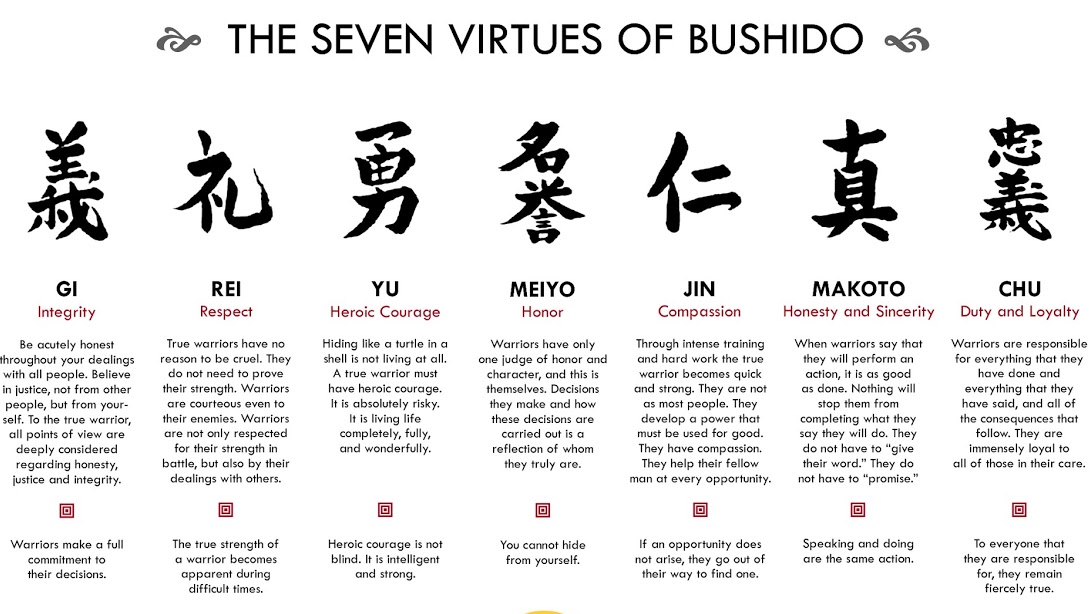
Directions: Look and read the image below.
Pick one (1) of the seven principles of Bushido to read, but not all of them!
Then create a one-pager on that principle. Rubric is at the end of this Formative.
The Seven Principles of Bushido
1. Integrity
Living life with integrity is a good starter for the warrior’s code of ethics. Everything starts with your integrity. It is the moral fiber that holds all the other pieces together. Without integrity, there is the opposite–disintegration, you fall apart. The degree to which we live with integrity is reflected in what we say and do. People around us can sense our integrity, even though it is an inner trait. Our trustworthiness hinges on how people sense our integrity or otherwise.
Yes, integrity is something you do solely for your own sake, firstly and mostly. It is for your own growth as a spiritual being. You can’t fake integrity. Yet at the same time, we need integrity in society because of how it is reflected in the interactions we have with others. We are social creatures. Integrity is the glue that holds bonds of relationships together. This was–and still is–something so important in elite groups such as the Samurai. On the other hand we can observe much distrust in today’s society. Integrity can be scarce to find nowadays.
For the noble Samurai, integrity was principally the ability to make a wise discernment or judgment: “To die when it is right to die, to strike when it is right to strike.” Now, this might sound a bit extreme, but the idea is that discernment can be applied to any circumstance and not just life-threatening ones. Integrity gives us discernment in thought, speech, and action. For example, it enables us to refrain from talking or acting in a nonsensical, hurtful, or egocentric way. This generates peace both internally and between people.
2. Respect
Respect and/or politeness “in its highest form approaches love”. Like compassion, to respect others you need to first respect and value yourself. Respect for others without respecting yourself is only a shadow of virtue. We live in a world where politeness is often born out of conditioned responses or fear of being disapproved or disrespected, rather than true beliefs.
Warriors understand the power of being connected with life and other sentient beings.
Real politeness and respect are authentic and very often do not require words–although a timely compliment or kind words and gestures do no harm. To be able to respect the feelings and opinions of others and use politeness to harmoniously keep social connections meaningful is both a beautiful virtue and skill to have. The real warrior is both respected and knows how to show respect. It is such a valuable implicit agreement between souls.
3. Courage
Courage is obviously one of the first associations we make with warriors–both those on the battlefield and those in spirit. Many people overlook the difference between fearlessness and courage. Living without fear is an illusion. If you are completely fearless it is because you are ignorant and will not live a long life. Fearlessness can be equated with foolhardiness or ego-based illusions. Nobody can be completely without fear because, in its pure form, fear is an evolutionary survival tool.
Yet, we can recognize our fears and learn to put them in their own place without letting them run our lives. This takes courage. It is the courage that we summon in our hearts when we step out into the world and make that important move, even though we still have some fears and uncertainty about it. Courage is a beautiful energy that initiates a lot of changes and decisive movement that takes us far and forward in our life.
4. Honor / Sovereignty
There is almost a romantic idea behind honor and the noble warrior, most accentuated in the Japanese Samurai culture. Honor is one of the highest virtues because it captivates and motivates the soul of the warrior to fight with valor and to summon up the courage from the heart. Honor is a goal as much as it is a way of being. Honor is following a morale code.
Although they do not directly translate into each other, Sovereignty has a bad historical connotation with ruthless powers and evil kings. But it’s actually quite the opposite–what sovereignty really means is to cut loose of any shackles or dependencies that are stealing away your power; your birthright to be free and to be who you authentically are. This is the battle cry of the spiritual warrior. To regain sovereignty and break free from the chains that keep us limited, powerless, in suffering, and worst of all, in the illusion of something we truly are not.
5. Compassion
Now, this is something that not many associate with warriors but together with courage, it is one of the most important virtues of a warrior. It centers us and allows feelings such as love, benevolence, sympathy, and empathy. Compassion is a very noble virtue and one that Bushido, or the way of the warrior, holds up high in importance and value.
Without nurturing compassion, you can’t sail very far in the ocean of life. Compassion is in fact nurtured through a very simple first step–loving-kindness towards oneself. Without giving love to yourself and allowing yourself to be loved, it is very difficult to be compassionate towards others. In turn, lacking compassion is like living in a dried up riverbed–disconnected from both the source and flow of life. The warrior understands the power of being connected with life and other sentient beings, and so, he understands the importance of compassion.
6. Honesty / Truthfulness
Truthfulness is also closely akin to the virtue of integrity. To have integrity also means, among other things, to be truthful in your words and actions. Slander, for instance, is such a weak strategy and will eventually come back to bite you in the behind. Yet once again, and you will obviously start noticing the pattern here, truthfulness starts from being truthful to oneself. And here is the heart of the matter. We are so often untruthful to ourselves with all the stories we invent–all the excuses–that we do not have the courage to face.
Standing in your own truth and guarding your authenticity, your sovereignty, and that of others is tantamount to living the warrior way of life. Stay firm in your truth and speak and express it with courage. Nothing can ever harm you if you do those two things. Truthfulness is the heart of the warrior. It is both the spear, the shield, and the armor.
7. Loyalty
Loyalty can also be misunderstood and might appear to be in stark contrast with honor and sovereignty. In fact, it is quite complementary. Loyalty does not necessarily mean just following orders from a higher power (or one perceived as such). Loyalty is placing ties, your efforts, commitments, and resolutions where it matters most for your own freedom and spiritual development, and those of others. Once again, it is rooted in the practice of being loyal to one’s own feelings and beliefs first and then placing your loyalty and trust where it ought to belong.
For the Samurai culture of Bushido, both honor and loyalty were highly regarded and to break one or the other was a disgraceful act, often punishable (or self-punishable) by death. It means to cooperate and co-create in loyalty to a cause or a shared vision. Even in practical day-to-day life, it is essential to clearly know other’s loyalty, and where your own loyalty stands. When you start living from your own truth with honor and integrity, you become loyal to your own purpose and sovereignty. Loyalty is built amongst those who share the same way of life.
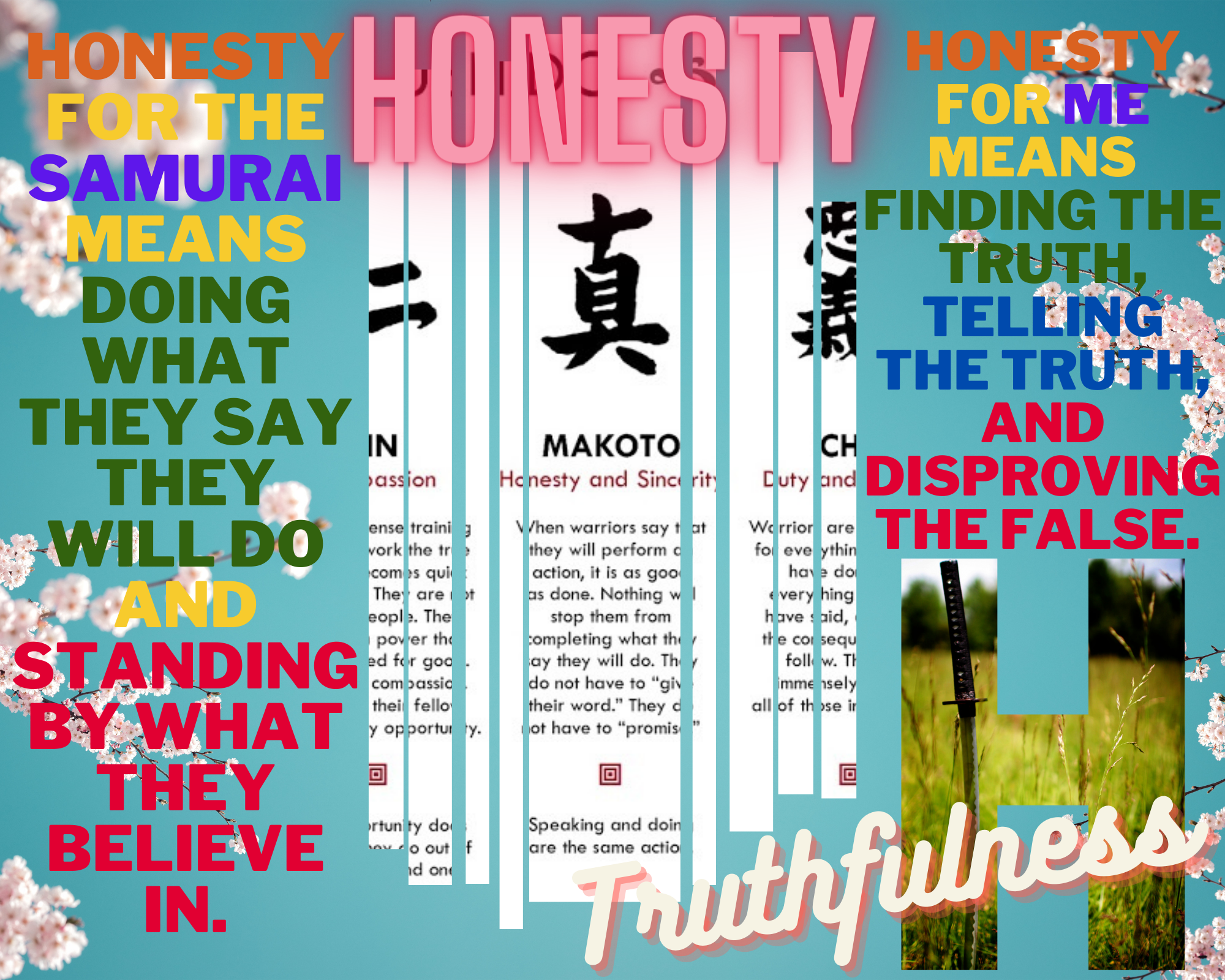
Step 1. Open SBLINK. Find the Canva application. Click that button.

Step 2. If SBLINK doesn't automatically log you in, sign up with your school Google account/Gmail.

Step 3. · Create a new Graphic, with any graphic size or style of your choice. Click the + icon on the top left to do so. For my example I use the ‘collage’ style.

Step 4. View One Pager Rubric below and explain the principle.
Use Canva to create a post or draw on a blank paper.
Read through and use the above ‘Principles of Bushido’ to pick your principle.
☐ Create a central focus around one principle of Bushido.
☐ Title the One Pager appropriately to reflect the content.
☐ Include your name and period somewhere in the post.
☐ Explain what the principle means to the Samurai.
☐ Explain what the principle means to you and how you could use it in your life.
☐ Use plenty of colors, photos, and shapes in your one pager.
☐ Fill the entire page [No lazy white spots!].
Rubric (How you will be graded.)
4 - Created a one pager on a principle of Bushido, explain what the principle means to the Samurai, explain what the principle means to you, title appropriately, and have plenty of colors, photos, and shapes.
3 - Created a one pager with at least four of the required elements.
2 - Created a one pager with at least two of the required elements.
1 - Created a one pager with at least one of the required elements.
0 - I did not attempt to create a one pager on a principle of Bushido.