1.3 What is Pamela’s Current Speed?

Last updated over 2 years ago
16 questions
Note from the author:
Lesson Details
Experience
Activity trackers and smartwatches can help you gain valuable data about your exercise routine. Runners often use them to keep track of mileage, pace, calories, and steps. Today we will explore some of the measurements in greater detail.

0

In the middle of her run, Pamela looks down at her Fitbit screen and sees that she is currently running at a pace of 8’45”. The next screen shows an average pace of 9’48”.
How is this possible? Why might these two numbers differ?

1

Look at the summary report of Pamela’s run. What is her average speed, in miles per minute?
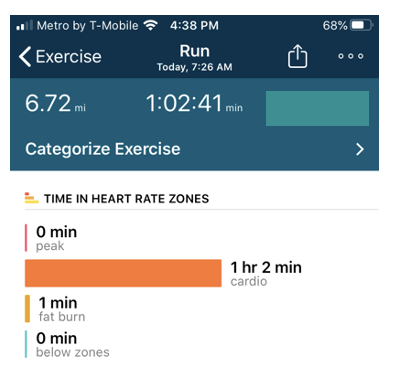
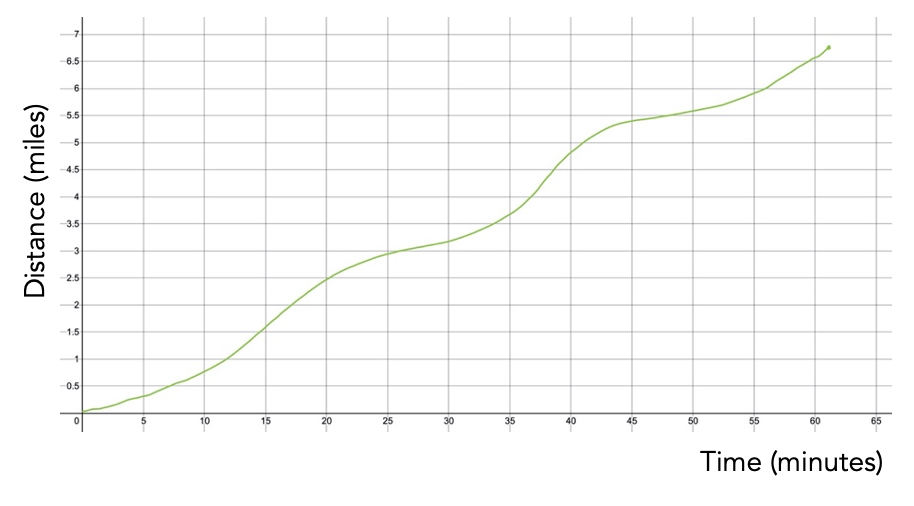
Below is a graph showing Pamela’s distance traveled with respect to time (in minutes).


0

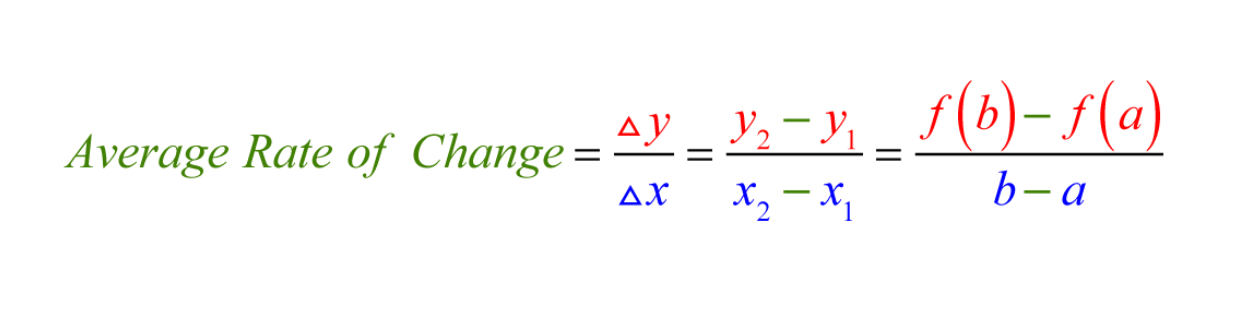
How could you use this graph, instead of the summary report, to calculate Pamela’s average speed?

0

Was Pamela running at a constant speed? How do you know?

0

What time does it look like Pamela is running the fastest? How can you tell?

0

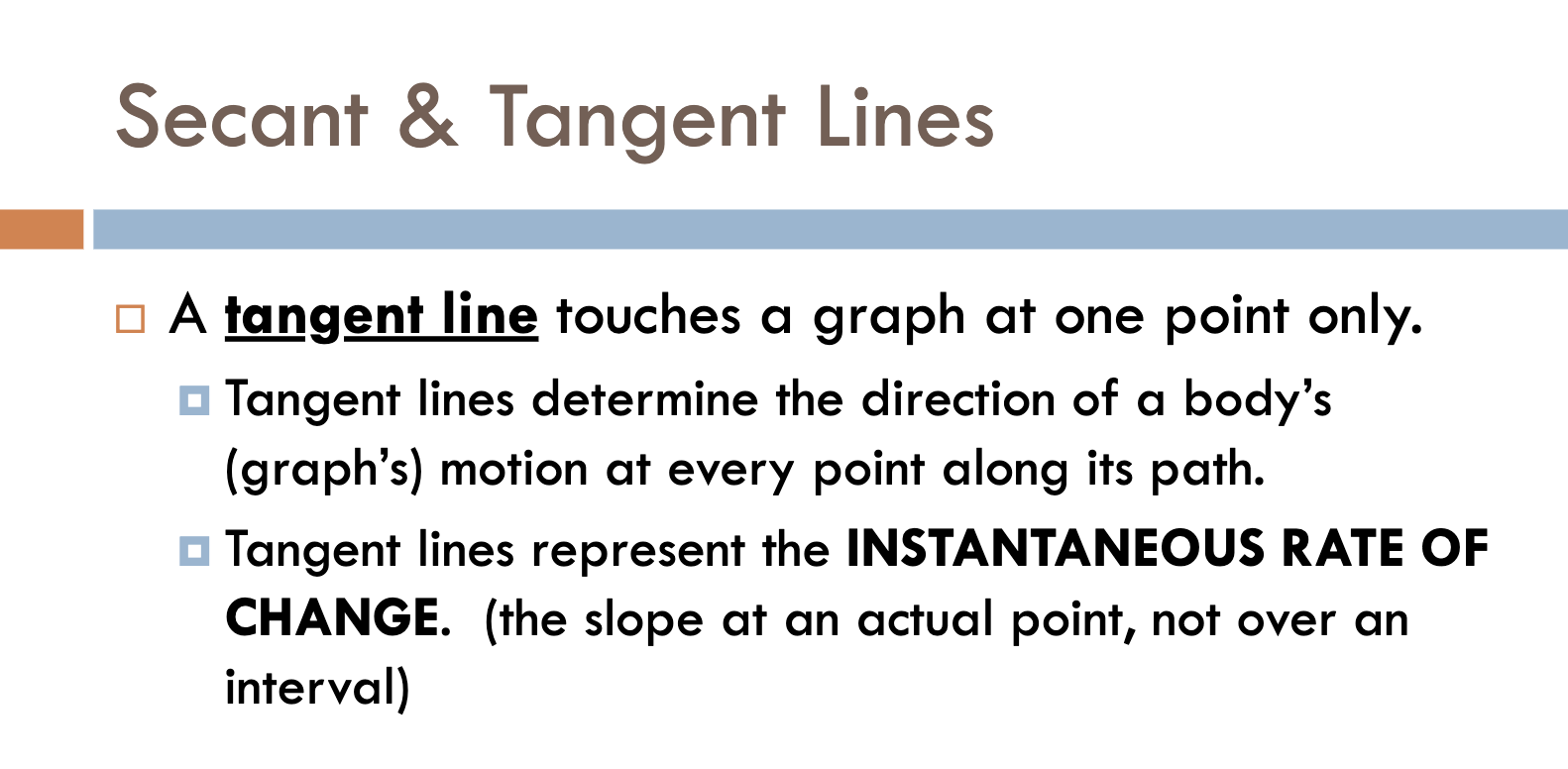
How do you think Fitbit is able to capture a current speed at any time during the run?

0

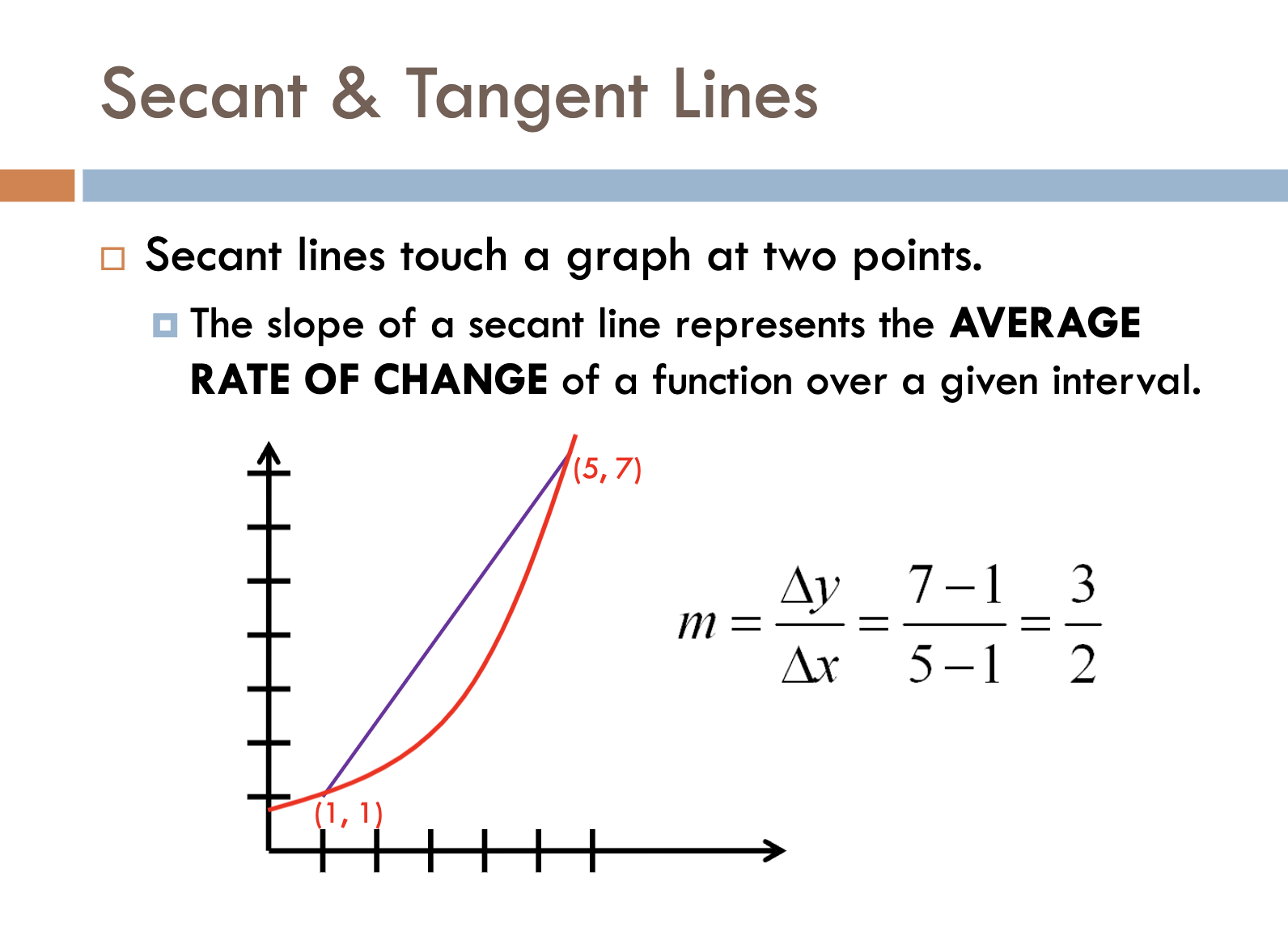
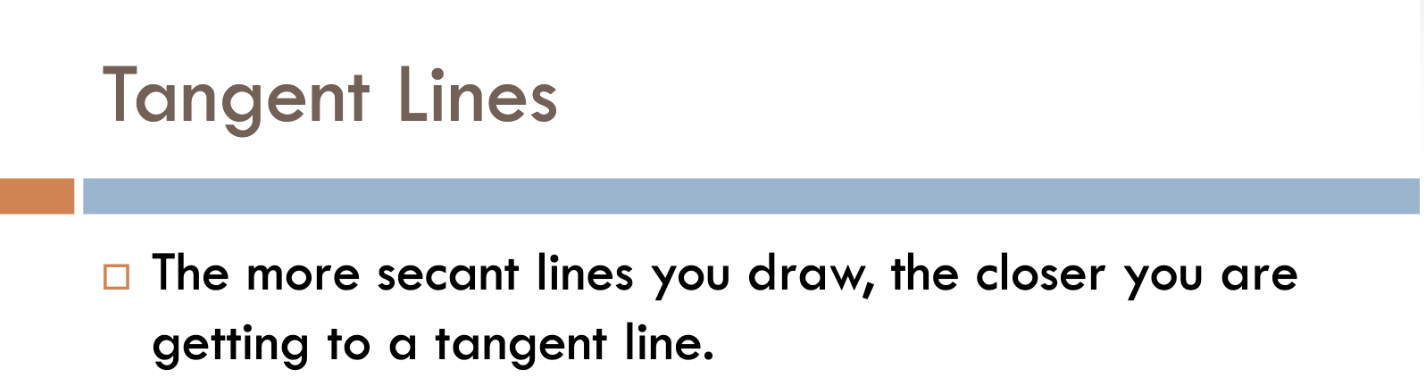
Do the terms secant line and tangent line ring any bells?

Click for hints if you need them!

Formalize

Secant Lines & Tangent Lines are back!

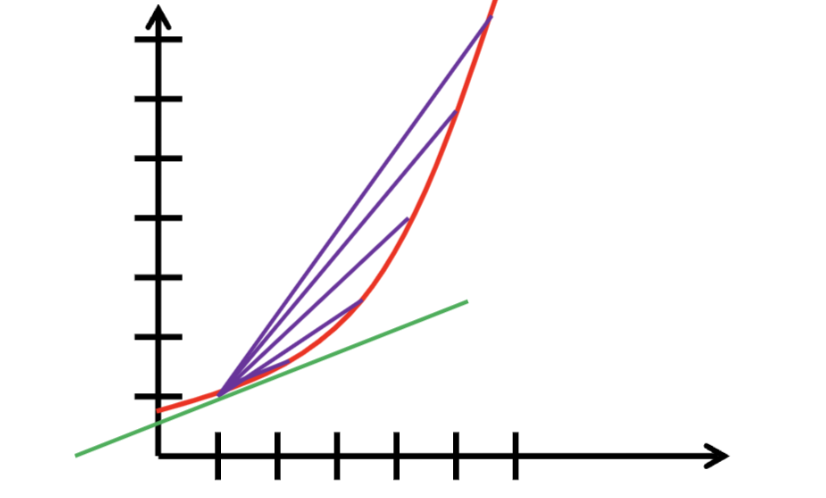
But now we use them (in the same way as before) with curves on a graph!!


The rate of change at a point x=a is given by the slope of the tangent line at x=a and can be estimated by finding an average rate of change on a small interval around x=a .

1

What is the purpose of a secant line and a tangent line when working with functions?

Draggable itemCorresponding Item
Secant Line
Calculates Average Rate of Change
Tangent Line
Calculates Instantaneous Rate of Change
P.S. We are not actually calculating the instantaneous rate of change yet. The goal is for you to understand how slope at a single point can be approximated by finding the rate of change over a very short interval of time.
Check Your Understanding
NO CALCULATOR
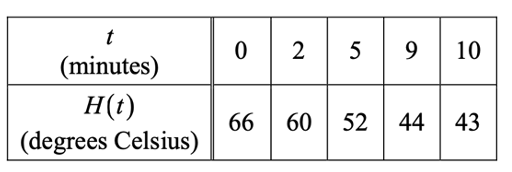
The temperature of a pot of tea as it is cooling is given by the function H(t), measured in ˚Celsius. Time, t, is measured in minutes.

1

How fast is the tea cooling, on average, over the ten-minute interval?
Show work and include units.

1

Estimate the rate at which the temperature of the tea is changing at t=3.5.

1

Find the average rate of change of f(x)=\sqrt{3x+4} on the interval [-1, 4].

1

Which is greater: the instantaneous rate of change of f(x)=\sqrt{3x+4} at x=0 or at x=4? How do you know?

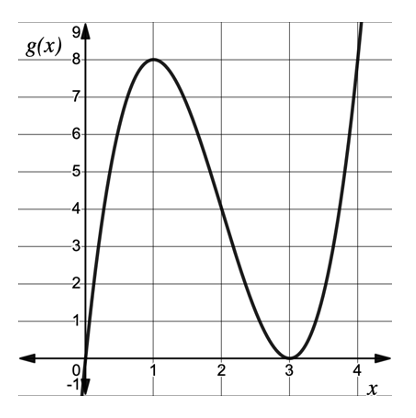
The graph of a function g is shown.
1

Find the average rate of change of g on the interval [0,2]. Show work.

1

Order the following from least to greatest.

  1. Instantaneous rate of change at x=1
  2. Average rate of change on [1,3]
  3. Instantaneous rate of change at x=0.5
  4. Average rate of change on [0,3.5]
1

Estimate the rate of change of the function at the given point.

f(x)=\frac{1}{3x} at x=4

1

Estimate the rate of change of the function at the given point.

g(x)=2x^{2}+1 at x=-2