Functions help us understand how one quantity changes with respect to another. This is especially important when our money is involved. Today we’re going to study the value of a stock in a large sportswear corporation over a one-month period.
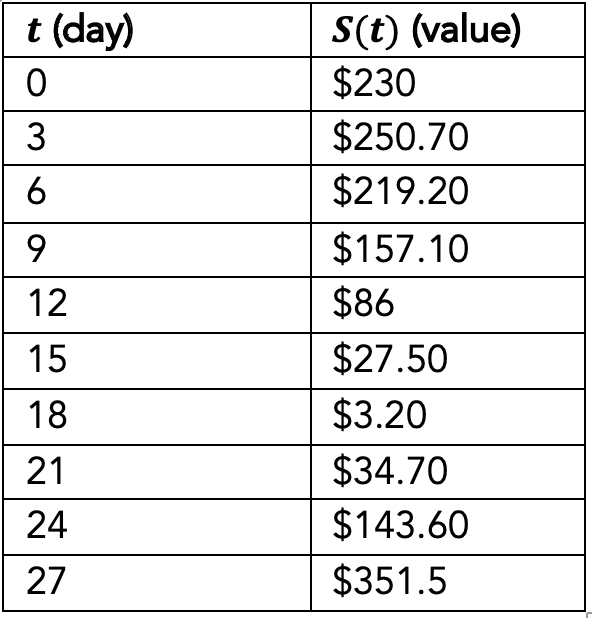
The table shows data for the value of a stock on the tth day of February.
No graphing allowed.
1 point
1
Question 1
1.
Is there a linear relationship between the day and the value of the stock? How do you know?
1 point
1
Question 2
2.
Is there a quadratic relationship between the day and the value of the stock? How do you know?
1 point
1
Question 3
3.
Any guesses on the type of relationship between the day and the value of the stock? How do you know?
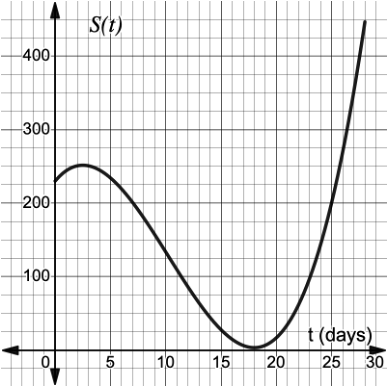
A graph of S is shown.
1 point
1
Question 4
4.
Estimate the first time that the value of the stock starts to decrease.
1 point
1
Question 5
5.
Does the value of the stock ever reach $0? Explain.
1 point
1
Question 6
6.
On which day during this 28-day period is the value of the stock the highest? What is the value of the stock on that day?
1 point
1
Question 7
7.
Is the rate of change of S increasing or decreasing over the interval [3,9]?
How can you tell based on the graph?
1 point
1
Question 8
8.
Use the table to calculate the average rate of change of S on the interval [3,6] and on the interval [6,9]. Were you correct?
1 point
1
Question 9
9.
For the first 20 days of February, use the graph to estimate the day on which the value of the stock changes the fastest.