2.2 The End is in Sight

Last updated over 2 years ago
19 questions
Untitled Section
What happens when you evaluate polynomial functions for very large positive numbers and very large negative numbers? How does that manifest on the graph? Let’s investigate!
Discovery
Without evaluating, determine if each expression will be positive or negative.
1

100^{5}

1

(-100)^{4}

1

1

(-230)^{17}

1

-6(-900)^{5}

Consider f(x)=x^{3}+5.
1

What happens to the y-values as the x-values get bigger and bigger? Try a few values to investigate.

1

What happens to the y-values as the x-values decrease without bound? Try a few values to investigate.

Consider g(x)=3x^{4}-x^{3}+5.
1

What happens to the y-values as the x-values get bigger and bigger? Try a few values to investigate.

1

What happens to the y-values as the x-values decrease without bound? Try a few values to investigate.

1

How would your answers to numbers 8 and 9 change if the function was g(x)=-3x^{4}-x^{3}+5?

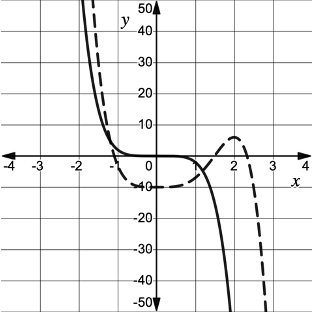
The graphs of the functions g(x)=-2x^{5} and h(x)=-2x^{5}+5x^{4}-10 are shown.
1
Which graph is g? __________

Which graph is h? __________

Use the Show Your Work tool to explain how you know.
1

Compare the end behavior of the two graphs.

1

Which term in the polynomial seems to have the biggest impact on the end behavior of the graph?
Why do you think this is?
Notes
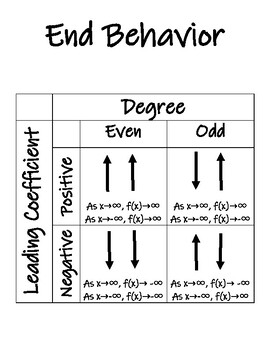
For very large positive and very large negative input values (which are at the end of graphs), the polynomial behavior is dominated by the leading term.

Polynomials have unbounded end behavior.
Right end behavior comes from whether the function is positive or negative (determined by the leading term.)
Positive: ____________ ↑
Negative: ___________ ↓

Then the degree fills in the left end behavior
Even degree's left end behavior has the same as the right end behavior.
Odd degree's left end behavior has the opposite of the right end behavior.
In Algebra, we mainly used ↑↑, ↓↑, ↑↓, and ↓↓.

But for Precalculus, we will discuss the limits.

\lim_{x\to\infty}f(x)=\infty reads as "the limit as x approaches infinity of f(x) is infinity."
1

  • and


  • and


  • and


  • and

  • ↑↑
  • ↓↑
  • ↑↓
  • ↓↓
Practice
1

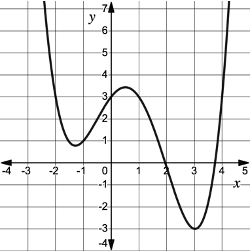
Use limit notation to describe the end behavior of the graph shown.

1

Is it possible for this graph to have a degree of 5? Why or why not?

1

Which of the following terms, when added to the given polynomial, will change the end behavior? Check all that apply.
y=-2x^{7}+5x^{6}-24

1

Use limit notation to describe the end behavior of y=\frac{1}{6}(x-9)(x+4)^{2}.

1

The graph of f(x)=8x^{3}-5x^{6}+2x^{2}-24 has the same end behavior as...