Ɛhia
0.25
Ɛhia
0.25
Ɛhia
0.25
Ɛhia
0.25
Before you can complete this assignment, you need to click here log in to Gizmos.
Gizmos switched to their new log in system. Follow the directions in this document to join:
Before you can complete this assignment, you need to click here log in to Gizmos.
Gizmos switched to their new log in system. Follow the directions in this document to join:
Gizmo Warm-up
Heredity is the passage of genetic information from parents to offspring. The rules of inheritance were discovered in the 19th century by Gregor Mendel. With the Mouse Genetics Gizmo, you will study how one trait, or feature, is inherited.
Drag two black mice into the Parent 1 and Parent 2 boxes. Click Breed to view the five offspring of these parents.
What do the offspring look like?
The appearance of each mouse is also called its
Click Clear, and drag two white mice into the parent boxes. Click Breed several times.
What is the phenotype of the offspring now?
Do you think mouse offspring will always look like their parents? Why or why not?
Part 1: Patterns of Inheritance
Question: What patterns are shown by offspring traits?
Get the Gizmo ready:
Click Clear.
Drag a black mouse and a white mouse into the parent boxes, but don’t click Breed yet.
Predict: What do you think the offspring of a black mouse and a white mouse will look like?
Observe: Click Breed several times. What do you see?
Observe: Drag two offspring into the Holding Cages. These mice are called hybrids because their parents had different traits. Click Clear, and then breed the two hybrids.
What do you see now?
Experiment: Turn on Show statistics. Click Breed until there are 100 offspring.
How many offspring were black?
How many offspring were white?
Explore: Try other combinations of mouse parents. You can refer to the parents as “pure black,” “pure white,” or “hybrid.”
Which parent combination(s) yield only white offspring?
Which parent combination(s) yield only black offspring?
Which parent combination(s) yield a mixture of black and white offspring?
Part 2: Genetics Basics
Inherited traits are encoded on a molecule called DNA (deoxyribonucleic acid). Genes are segments of DNA that control a particular trait. Most genes have several different versions, or alleles. The genotype is the allele combination an organism has.
Question: How do alleles determine fur color?
Get the Gizmo ready:
Click Clear.
Drag a black mouse and a white mouse into the parent boxes.
Observe: Turn on Show genotype. Move your cursor over a mouse to see its genotype.
What is the genotype of the black parent?
What is the genotype of the white parent?
These mice are for fur color, meaning both alleles are the same.
Click Breed. What is the genotype of the offspring mice?
These mice are for fur color, meaning the alleles are different.
Analyze: Dominant alleles are always expressed when present. Recessive alleles are not expressed when the dominant allele is also present. Look at the two alleles for fur color.
Which allele is dominant?
What fur color does it produce?
Which allele is recessive?
What fur color does it produce?
Predict: Place two of the Ff offspring into the Holding Cages. Click Clear, and then place them into the parent boxes.
Which allele(s) could the offspring inherit from each parent? Options may be used more than once.
F
f
Parent 1
Parent 2
What are the possible genotypes of the offspring? Select all that apply.
Experiment: Click Breed several times, and look at the genotypes of the offspring. Did you find all the predicted genotypes? Explain.
Part 3: Modeling Inheritance
Question: How do scientists predict the genotypes of offspring?
Get the Gizmo ready:
Click Clear.
Drag a black mouse and a white mouse into the parent boxes.
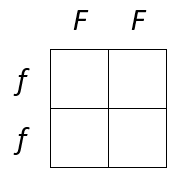
Model: Scientists use a Punnett square to model the different possible offspring genotypes from a parent pair. The parent genotypes are written across the top and side of the square, as shown. The four possible offspring genotypes are then filled in.
Complete the following Punnett square for a homozygous black mouse (FF) and homozygous white mouse (ff).
What are the genotypes of the offspring?
What percentage of the offspring will have black fur?
What percentage of the offspring will have white fur?
Experiment: Click Breed several times. Were your predictions correct?
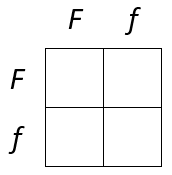
Predicted % black offspring:
Predicted % white offspring:
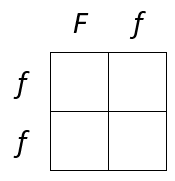
Predicted % black offspring:
Predicted % white offspring:
Experiment: Turn on Show statistics and Show as approximate percentage. For each combination, breed approximately 500 offspring. Record the results below.
(Hint: To obtain an Ff mouse, breed an FF mouse to an ff mouse. Place two Ff offspring into the holding cages, click Clear, and then drag the Ff mice into the parent boxes.)
Parent 1 Genotype Parent 2 Genotype % Black Offspring % White Offspring
Ff Ff
Ff ff
Draw conclusions: How well did the Punnett squares predict the offspring percentages for each parent pair?
Summarize: In your own words, describe what heredity is and how it works in mice.
Part 4: Expanded Punnett Square
Question: How can scientists predict the inheritance of two traits?
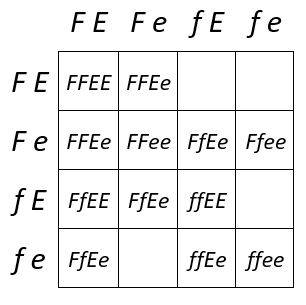
Model: Mice have alleles for fur color (F for black, f for white) and eye color (E for black, e for red). Each parent mouse will contribute one allele for fur color and another for eye color.
If a parent mouse is Ff Ee, there are four possible allele combinations the parent could pass to its offspring: FE, Fe, fE, and fe. The combinations are written along the top and sides of the expanded Punnett square.
Predict the offspring of two Ff Ee parents.
Genotype:
Phenotype:
Genotype:
Phenotype:
Genotype:
Phenotype:
Genotype:
Phenotype: