Look at the food web below to answer the following question:
Which organism is both a primary and secondary consumer?

Look at the food web below to answer the following question:
Which organism is both a primary and secondary consumer?
Match the vocabulary to the definition
| Draggable item | arrow_right_alt | Corresponding Item |
|---|---|---|
Abiotic | arrow_right_alt | Relationship where both organisms benefit |
Mutualism | arrow_right_alt | Relationship where one organism benefits and the other is neither helped nor harmed |
Biotic | arrow_right_alt | Relationship where one organism harms another |
Parasitism | arrow_right_alt | Nonliving factors in the environment like temperature and nutrients levels |
Commensalism | arrow_right_alt | Living factors in the environment like plants, animals, and bacteria |
Match the word with the definition
| Draggable item | arrow_right_alt | Corresponding Item |
|---|---|---|
Emigration | arrow_right_alt | Amount of organisms that enter a population |
Carrying capacity | arrow_right_alt | Amount of organisms that exit a population |
Immigration | arrow_right_alt | The maximum number of organisms that an area can support |
What do producers eat?
What do herbivores eat?
What do carnivores eat?
What do scavengers eat?
What do omnivores eat?
What is the role of decomposers? Click two
Another term for carnivore is
Another term for herbivore is
Another term for producer is
An organism that consumes other organisms is a
Look at the food web below to answer the following question:
Which organism is both a primary and secondary consumer?
Look at the food web below to answer the following question:
Which organism is an omnivore?
Look at the food web below to answer the following question:
What would happen to the hawk population if there was a decrease in grouse population?
Look at the food web below to answer the following question:
Which two organisms are in competition?
In the food web, identify all the organisms that are primary consumers?
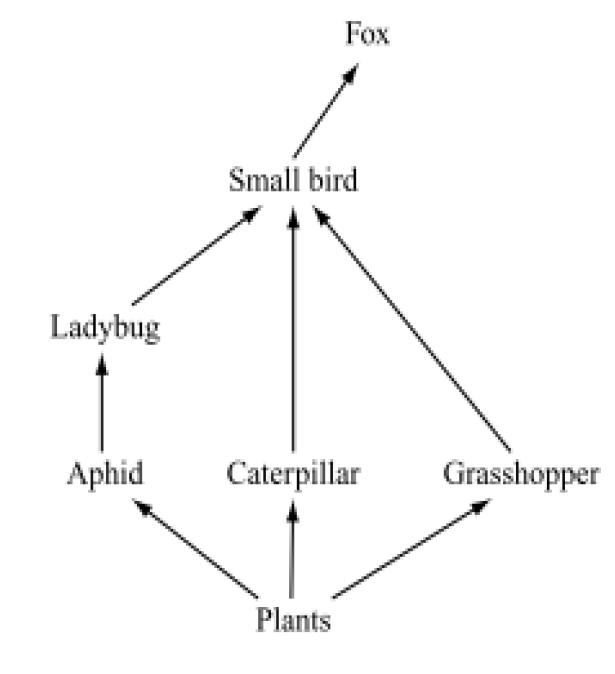
In the food web, identify the top carnivore?
Using the food web, fill in the ecological pyramid.
Determine how much energy is transferred to the ladybug, if plants contain 50,000 calories

Remora fish can attach themselves to larger aquatic animals, such as whales. When the whales eat, the fish detach themselves and eat leftover scraps of food. These fish do not harm or help the whales.
What is the ecological relationship between the remora fish and the whales?
The Karner blue butterfly has been listed as an endangered species since 1992. Karner blue butterfly larvae feed only on wild lupine plants, which require a habitat with dry soil and exposure to direct sunlight.
Which of the following would be the best habitat for wild lupine that could help Karner blue butterfly populations recover?
A large decrease in the sea otter population would most likely cause the size of which of the following populations to increase the most?
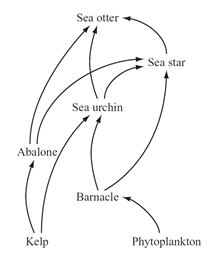
Which of the following statements best describes how an increase in the size of a mammal population could be related to a large surplus of food?
The graph below shows the estimated number of orca whales off the coast of Washington State over a 20-year period
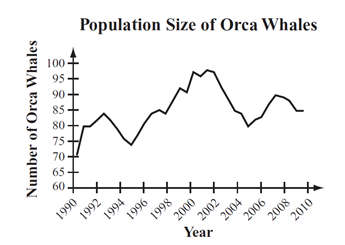
Which of the following best explains the orca population changes between 1996 and 2002?