Snow also recognized that many factors in these London districts other than the water supplier were different and could be the reason for the difference in cholera rates.
Snow’s unique contribution to epidemiology was to recognize a way to test his hypothesis that the water supply caused the cholera epidemic. Snow outlined his
investigation in the book On the Mode of Communication of Cholera, published in 1855:
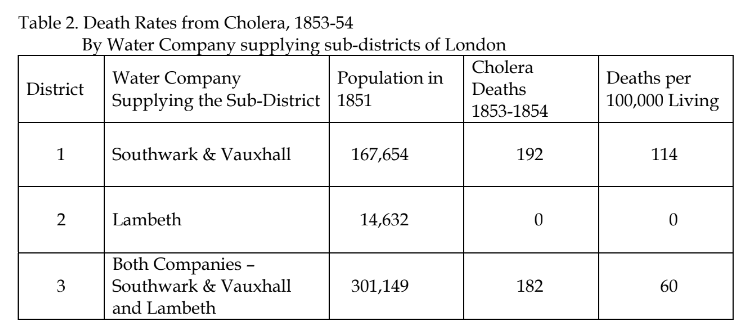
In sub-districts enumerated in the above table as being supplied by both Companies, the mixing of the supply is of the most intimate kind. The pipes of each Company go down all the streets, and into nearly all the courts and alleys. A few houses are supplied by one Company and a few by the other, according to the decision of the owner or occupier at the time when the Water Companies were in active competition. In many cases a single house has a supply different from that on either side. Each company supplies both rich and poor, both large houses and small; there is not any difference either in the condition or occupation of the persons receiving the water of different Companies.
The experiment, too, was on the grandest scale. No fewer than three hundred thousand people of both sexes, of every age and occupation, and of every rank and station, from gentle folk down to the very poor, were divided into two groups without their choice, and, in most cases, without their knowledge...
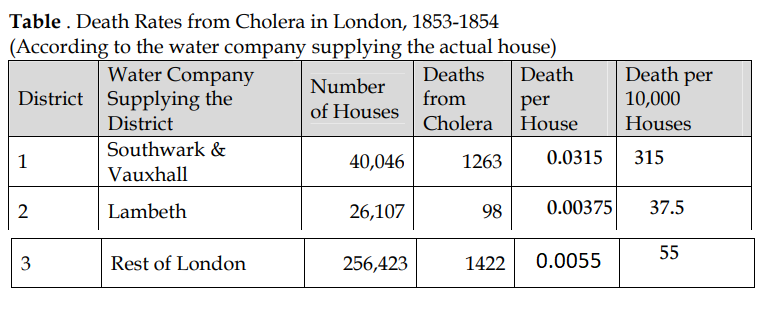
To turn this grand experiment to account, all that was required was to learn the supply of water to each individual house where a fatal attack of cholera might occur.
Therefore, Snow walked the London district supplied by both water companies, District 1 (Southwark and Vauxhall) and District 2 (Lambeth). He went from house to house and for every dwelling in which a cholera death had occurred, he asked questions to determine the source of the water.