1
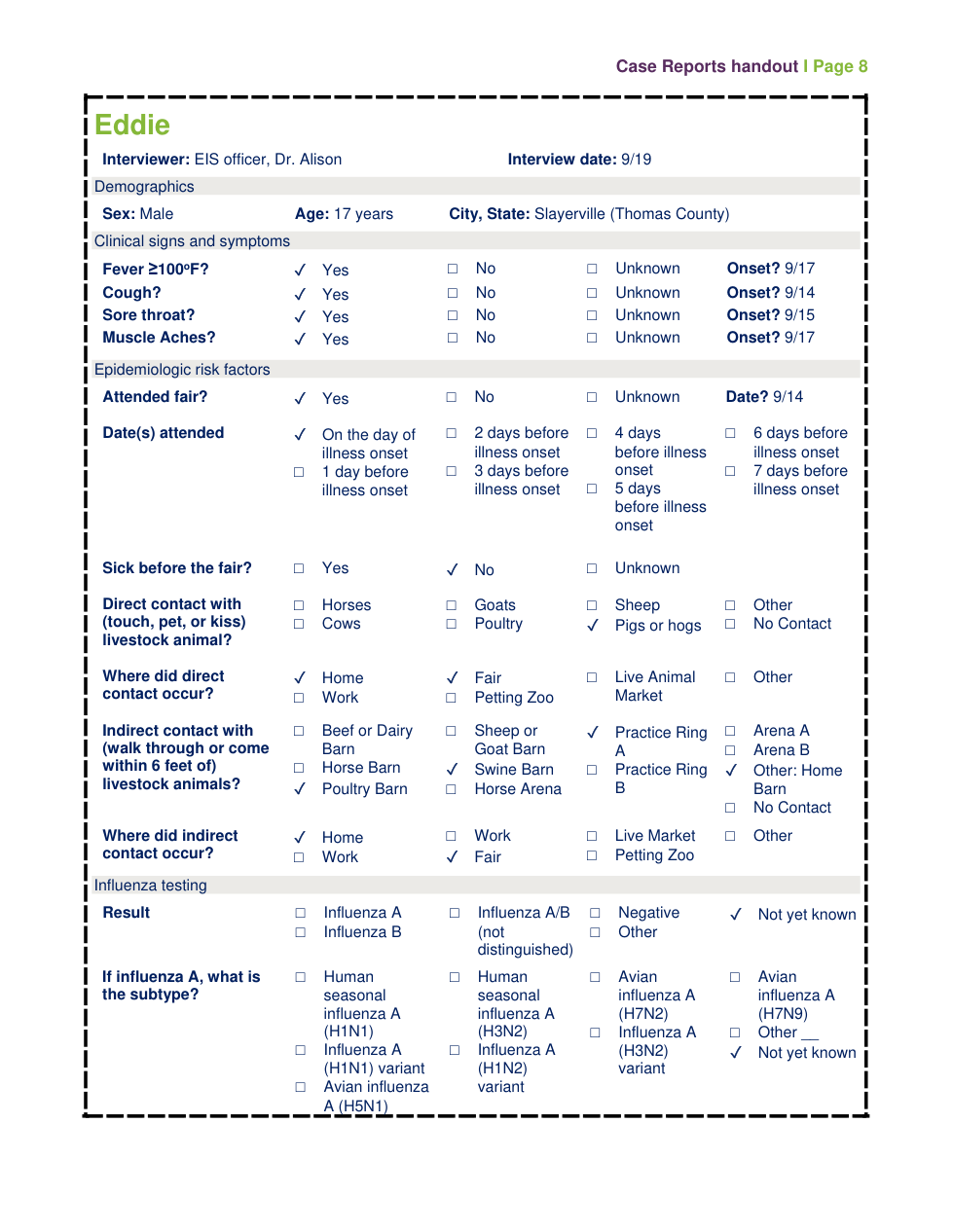
What animal was Eddie in direct contact with?
What animal was Eddie in direct contact with?
1
Dr. Alison, one of CDC’s disease detectives, interviews Eddie’s family, primary care providers, and friends while at the hospital. Eddie’s family and primary care providers describe Eddie’s clinical signs and symptoms, such as fever (measured temperature of 100°F or greater), cough, and muscle aches.
They also provide information about Eddie’s other health condition, asthma. Preexisting health conditions, like asthma, can put a person at a higher risk for developing severe disease. Eddie’s friends provide information on what activities Eddie was involved with at the Thomas County Fair. They provide important epidemiologic information on place (i.e., the geographic location of where Eddie recently visited, such as visiting the animal areas at the fair); and time (i.e., when Eddie may have been exposed and infected), such as before or during the Thomas County Fair and when Eddie started showing clinical signs and symptoms of infection.
After collecting some initial information, Dr. Alison and the other disease detectives work together to create a case definition. They will use the case definition to see if anyone else who is ill should be included in the investigation.
A case definition is a set of uniformly applied criteria for determining whether an event (e.g., disease or injury) should be considered as part of the outbreak. A case definition often includes medical features (e.g., clinical signs and symptoms), epidemiologic information, and laboratory test results. Epidemiologic information can include criteria on the demographic characteristics such as sex and age (i.e., person), geographic location of where an ill person lives or visited recently (i.e., place), and onset of clinical signs and symptoms (i.e., time).
What is included in a case definition?
Use Eddie's case to write an initial case definition for the outbreak investigation. Remember to include medical features- signs and symptoms, person, place, and time
Directions: On pages 40–41, Dr. Alex, a CDC EIS officer, asks Andy Duncan, the Thomas County Fair director, if he is aware of any illness reported among people who attended the fair. Mr. Duncan explains that a few people told him that they or someone in their family got sick with some kind of respiratory bug after the fair.
Dr. Alex suspects that these may be additional cases in this outbreak. Dr. Alex requests the contact names and telephone numbers to follow up with the three additional patients. He uses a case report form to make sure he asks the right questions.
Look at Eddie's and Patients A, B, and C Case Reports. Answer the questions about the 4 cases.
What animal was Eddie in direct contact with?
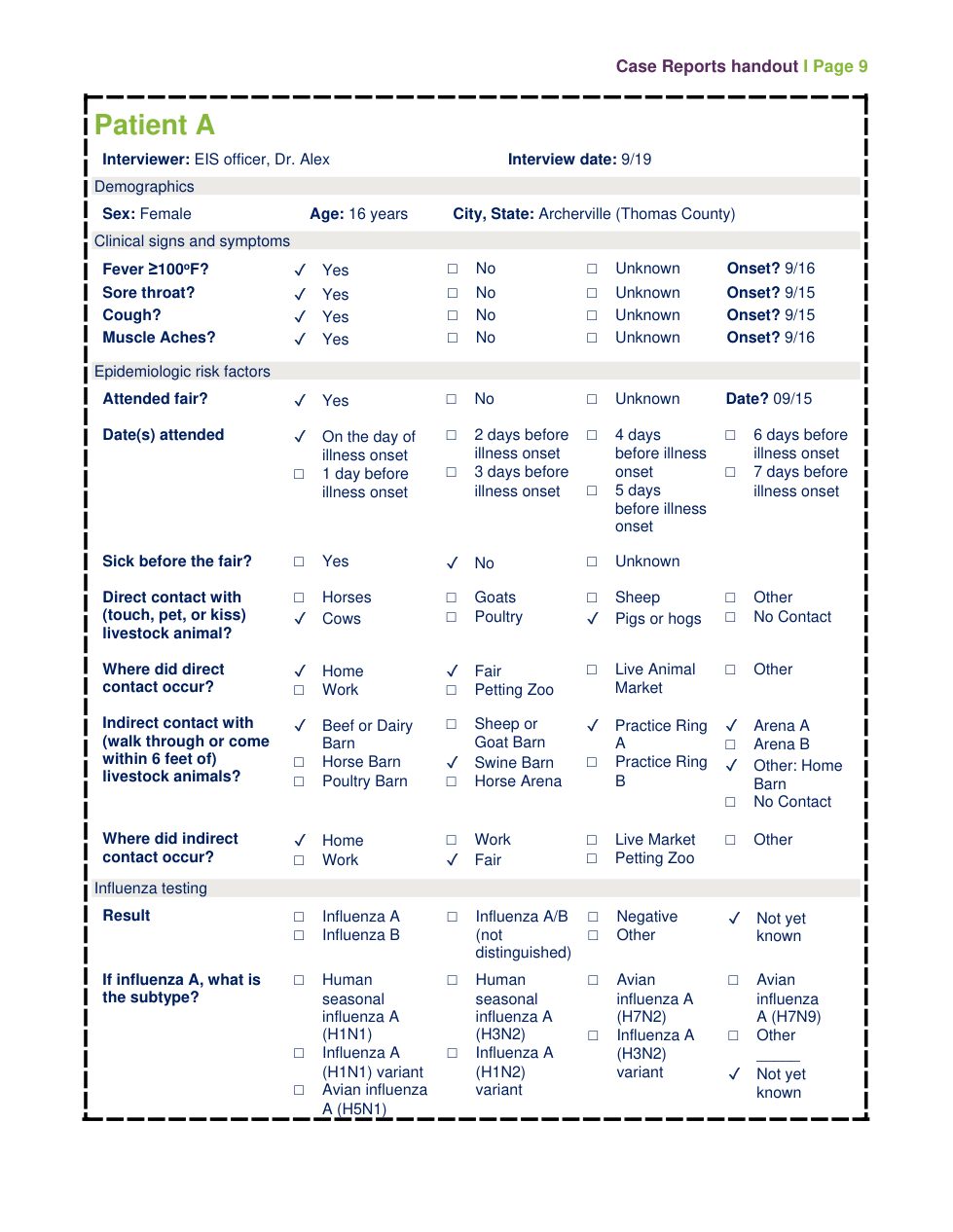
Did this female patient attend the fair?
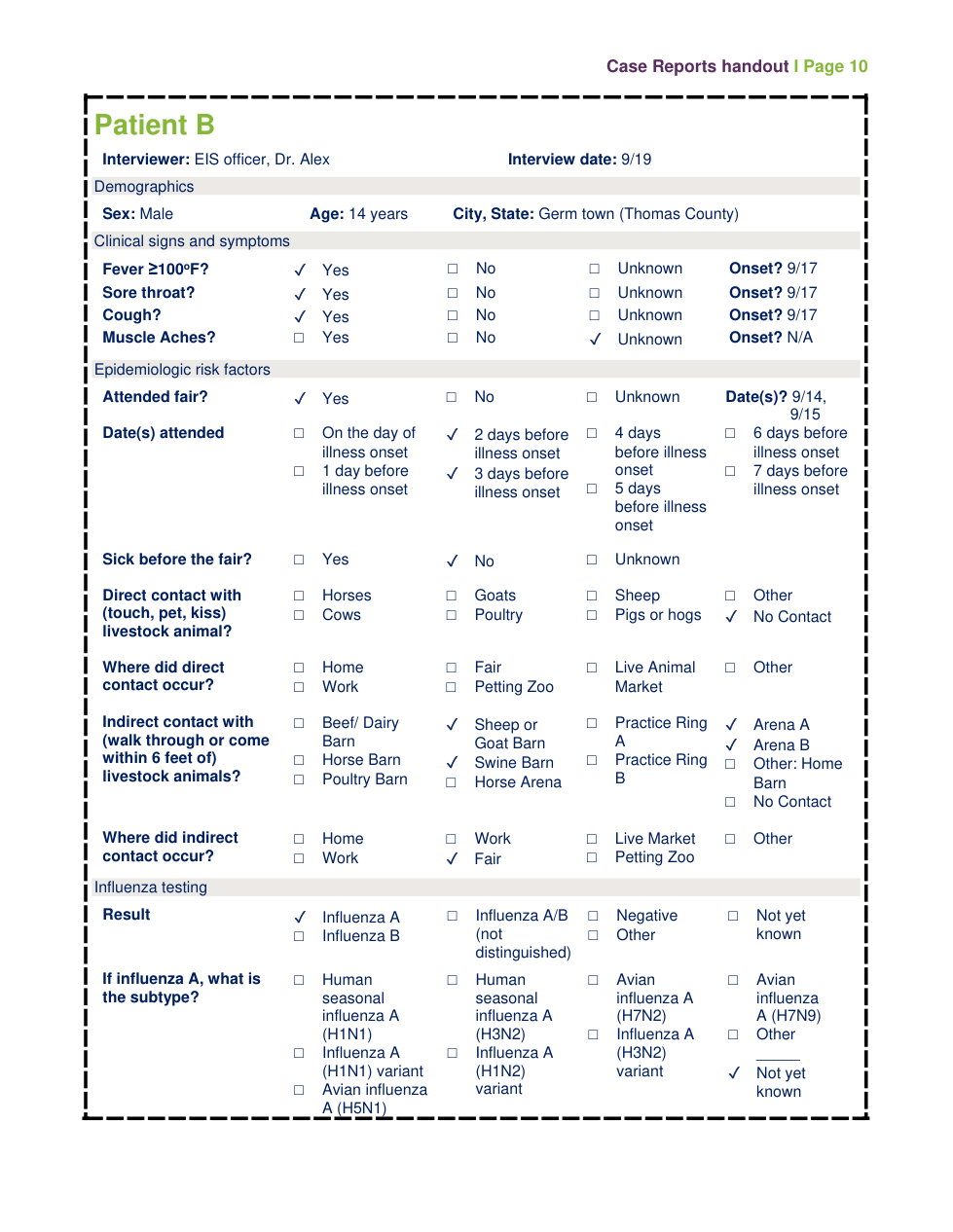
Did this male attendant have direct contact with pigs?
Did this male attendant have indirect contact with pigs at the swine barn?
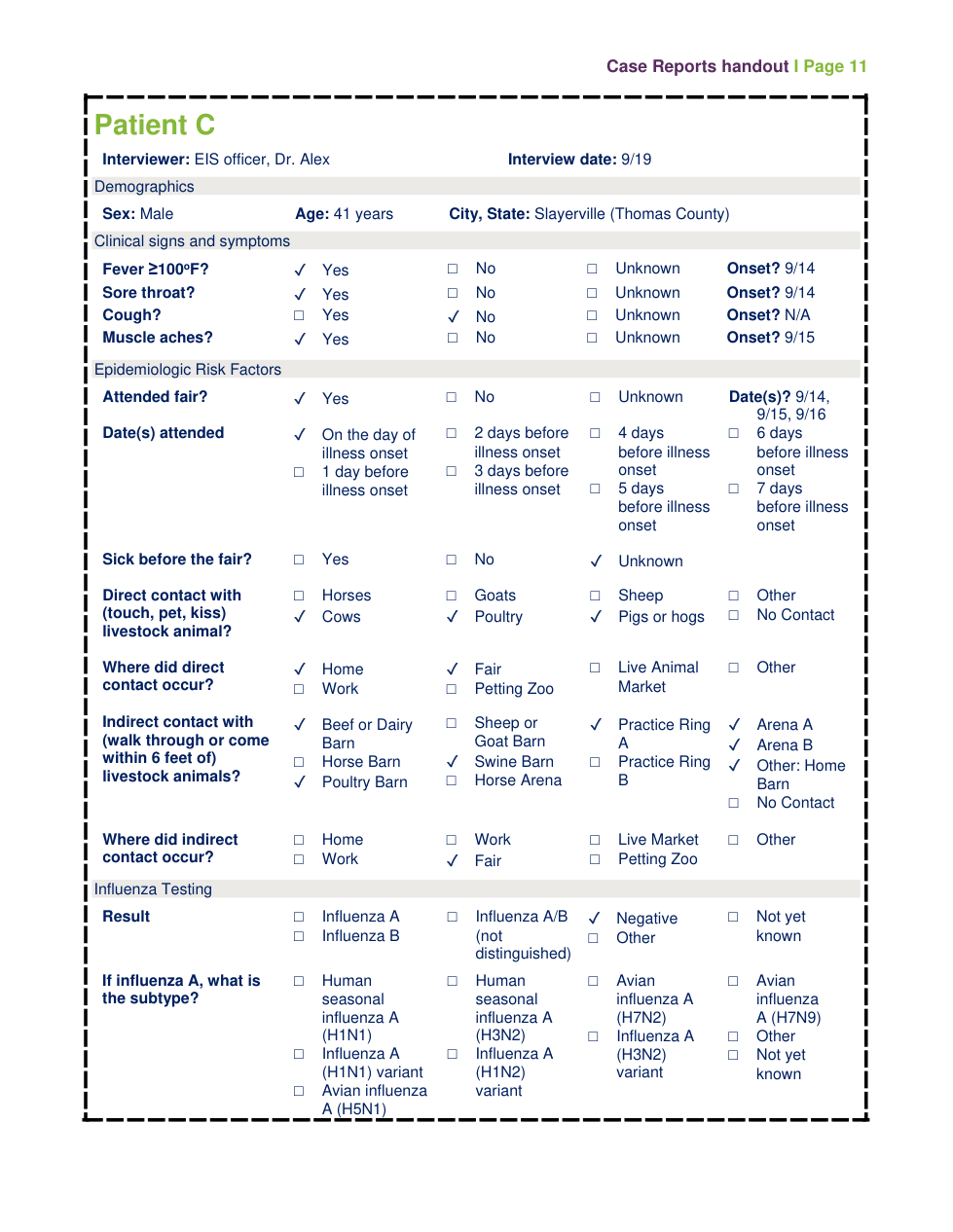
When did this person attend the fair?
What similarities exist between Eddie and Person A, B, and C?
Generate a possible hypothesis about if Eddie and the other patients illness might be linked.
A more detailed case definition typically includes case classifications — suspected, probable, or confirmed. CDC provides a case definition for novel influenza A virus infections to help disease detectives determine if patient illnesses can be classified as a case of novel influenza A virus infection or not.
Suspected
A case meeting the clinical criteria (fever with measured temperature of 100°F or greater, with cough or sore throat), pending laboratory confirmation. Any case of human infection with an influenza A virus that is different from currently circulating human influenza H1 and H3 viruses is classified as a suspected case until the confirmation process is complete.
Probable
A case meeting the clinical criteria (fever with measured temperature of 100°F or greater, with cough or sore throat) and epidemiologically linked to a confirmed case (i.e., the patient has had contact with one or more persons who either have or had the disease, and transmission of the agent by the usual modes of transmission is plausible), but for which no confirmatory laboratory testing for influenza virus infection has been performed or test results are inconclusive for a novel influenza A virus infection.
Confirmed
A case of human infection with a novel influenza A virus confirmed by CDC’s influenza laboratory or by public health laboratories following CDC-approved protocols. (Note: Although flu has a confirmed case definition that does not require symptoms, the confirmed case definition for other diseases may include clinical illness. For example, the confirmed case definition for other diseases might be “laboratory confirmation of infection in a patient with compatible symptoms”.
A case is if the patient has a fever, cough, and sore throat but is pending lab confirmation.
A case is if the patient has a fever, cough, sore throat and is epidemiologically linked to a confirmed case but is pending lab confirmation.
A case is if the patient has a positive lab test
At each point in time, identify to what extent Eddie meets the case definition for a novel influenza A virus infection. Justify your answer.
Friday Sept 14 to Monday Sept. 17. (page 16 to 26)
How would you classify Eddie's case (suspected, probable, confirmed). Justify your answer.
Early Wednesday Sept. 19 (page 29 to 41)
How would you classify Eddie's case (suspected, probable, confirmed). Justify your answer.
Later Wednesday, Sept. 19 (page 42 to 48)
How would you classify Eddie's case (suspected, probable, confirmed). Justify your answer.
Look back at the case studies for person A. How would you classify person A (not a case, suspected, probable, or confirmed). Explain your answer.
Look back at the case studies for person B. How would you classify person B (not a case, suspected, probable, or confirmed). Explain your answer.
Look back at the case studies for person C. How would you classify person C (not a case, suspected, probable, or confirmed). Explain your answer.
Why would one case of respiratory illness caused by an unidentified virus in a person who
recently attended an agricultural fair be cause for concern?
Some influenza viruses in animals have the potential to cause disease in humans and vice versa. Define zoonotic influenza virus.
Define novel influenza virus and explain how zoonotic and novel influenza virus – on rare occasion- may cause pandemics among humans.
What are Eddie's test results?
Click on the symptoms that the female patient has.
What animal(s) did this patient have direct contact with?
What are the test results for this patient?
What are the test results for this male patient?
What are this patients test results?
A case is suspected if the patient has a fever, cough, and sore throat but is pending lab confirmation.