Lesson 33
Anna solved the following division problem by drawing an area model:
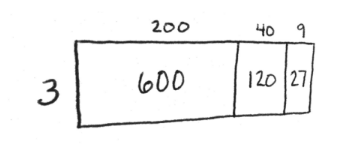
What division problem did she solve?
Show a number bond to represent Anna’s area model, and represent the total length using the distributive property.
Lesson 26
Solve for the quotient. Rewrite each in unit form.
a. 600 ÷ 3 = 200
6 hundreds ÷ 3 =
b. 1,200 ÷ 6 =
c. 2,100 ÷ 7 =
d. 3,200 ÷ 8 =
Lesson 26
Hudson and 7 of his friends found a bag of pennies. There were 320 pennies, which they shared equally. How many pennies did each person get?
Lesson 27
Divide. Use place value disks to model each problem. Then, solve using the algorithm.
423 ÷ 3
Lesson 27
Divide. Use place value disks to model each problem. Then, solve using the algorithm.
564 ÷ 4
Lesson 28
Divide. Check your work by multiplying. Draw disks on a place value chart as needed.
776 ÷ 2
Lesson 28
Divide. Check your work by multiplying. Draw disks on a place value chart as needed.
596 ÷ 3
Lesson 28
A carton of milk contains 128 ounces. Sara’s son drinks 4 ounces of milk at each meal. How many 4- ounce servings will one carton of milk provide?
Lesson 29
Divide, and then check using multiplication.
1,773 ÷ 3
Lesson 29
Divide, and then check using multiplication.
8,472 ÷ 5
Lesson 29
The post office had an equal number of each of 4 types of stamps. There was a total of 1,784 stamps. How many of each type of stamp did the post office have?
Lesson 30
Divide. Check your solutions by multiplying. 380 ÷ 4
Lesson 30
Divide. Check your solutions by multiplying. 7,040 ÷ 3
Lesson 31
Solve the following problem. Draw tape diagrams to help you solve. 572 cars were parked in a parking garage. The same number of cars was parked on each floor. If there were 4 floors, how many cars were parked on each floor?
Lesson 31
Solve the following problem. Draw tape diagrams to help you solve. 356 kilograms of flour were packed into sacks holding 2 kilograms each. How many sacks were packed?
Lesson 32
Solve the following problem. Draw tape diagrams to help you solve. If there is a remainder, shade in a small portion of the tape diagram to represent that portion of the whole. Mr. Foote needs exactly 6 folders for each fourth-grade student at Hoover Elementary School. If he bought 726 folders, to how many students can he supply folders?
Lesson 32
Solve the following problem. Draw tape diagrams to help you solve. If there is a remainder, shade in a small portion of the tape diagram to represent that portion of the whole. Mrs. Terrance has a large bin of 236 crayons. She divides them equally among four containers. How many crayons does Mrs. Terrance have in each container?
Lesson 33
Anna solved the following division problem by drawing an area model:
What division problem did she solve?
Show a number bond to represent Anna’s area model, and represent the total length using the distributive property.
Lesson 33
Draw an area model, a number bond, and use the traditional long division algorithm to solve 1,368 ÷ 2.
Lesson 34
Use the associative property to rewrite each expression. Solve using disks, and then complete the number sentences.
Lesson 34
Distribute 32 as 30 + 2 and solve. 60 × 32
Lesson 35
Use an area model to represent the following expression. Then, record the partial products and solve.
Lesson 35
Use an area model to represent the following expression. Then, record the partial products and solve.
Lesson 36
Record the partial products to solve. Draw an area model first to support your work, or draw the area model last to check your work. 26 × 43
Lesson 36
Record the partial products to solve. Draw an area model first to support your work, or draw the area model last to check your work. 17 × 55
Lesson 37
Solve 43 × 22 using 4 partial products and 2 partial products. Remember to think in terms of units as you solve. Write an expression to find the area of each smaller rectangle in the area model.
Lesson 37
Solve the following using 2 partial products.
Lesson 38
Solve using the multiplication algorithm.
Lesson 38
Solve using the multiplication algorithm. 35 × 53