2-3 (Activity): Banksy
star
star
star
star
star
Last updated over 2 years ago
1 Asɛmmisa
Ɛhia
1
Who is Banksy? 10 Myths About The World’s Most Talked About Artist
As one of the most elusive figures on the contemporary art scene, Banksy continues to be the subject of news stories and rumours. Mostly, these debate his true identity and above all else, the question lingers: "Who is Banksy?" While some believe him to be a member of the band Massive Attack, others have speculated that he is not, in fact, one person but many; meanwhile there are still those who believe the artist to be a woman. Here we take a look at some of these rumoured identities as well as other myths circling Banksy’s name…
1. Is Banksy Massive Attack band member Robert del Naja?
The media and the public have been speculating over Banksy’s identity since the early 2000s, when he first broke onto the scene. For a long time, the most likely candidate appeared to be Robert del Naja of Massive Attack, who also grew up in Banksy’s hometown of Bristol. Further proof is suggested by the appearance of Banksy murals in places where the band has toured. But the most convincing evidence comes thanks to DJ Goldie who accidentally called Banksy ‘Robert’ during a podcast in 2017. Others have claimed del Naja is in fact just the leader of a team of graffiti artists but the picture remains unclear to this day, with Banksy’s lawyers neither confirming nor denying these allegations.
3. He was denied access to the Oscars
This one is true! In 2011, Banksy’s Exit Through The Gift Shop was nominated in the best documentary category at the Oscars. Naturally, the artist would never be able to attend the event as his true self so he reportedly requested permission to attend wearing a monkey mask only to be turned down for fear of multiple imposters turning up on the night.
4. What is Banksy's gender?
Some believe Banksy must be a woman, contrary to popular belief. This was claimed by a number of people but most famously by Canadian artist Chris Healey who believed Banksy was a team of seven artists led by a blonde woman who can be seen in Banksy’s studio in his documentary. This is widely considered to be implausible, however website Atlantic City Lab did back up the claim saying, “Girls and women figure into Banksy’s stencilled figures, for starters, something that isn’t true of 99% of street art.”
5. Banksy is actually King Robbo
When Banksy painted over a King Robbo mural in London in 2009, the artist sparked a feud which made headlines and brought the lesser-known tagger to new heights of fame on the street and in the art world. While the rivalry continued for some time, with each artist painting over the other’s work until Banksy eventually backed down, some speculated if the two were perhaps the same person, out to get even more publicity with a fake ‘graffiti war’. Of course this theory was later disproved as King Robbo – or John Robertson as he is legally known – died in 2014, while Banksy continues to remain active both on the street and online.
6. Banksy was arrested and had his identity revealed
In 2014 a story broke out saying that Banksy had been arrested by an ‘Anti-Graffiti Task Force’ and his identity revealed as Liverpudlian Paul Horner. In fact Horner engineered the whole thing but the news quickly gained traction and before you could say ‘fake news’ a number of newspapers and websites had begun broadcasting the story without fact-checking it first.
7. Banksy’s pseudonymous nickname comes from his football prowess
In Banksy Myths & Legends, Marc Leverton writes that Banksy earned his ‘tag’ through his skills as a goalkeeper, receiving the nickname ‘Banksy’ by his teammates after the England goalkeeper Gordon Banks. Other sources claim however that his earliest tag was ‘Robin Banx’ which later became the more catchy ‘Banksy’.
10. Is Banksy Bristolian Robin Gunningham?
Okay, so this one might be true. Recently criminologists at Queen Mary University used a tool called ‘geoprofiling’ to map the movements of a man named Robin Gunningham to those of Banksy according to where his latest murals had popped up. While this seemed like definitive proof, Banksy and his lawyers have never accepted or rejected the claim, preferring to leave the papers and the public guessing. As the artist himself has said, “If you want to say something and have people listen then you have to wear a mask. If you want to be honest then you have to live a lie.”
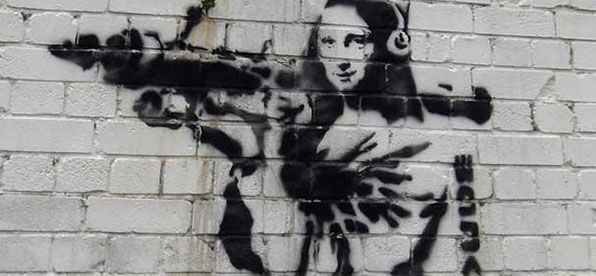
In this work, Banksy plays upon one of the world's most famous paintings, The Mona Lisa (1503-4). Although in his piece, the female protagonist wears a headset while aiming a rocket launcher in his typical black and white stencil style. The piece first appeared in the Soho district of West London. While Banksy's juxtaposition of art history's most famous female with a powerful modern weapon may certainly be cheeky, there is more that can be read into the image. While da Vinci's Mona Lisa appears graceful and passive, Banksy gives her a powerful, confrontational, and active sensibility. Her facial expression remains just as calm as in the original, however, next to the powerful weapon, her welcoming smile is menacing, in a much more horrific manner. It can also be read as a statement on how blasé citizens have become to the ongoing realities of war, always taking place somewhere far removed from their own tranquil lives.
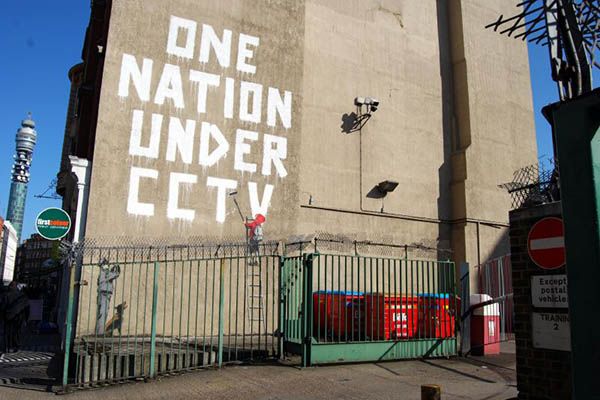
“If you want to say something and have people listen then you have to wear a mask. If you want to be honest then you have to live a lie.” - Banksy
Use specific information from any of these sources to explain what you think Banksy meant by this quote. Why do you think Banksy says you have to live a lie in order to be honest? What evidence is there that Banksy is living a lie in order to be honest? How would Banksy's situation be different if his identity was revealed?