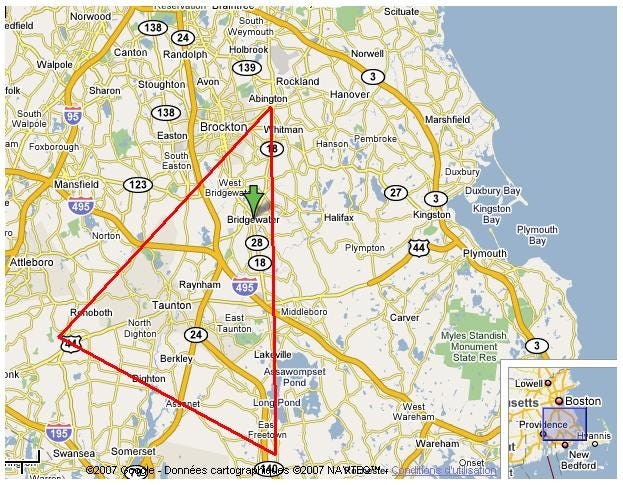
START by watching the three-minute video found on this website.
You can also scroll through images of places throughout the Bridgewater Triangle on this website.
A summary of phenomena (outlined below) has also been compiled on Wikipedia:
The Bridgewater Triangle is an area of about 200 square miles (520 km2) within southeastern Massachusetts in the United States, claimed to be a site of alleged paranormal phenomena, ranging from UFOs to poltergeists, and other spectral phenomena, various bigfoot-like sightings, giant snakes and thunderbirds. The term was coined by New England based cryptozoologist Loren Coleman
Freetown-Fall River State Forest - The Freetown-Fall River State Forest has reportedly been the site of various cult activity including animal sacrifice, ritualistic murders committed by admitted Satanists, as well as a number of gangland murders and a number of suicides.
Profile Rock - The supposed site of where Wampanoag historical figure Anawan received the lost wampum belt from Philip, legend has it the ghost of a man can be seen sitting on the rock with his legs crossed or with outstretched arms. Located within the Freetown-Fall River State Forest.
Solitude Stone - An inscribed stone located near Forest Street in West Bridgewater which was found near a missing person's body. Also known as "suicide stone," the rock was found with the inscription: "All ye, who in future days, Walk by Nunckatessett stream Love not him who hummed his lay Cheerful to the parting beam, But the beauty that he wooed."
Bridgewater State University - Several buildings and rooms on campus are alleged to be haunted by ghosts and other paranormal phenomena.
Taunton State Hospital - Some visitors have claimed that they had strange paranormal experiences in the hospital including being touched and pulled in certain areas of the hospital. It is also claimed that the hospital was used by satanic cults during the 1960s and 70s.
Hornbine School - The one-room schoolhouse was built during the 1840s and remained in active use until 1937. The building is alleged to be haunted by its former inhabitants.
Unidentified flying objects, often in the form of bright balls of light or large, unusual spacecraft.
Unnatural animal sightings, ranging from unusual reports of animals that are not found within the area (such as panthers and bears) to more supernatural claims of giant snakes and enormous vicious dogs.
Paranormal humanoids, including sightings of Bigfoot, ghosts, poltergeists, and shadow people.
Thunderbird sightings: Giant birds or pterodactyl-like flying creature with wingspans up to 12 feet are claimed to have been seen in Hockomock Swamp and neighboring Taunton and Easton, including a report by Norton Police Sergeant Thomas Downy.
Cult activity, especially animal mutilations: Various incidents of animal mutilation have been reported, particularly in Freetown and Fall River, where local police were called to investigate mutilated animals believed to be the work of a cult. Two specific incidents in 1998 were reported: one in which a single adult cow was found butchered in the woods; the other in which a group of calves were discovered in a clearing, grotesquely mutilated as if part of a ritual sacrifice.
Native American curses: According to one tale, Native Americans had cursed the swamp centuries ago because of conflict with Colonial settlers. A revered object of the Wampanoag people, a belt known as the wampum belt, was lost during King Philip's War. Legend says that the area owes its paranormal unrest to the fact that this belt was lost from the Native people.
Pukwudgie: A creature from Algonquian folklore. The local Wampanoag people consider these "little people" to be dangerous tricksters. They have been especially associated with the Freetown State Forest within the Bridgewater Triangle
List some of the strange phenomena that has been seen in the Bridgewater Triangle.
It's a classic manufactured mystery, ironically--and not coincidentally--modeled after another manufactured mystery, the Bermuda Triangle
A news article for Deadline.com describes it as "an actual area of well-documented supernatural activity that covers 17 small towns and 200 square miles of New England" (Petski 2019)
Where's the evidence that this particular patch of land is home to unusually elevated rates of high weirdness?
The variegated nature of "unexplained" phenomena makes it inherently difficult to quantify, much less verify. Identifying seemingly sinister names in landmarks is fairly straightforward (just look for words such as devil), but beyond that it's not clear how anyone would reliably measure such a broad range of phenomena. (Does any UFO or Bigfoot report, however scant or dubious, count toward a sinister sum?) Coleman does, however, provide us with some easily verifiable claims about the area, such as its "high incidence of accidents, violence, and crime."The area covers some 200 miles and several towns, but there is a medium-sized city, Taunton, which is directly in the center of the supposed mysterious triangle; it should be a valid barometer.
Before trying to explain the reasons (supernatural or otherwise) that the area has a high incidence of accidents, violence, and crime, of course we should verify that it in fact does. For this we can turn to publicly available data. One source, www.city-data.com (2019), notes that "The 2019 crime rate in Taunton is 131 which is 2.1 times lower than the U.S. average." Another data tracker, CrimeGrade.org (2019), gave Taunton an A- ranking for crime: "Taunton is in the 83rd percentile for safety, meaning 17% of cities are safer and 83% of cities are more dangerous." The same source concluded that it's safer than other cities of comparable size. This is of course the opposite of a "high incidence," and it's notable that Bridgewater--the town for which the triangle is named--has a crime rate index of 71, nearly one-fourth the national average.
Coleman is on firmer ground with the accident rate, however. The same website found that Taunton does have an average accident rate over twice that of the entire state (2019 data). Of course there may be many mundane reasons for this, including population, geography, drunk driving incidence, and so on. In fact, the data show that Taunton has over twice as many drunk driving fatalities per 100,000 population than the state average, which alone could explain the elevated accident rate. There's no need to invoke mysterious malevolent forces as an influence; when you hear hoofbeats, think horses instead of unicorns.
So is there anything to the Bridgewater Triangle? Sure there is. Give me a map and an hour, and I can likely draw you a dozen other equally mysterious "triangles" around the United States. It's easy to do with such broad categories of "unexplained" or "strange" events, including sinister deeds, serial killers, Bigfoot sightings, ghost stories, UFO reports, alleged curses, giant snakes, animal mutilations, giant birds, claims of Satanic cult activity, notable rocks, historical locations, and so on.
There's nothing unique or special about it, but if people want to arbitrarily pick three cities or points and dig deep enough at things that happened inside or nearby, they'll find enough to fill a book or documentary. Lumping disparate "weird things" together and trying to see some hidden underlying common cause or thread is easy to do but not useful. The mystery-mongering mentality underlying the triangle is basically "Oh, look! There was a UFO report in March 1986 here, which is only twenty miles from the spooky-named 'Devil's Rock,'--and look at this! The following year there was a Bigfoot sighting in a nearby town! Could there be some connection?' It's a form of anomaly hunting, which as I've described before in this column is not a good investigation technique. Humans are pattern-seeking creatures, and we find patterns in everything, from baseball statistics to clouds. Sometimes those patterns are real, but often they're what we psychologically impose on the world. They're created in our perceptions, not in real life (as in pareidolia).
You also have to think of not only whether there might be some genuine underlying reason for the events but why they would be a factor. For example, someone might say, "Could there be something in the water or environment that could cause weird things to happen or normal people to experience hallucinations or something?" It's hard to think of any specific etiological basis for strange activity in general, but it would depend on what exactly the "strange activity" is. If objects are prone to falling off shelves or walls, it might be in a seismic area with possibly unnoticed tremors (though they'd be recorded by scientists), whereas of course that wouldn't happen away from fault lines. The same thing would apply to strange lights in the sky; they'd be more common around military bases and airports than other places.
I often see exactly this kind of lumping together of unrelated phenomena in my investigations. For example, a couple who believes their house is haunted will attribute anything odd or strange to the ghost or spirit presumed to plague them. Flashlights with batteries that go dead, misplaced household objects, or phone calls with no one on the other end of the line can all be seen as having a common cause, yet they may in fact have completely different causes (old batteries, carelessness, and robocalls, for example). It is of course possible that there is an elevated incidence of Bigfoot sightings in the region, but to demonstrate that you'd need to examine other comparable regions. Utah and Arizona, for example, will naturally have fewer Bigfoot sightings merely due to their arid geography and smaller populations--regardless of whether or not Bigfoot exist.
As always, the burden of proof is on the claimants; it's not up to skeptics to prove there isn't a so-called Bridgewater Triangle. In the case of the Bermuda Triangle, researcher Larry Kusche chose to take on that burden of proof and found that much of that mystery was the result of mistakes, ignoring obvious explanations, and mystery mongering.
Source: Skeptical Inquirer
(Benjamin Radford, Nov-Dec 2021)
The Bridgewater Triangle mystery is modeled after the Bermuda Triangle mystery.
One reason why people might find meaning in the events in this location is that humans are pattern-seeking creatures and will look for connections everywhere.
List at least three reasons why Skeptical Inquirer author Benjamin Radford doesn't necessarily believe that there is a so-called "Bridgewater Triangle."
The