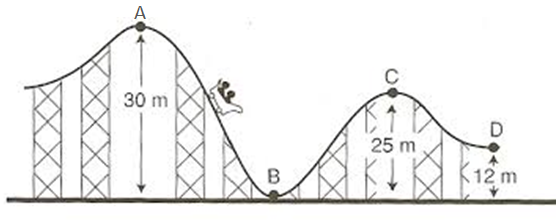
Drag and drop the choices to their correct place on the image.
Mmuae Afoforo a Wobɛpaw:
Car has about 50% KE and 50% PE
Car has 0% PE and 100% KE
Car has the highest potential energy (100%)
Complete the following worksheet using your knowledge from class.
| Draggable item | arrow_right_alt | Corresponding Item |
|---|---|---|
Acceleration | arrow_right_alt | energy of motion |
Speed | arrow_right_alt | energy stored. in an objects position |
Kinetic Energy | arrow_right_alt | Energy cannot be created or destroyed, only rearranged. |
Law of Conservation of Energy | arrow_right_alt | The rate at which an object travels a distance. |
Potential Energy | arrow_right_alt | the change of speed. |
What type of energy is stored in a raised object?
What type of energy does a moving car have?
In a closed system with only kinetic and potential energy, if kinetic energy increases, what happens to the potential energy?
What law states that energy cannot be created or destroyed, but only change its form?
Where does a roller coaster car possess the highest kinetic energy?
| Draggable item | arrow_right_alt | Corresponding Item |
|---|---|---|
At the bottom of the track | arrow_right_alt | No |
In the middle of the track | arrow_right_alt | Yes |
At the peak of the track | arrow_right_alt | No |
A roller coaster car has equal amounts of kinetic and potential energy when it's in the middle of a ride.
When the roller coaster car is at the highest point, is the potential energy at its maximum?
| Draggable item | arrow_right_alt | Corresponding Item |
|---|---|---|
Never | arrow_right_alt | No |
Always | arrow_right_alt | No |
Only when moving | arrow_right_alt | Yes |
Drag and drop the choices to their correct place on the image.
Select all of the types of energy that one type can be converted into.