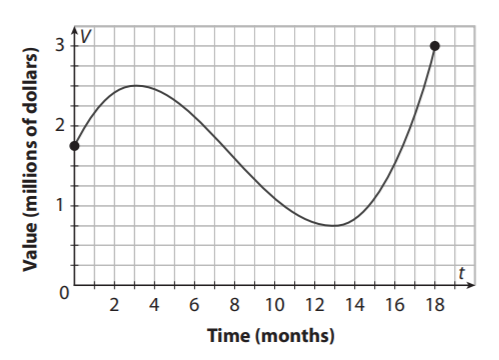
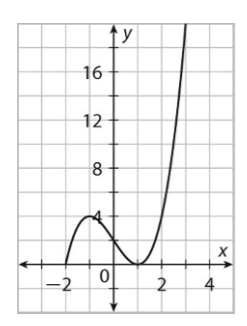
For what interval of x is the function f(x) increasing?
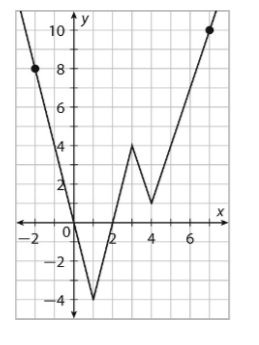
For what interval of x is the function f(x) increasing?
Essential Question: What are some of the attributes of a function, and how are they related to the function’s graph?
Learning Target: Students will be able to describe the key features of the graphs of functions and use the graphs to make predictions about the data.
Show your work for full credit.
Use the graph to create a function with the following features:
1) As x gets smaller; the function approaches infinity. x→ - ∞; f(x)→ ∞
2) As x gets larger; the function approaches infinity. x→ ∞; f(x)→ ∞
3) The graph of the function passes through the x-axis at -3.
Use the graph to create a function with the following features:
1) As x gets smaller; the function approaches infinity. x→ - ∞; f(x)→ ∞
2) As x gets larger; the function approaches infinity. x→ ∞; f(x)→ - ∞
3) The graph of the function passes through the x-axis at -3.
4) The graph of the function passes through the x-axis at 0.
For what interval of x is the function f(x) increasing?
For what interval of x is the function f(x) decreasing?
Identify one interval of (x) where the function f(x) positive.
Identify one interval of time (x) where the function f(x) decreasing.
Identify one interval of time (x) where the function f(x) increasing.
Identify one interval of x where the function f(x) increasing.
For what interval of x is the function f(x) decreasing?
Solve for the missing value of c.
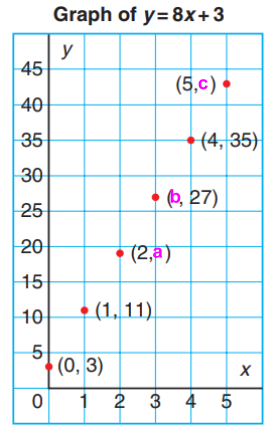
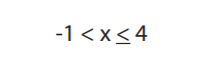
Is this an open or closed interval?
Use interval notation to describe the domain of this function.
Simplify each radical
Simplify this radical.
Simplify this expression that contains radicals.
Simplify. Your answer should not have negative exponents.
Simplify. Your answer should not have negative exponents.
Simplify. Your answer should not have negative exponents.
Simplify. Your answer should not have negative exponents.