7.4 Similar Polygons w/equations (Due 4/12/22)

Last updated 12 months ago
29 questions
Note from the author:
Essential Question: If you know two figures are similar, what can you determine about
measures of corresponding angles and lengths Learning Target: Students will be able to construct proportions from similar polygons and use them to determine the measures of the corresponding angles and side lengths of those polygons. Complete the entire document and show all work for credit.
Essential Question: If you know two figures are similar, what can you determine about
measures of corresponding angles and lengths Learning Target: Students will be able to construct proportions from similar polygons and use them to determine the measures of the corresponding angles and side lengths of those polygons. Complete the entire document and show all work for credit.

Day 1 (4/11/22)

Concept Review

Required
1

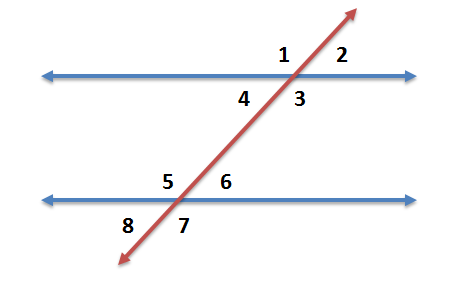
What is the name of the relationship between angle 5 and angle 7?

Required
1

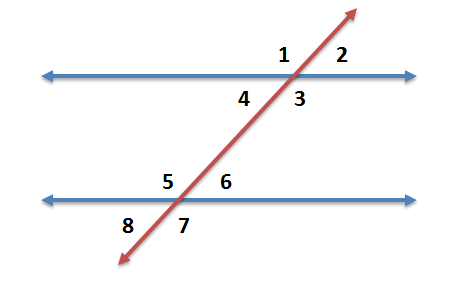
What is the relationship between angle 2 and angle 6?

Required
10

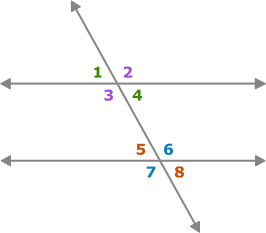
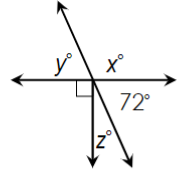
Select all the vertical angles to ∠6

Required
5

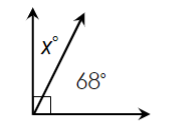
What is the value of x?


Required
5

What is the value of z?


Similar Polygons

Required
16

What is the correct order of steps to solve this similarity problem?

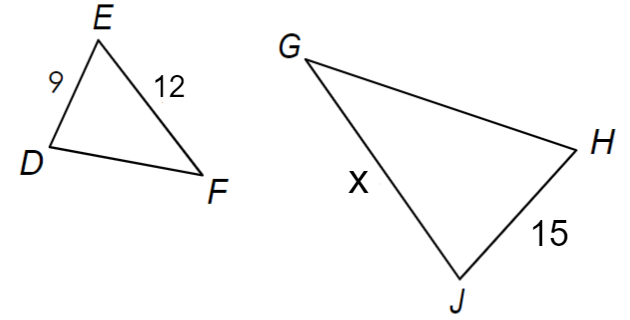
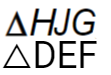
If △DEF ~ △HJG; find x


  1. JG is the side that has to be in the proportion created because it contains x, so create a proportion using corresponding sides from each triangle:
  2. Cross multiply to make the equation:
  3. Replace the all the sides with numbers:
  4. Rewrite the similarity statement so that you can line up the corresponding letters from each polygon:
  5. Simplify the equation to
  6. Divide both sides of the equation by 9:
  7. x=20
Required
10

USE THE SIMILARITY RELATIONSHIP TO FIND THE INDICATED VALUE:

If △DEF ~ △HJG; find x


Required
16

What is the correct order of steps to solve this similarity problem?

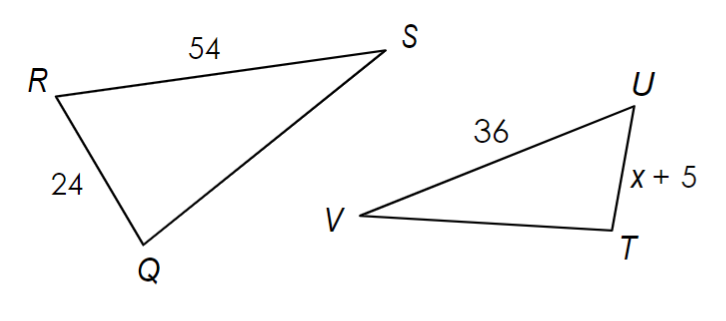
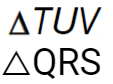
If △QRS ~ △TUV; find x


  1. Rewrite the similarity statement so that you can line up the corresponding letters from each polygon:
  2. Divide both side of the equation by 54:
  3. Replace the all the sides with numbers:
  4. Cross multiply to make the equation:
  5. Subtract 270 from both sides of the equation:

  6. Simplify the equation to
  7. UT is the side that has to be in the proportion created because it contains x, so create a proportion with UT using corresponding sides from each triangle:
  8. x=11
Required
10

USE THE SIMILARITY RELATIONSHIP TO FIND THE INDICATED VALUE:

If △QRS ~ △TUV; find x

Required
10

USE THE SIMILARITY RELATIONSHIP TO FIND THE INDICATED VALUE:

If △AGM ~ △KXD; find x

Required
10

USE THE SIMILARITY RELATIONSHIP TO FIND THE INDICATED VALUE:

If △TLY ~ △CHK; find x

Required
10

USE THE SIMILARITY RELATIONSHIP TO FIND THE INDICATED VALUE:

If △BCD ~ △FGE; find FE

Required
10

USE THE SIMILARITY RELATIONSHIP TO FIND THE INDICATED VALUE:

If △MNP ~ △QRP; find x

Required
10

USE THE SIMILARITY RELATIONSHIP TO FIND THE INDICATED VALUE:

If ▱KLMN ~ ▱PQRS; find x

Day 2 (4/12/22)

Concept Review

Required
10

Determine the scale factor of the dilation that transformed triangle ABC to triangle A'B'C'.

10

What is the dilation of △ ABC → △ A'B'C'? Page 12
A (0, 4) B (5,5) C (3,3)
A’ (0, 8) B’ (10, 10) C’ (6, 6)

Part II

Triangle Inequalities


Required
10
Determine if the side lengths could form a triangle. Use an inequality to prove your answer.
18 in, 6 in, 13 in
_______+_______ =_______; and 19 _______ 18

Therefore this _______ a triangle
Part I

Isosceles and Equilateral Triangles
Required
10
Find the measure of the indicated angle.

m∠C=_______
m∠A=_______
Required
10
Solve for x.

Find the length of the indicated side.

x=_______
DE=_______
m∠E=_______
Required
10
Solve for x.

Find the length of the indicated side.

x=_______
OM=_______
m∠G=_______

Triangle Proportionality

Required
10

What is the value of x?

Required
10

What is the value of x?

Required
10

What is the value of x?

Required
10

What is the value of x?

Day 3 (4/13/22)

Special Triangle Similarity Theorems


Required
10

Use the new "side-splitter" Theorem to create a proportion to solve for x.

Required
10

Use the new "side-splitter" Theorem to solve for x.

Required
10

Use the new "side-splitter" Theorem to create a proportion to solve for x.

Required
10

Use the new "side-splitter" Theorem to solve for x.

Required
10

Use the new "side-splitter" Theorem to solve for x.