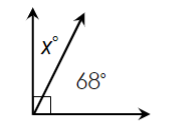
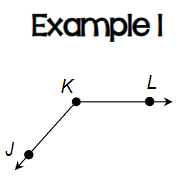
Use this example to answer the following questions
Ɛhia
5
Name the vertex of the angle.
Name the vertex of the angle.
Ɛhia
10
Name the sides of the angle.
Ɛhia
15
Give three ways to name the angle.
Ɛhia
5
Classify the angle.
Classify the angle.
Use this example to answer the following questions
Name the vertex of the angle.
Name the sides of the angle.
Give three ways to name the angle.
Classify the angle.
What type of angle is formed by a straight line?
What is an angle between 90 and 180 degrees called?
What type of angle measures between 0 and 90 degrees?
Match the definition of the angle relationship with the angle relationships it describes...
| Draggable item | arrow_right_alt | Corresponding Item |
|---|---|---|
Any two angles whose sum is 180° | arrow_right_alt | Vertical angles |
Two angles that share a vertex and a common side. They are next to each other | arrow_right_alt | Supplementary angles |
Two angles that are adjacent and supplementary. They form astraight line! | arrow_right_alt | Complementary angles |
Two angles across from each other on intersecting lines. They share a vertex and they are always congruent! | arrow_right_alt | Linear pairs |
Any two angles whose sum is 90° | arrow_right_alt | Adjacent Angles |
Select all the adjacent angles to ∠1
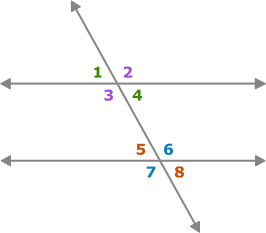
Select all the vertical angles to ∠6
What is the value of x?
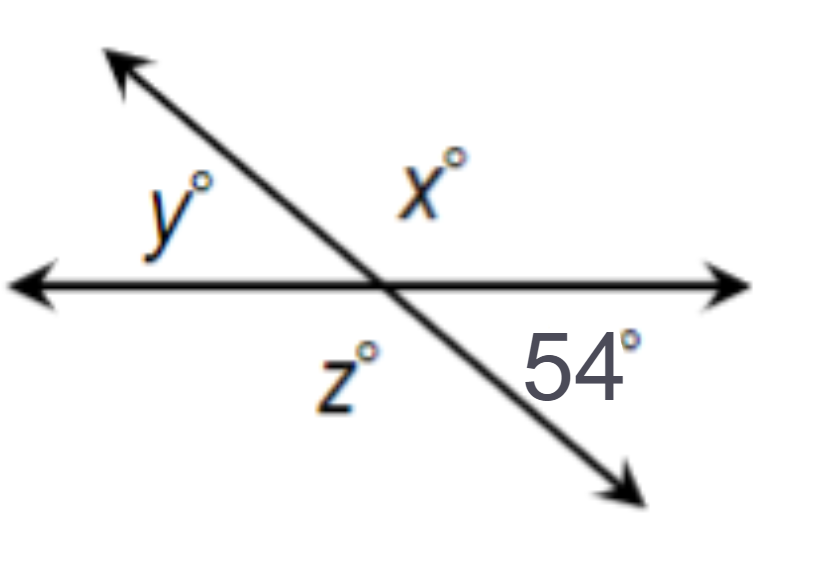
What are the values of x, y, and z?
x°=
y°=
z°=
If m∠DEG = (16x+5)°, m∠GEF = (44x + 5 )°, m∠DEH = (14y - 8)°, find the values of x.
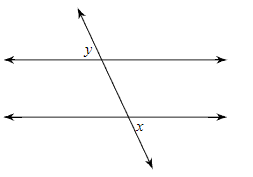
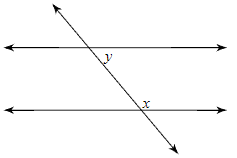
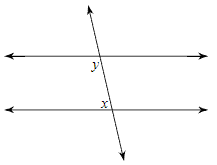
Name the angle relationship between the two indicated angles in the diagram:
These angles are on side(s) of the transversal and the other two lines. Therefore these angles are .
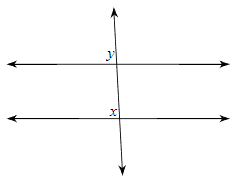
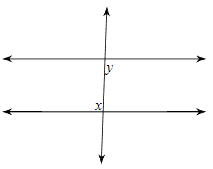
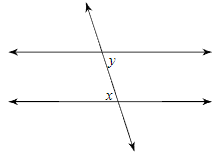
Name the angle relationship between the two indicated angles in the diagram:
These angles are on side(s) of the transversal and the other two lines. Therefore these angles are .
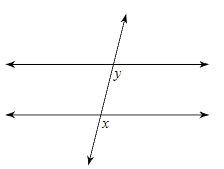
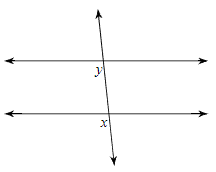
Name the angle relationship between the two indicated angles in the diagram:
These angles are on side(s) of the transversal and the other two lines. Therefore these angles are .
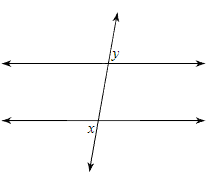
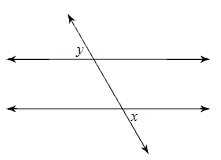
Name the angle relationship between the two indicated angles in the diagram:
These angles are on side(s) of the transversal and the other two lines. Therefore these angles are .
Name the angle relationship between the two indicated angles in the diagram:
These angles are on side(s) of the transversal and the other two lines. Therefore these angles are .
Name the angle relationship between the two indicated angles in the diagram:
These angles are on side(s) of the transversal and the other two lines. Therefore these angles are .
Name the angle relationship between the two indicated angles in the diagram:
These angles are on side(s) of the transversal and the other two lines. Therefore these angles are .
Name the angle relationship between the two indicated angles in the diagram:
These angles are on side(s) of the transversal and the other two lines. Therefore these angles are .
Name the angle relationship between the two indicated angles in the diagram:
These angles are on side(s) of the transversal and the other two lines. Therefore these angles are .
Name the angle relationship between the two indicated angles in the diagram:
These angles are on side(s) of the transversal and the other two lines. Therefore these angles are .
If m∠1 = 57°, find each measure.
m∠2=
m∠3=
m∠4=
m∠5=
m∠6=
m∠7=
m∠8=
If l ∥ m, then solve for x and y.
x=
y=
Find the value of x.
x=
Then, find the measure of each labeled angle.
(12x+10)° =
(7x - 1)° =
Find the value of x.
x=
Then, find the measure of each labeled angle.
(13x-32)° =
(9x)° =
Given the following information, determine which lines, if any, are parallel. State the converse that justifies your answer. Remember that || means "parallel to".
∠3≅∠14
Which lines are parallel? (If none are then write none)
line
What is the reason? (If there is no reason, then write not parallel)
Given the following information, determine which lines, if any, are parallel. State the converse that justifies your answer. Remember that || means "parallel to".
∠1+∠13=180
Which lines are parallel? (If none are then write none)
line
What is the reason? (If there is no reason, then write not parallel)
Given the following information, determine which lines, if any, are parallel. State the converse that justifies your answer. Remember that || means "parallel to".
∠11+∠15=180
Which lines are parallel? (If none are then write none)
line
What is the reason? (If there is no reason, then write not parallel)
Find x so that a || b.
x=
State the converse used.
Find x so that a || b.
x=
State the converse used.