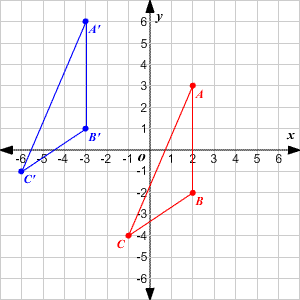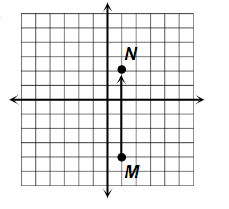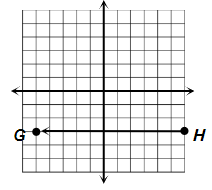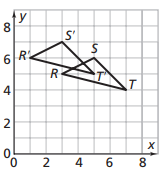
Which of the following shows the rule in coordinate notation for the translation above?
Which of the following shows the rule in coordinate notation for the translation above?
What are the three types of rigid motion?
"Spin"
"Slide"
"Flip"
What is another word for translation besides "slide"?
Rigid motion like, translations, reflections, and rotations change the size and shape of a figure.
Match the description of a translation to its coordinate form
| Draggable item | arrow_right_alt | Corresponding Item |
|---|---|---|
to the right 1 units and up 1 units | arrow_right_alt | (x+2,y+3) |
to the right 1 units and down 7 units | arrow_right_alt | (x-5,y+6) |
to the right 2 units and up 3 units | arrow_right_alt | (x+1,y-7) |
to the down 3 units and down 3 units | arrow_right_alt | (x+3,y-3) |
to the left 5 units and up 6 units | arrow_right_alt | (x-3,y-3) |
to the left 2 units and up 8 units | arrow_right_alt | (x+3,y+3) |
to the right 3 units and down 3 units | arrow_right_alt | (x-2,y+8) |
to the right 3 units and up 3 units | arrow_right_alt | (x+1,y+1) |
You need to move a figure to the right 3 units and down 4 units.
What is the coordiante notation for this rule?
What does the following rule describe? (x, y) → (x-2, y+5)
Use your own words to describe the rule.
Finish the rule for a transformation that translates 2 units up and 3 units left.
(x,y) →
Which of the following shows the rule in coordinate notation for the translation above?
Write the translation rule in coordinate notation for the above image. (You can copy and paste the following notation)
(x,y) →
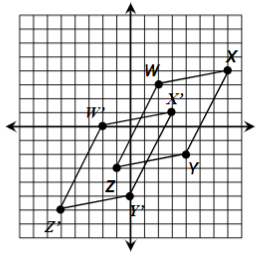
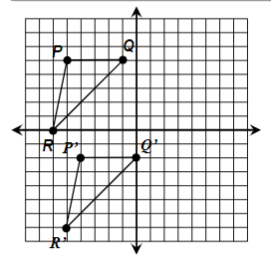
Describe the translation that maps each preimage to its image in coordinate
notation.
Describe the translation that maps each preimage to its image in coordinate
notation. No Spaces
Graph and label each figure and its image under the given translation. Identify the coordinates of the image. Use coordinate form and your answer should have no spaces.
C'
D'
E'
Protip: Transform the points first then graph them.
Graph and label each figure and its image under the given translation. Identify the coordinates of the image. Use coordinate form and your answer should have no spaces.
J'
K'
L'
M'
Protip: Transform the points first then graph them.
Graph and label each figure and its image under the given translation. Identify the coordinates of the image. Use coordinate form and your answer should have no spaces.
W'
X'
Y'
Z'
Protip: Transform the points first then graph them.
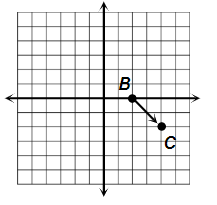
Describe the translation that maps each preimage to its image as a vector in component form. No Spaces
Describe the translation that maps each preimage to its image as a vector in component form. No Spaces
Describe the translation that maps each preimage to its image as a vector in component form. No Spaces
Describe the translation that maps each preimage to its image as a vector in component form. No Spaces
Describe the translation that maps each preimage to its image as a vector in component form. No Spaces
Graph and label each figure and its image under the given translation. Identify the coordinates of the image. Use coordinate form and your answer should have no spaces.
L'
M'
N'
P'
Protip: Transform the points first then graph them.
Graph and label each figure and its image under the given translation. Identify the coordinates of the image. Use coordinate form and your answer should have no spaces.
F'
G'
H'
I'
Protip: Transform the points first then graph them.
The slope of a line is the ratio of over . Another name for slope is .
Write the equation in slope intercept form with the given information:
Identify the coordinate (-5,5) and the coordinate that is 5 units to the right and 1 unit up from it.
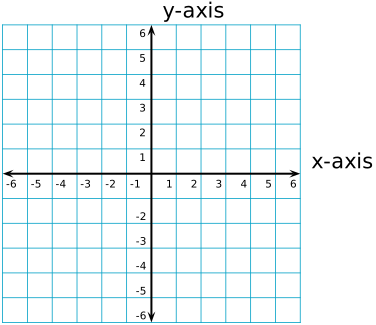
Identify the coordinate (-3,2) and the coordinate that is 1 unit to the left and 6 units down from it.
Identify the point that is 3 units to the left and 4 units down from the coordinate (3,0).
Identify the point that is 3 units to the left and 3 units up from the coordinate (3,0).
What are the x and y-intercepts for this function? Use desmos to help you identify them.
(Do not use spaces when you enter the coordinates)
\/\/\/\/\/\/\/\/\/\/\/
x-intercept
y-intercept
What are the x and y-intercepts for this function? Use desmos to help you identify them.
(Do not use spaces when you enter the coordinates)
\/\/\/\/\/\/\/\/\/\/\/
x-intercept
y-intercept
Directions: Solve each system by substitution. [Write your answer in coordinate form--(x,y)]
Be sure to write your solution in coordinate form (x,y)
Solve each system of equations by elimination. [Write your answer in coordinate form--(x,y)]
Solve each word problem using substitution or elimination.
# nickels
# quarters
You need to move a figure to the right 3 units and down 4 units.
What is the coordiante notation for this rule?
What does the following rule describe?
(x, y) → (x-2, y+5)
Finish the rule for a transformation that translates 5 units down and 2 units right.
(x,y) →
Are the two figures congruent? Explain your reasoning using complete sentences.
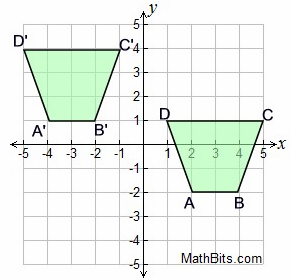
Which of the following shows the rule in coordinate notation for the translation from question 39 above?
Remember to use the coordinate notation (x,y)→(x+h,y+k)
△ABC has coordinates of A(0,4), B(-3,4), and C(-3, -1). What are the new coordinates of △ABC when the figure is moved 3 units left and 1 unit up?
A'
B'
C'
Translate △RST 3 spaces down and 5 space to the right. Be sure to have the correct labels of your new prime vertices.
R'-
S'-
T'-
△CAT has coordinates of C(6,1), A(6,-2), and T(2, -2). What are the new coordinates of △C'A'T' when the figure is translated 6 units down and 4 units to the left?
C'-
A'-
T'-
In your own words, describe what a translation is. (Use complete sentences)