Slope-Intercept Form

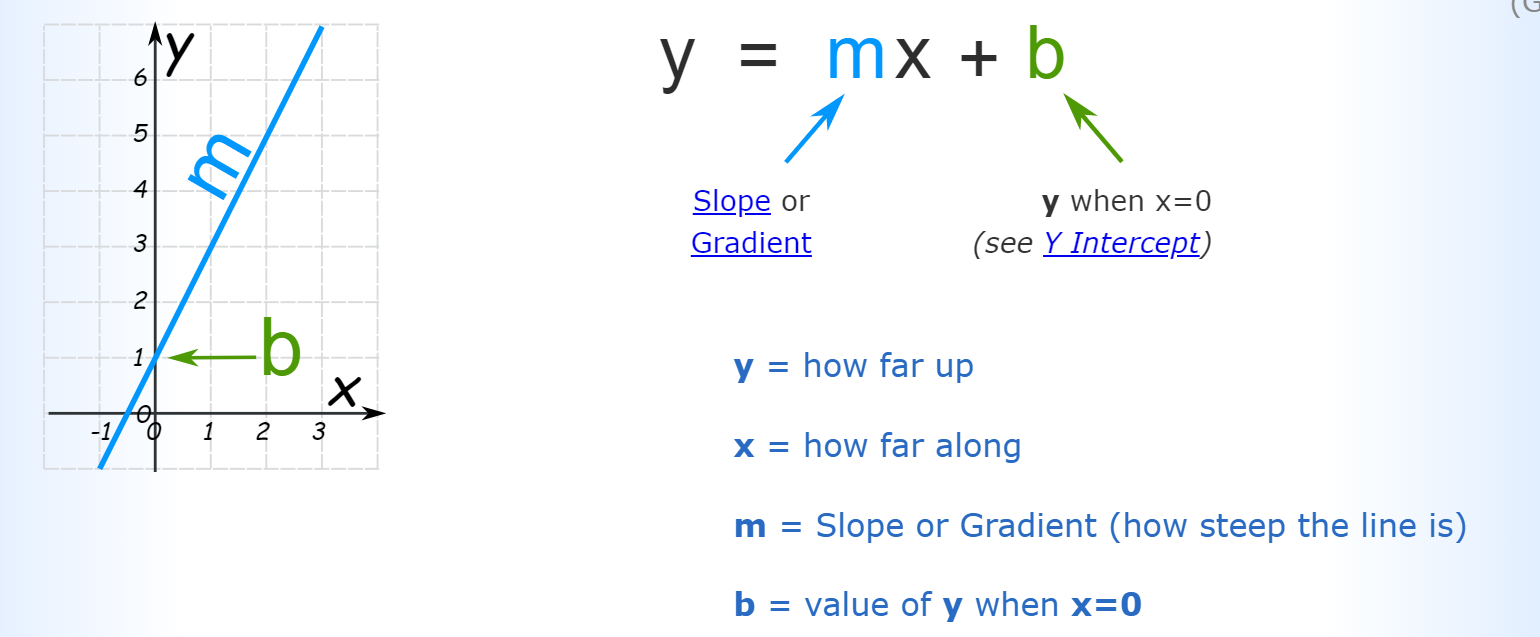
Slope (m)
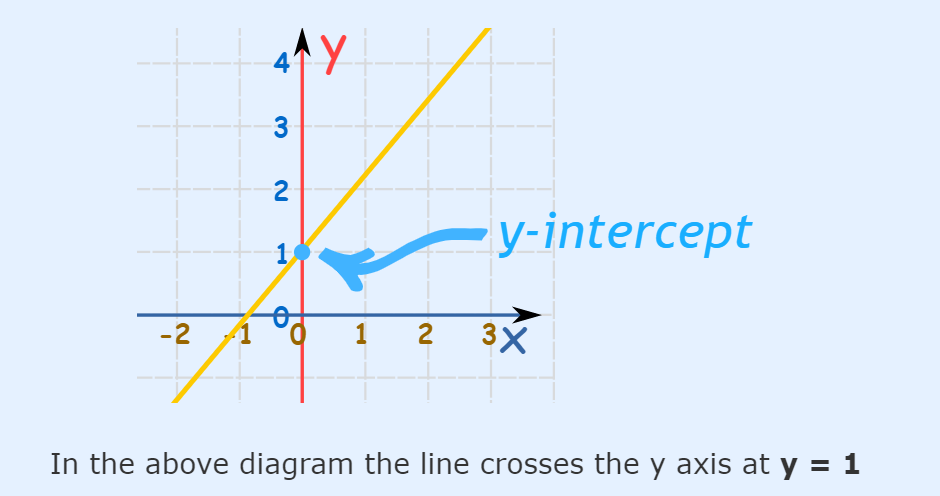
y-intercept (b)
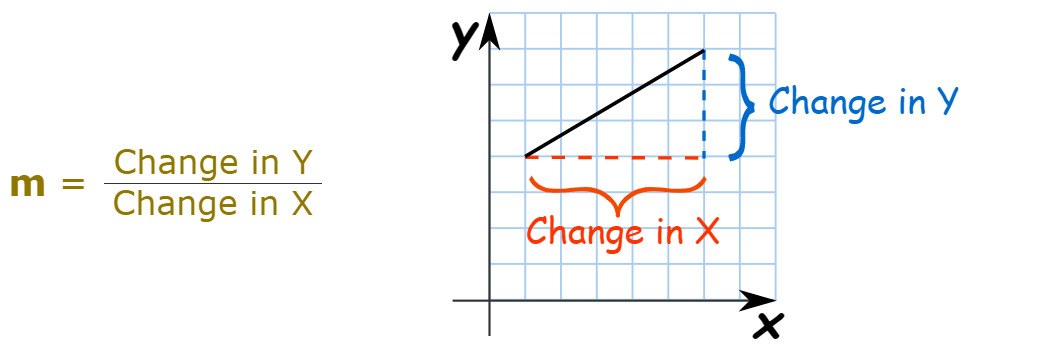
The slope of a line is the ratio of over . Another name for slope is .
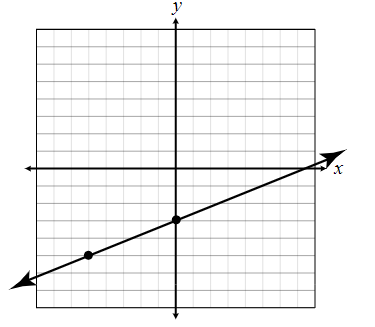
Write the equation in slope intercept form with the given information:
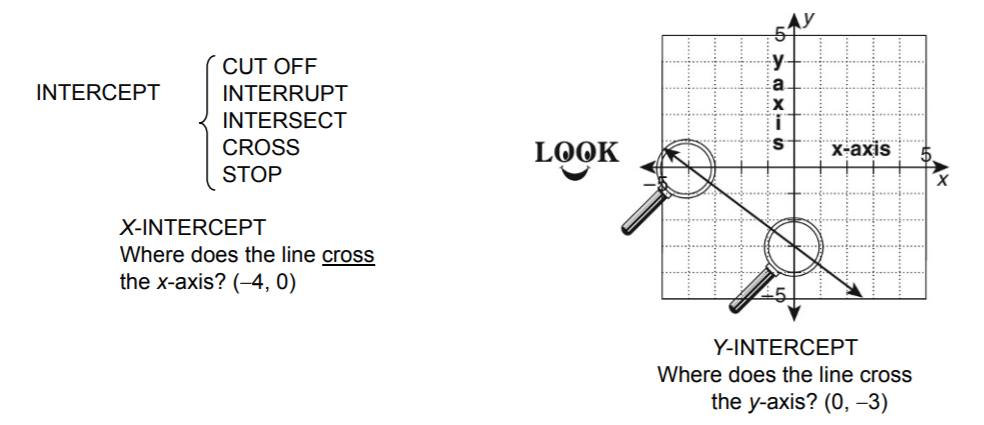
Click on the y-intercept
What are the x and y-intercepts for this function? Use desmos to help you identify them.
(Do not use spaces when you enter the coordinates)
\/\/\/\/\/\/\/\/\/\/\/
x-intercept
y-intercept
What are the x and y-intercepts of this function? (Do not use spaces when you enter the coordinates)
x-intercept
y-intercept
Directions: Solve each system of equations by graphing.
Type the solution in coordinate form - (x,y)
(Do not use spaces when you enter the coordinates)
Directions: Solve each system of equations by graphing.
Type the solution in coordinate form - (x,y)
(Do not use spaces when you enter the coordinates)
Directions: Solve each system of equations by graphing.
Type the solution in coordinate form - (x,y)
(Do not use spaces when you enter the coordinates)
Directions: Solve each system by substitution.
Be sure to write your solution in coordinate form (x,y)
Directions: Solve each system by substitution.
Be sure to write your solution in coordinate form (x,y)
Solve each system of equations by elimination.
Solve each system of equations by elimination.
Solve each word problem using substitution or elimination.
1st Number
2nd Number
Solve each word problem using substitution or elimination.
# of T/F questions
# of Multiple Choice Questions
What are the three types of rigid motion?
"Spin"
"Slide"
"Flip"
Match the description of a translation to its coordinate form
| Draggable item | arrow_right_alt | Corresponding Item |
|---|---|---|
to the right 3 units and up 3 units | arrow_right_alt | (x+2,y+3) |
to the right 2 units and up 3 units | arrow_right_alt | (x-5,y+6) |
to the left 3 units and down 3 units | arrow_right_alt | (x+1,y-7) |
to the left 2 units and up 8 units | arrow_right_alt | (x+3,y-3) |
to the left 5 units and up 6 units | arrow_right_alt | (x-3,y-3) |
to the right 3 units and down 3 units | arrow_right_alt | (x+3,y+3) |
to the right 1 units and up 1 units | arrow_right_alt | (x-2,y+8) |
to the right 1 units and down 7 units | arrow_right_alt | (x+1,y+1) |
What does the following rule describe? (x, y) → (x-2, y+5)
Use your own words to describe the rule.
Finish the rule for a transformation that translates 2 units up and 3 units left.
(x,y) →
Which of the following shows the rule in coordinate notation for the translation above?
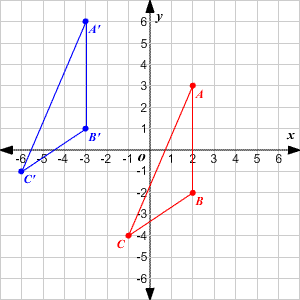
Write the translation rule in coordinate notation for the above image. (You can copy and paste the following notation)
(x,y) →
△ABC has coordinates of A(0,4), B(-3,4), and C(-3, -1). What are the new coordinates of △ABC when the figure is moved 3 units left and 1 unit up?
A'
B'
C'
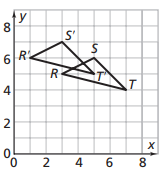
Graph and label each figure and its image under the given translation. Identify the coordinates of the image. Use coordinate form and your answer should have no spaces.
C'
D'
E'
Protip: Transform the points first then graph them.
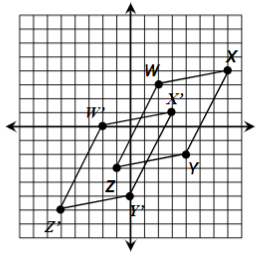
Graph and label each figure and its image under the given translation. Identify the coordinates of the image. Use coordinate form and your answer should have no spaces.
W'
X'
Y'
Z'
Protip: Transform the points first then graph them.
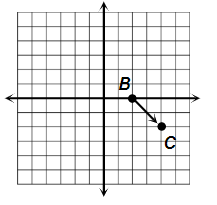
Describe the translation that maps each preimage to its image as a vector in component form. No Spaces
Describe the translation that maps each preimage to its image as a vector in component form. No Spaces
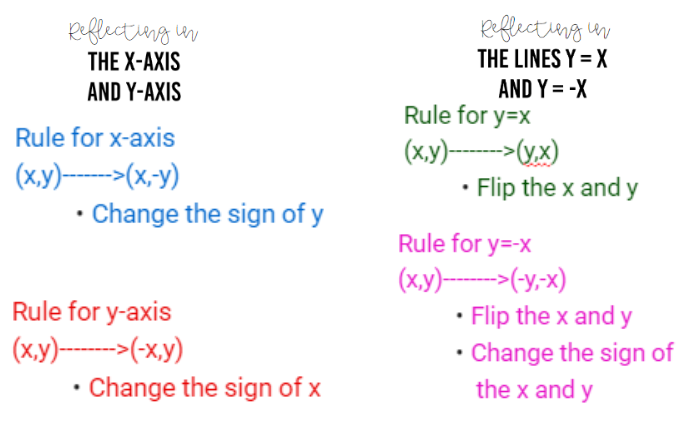
Which graph show the x-axis as the line of reflection?
Which graph show the y-axis as the line of reflection?
Which graph show the y=x as the line of reflection?
Which graph shows the line, y= - x as the line of reflection?
Graph and label each figure and its image under a reflection in the given line. Give the coordinates of the image. Be sure your answer is in coordinate form (x,y). No spaces
Protip: Transform the points first then graph them.
W'
X'
Y'
Z'
Graph and label each figure and its image under a reflection in the given line. Give the coordinates of the image. Be sure your answer is in coordinate form (x,y). No spaces
Protip: Transform the points first then graph them.
B'
C'
D'
E'
Graph and label each figure and its image under a reflection in the given line. Give the coordinates of the image. Be sure your answer is in coordinate form (x,y). No spaces
Protip: Transform the points first then graph them.
F'
G'
H'
Graph and label each figure and its image under a reflection in the given line. Give the coordinates of the image. Be sure your answer is in coordinate form (x,y). No spaces
Protip: Transform the points first then graph them.
M'
N'
O'
P'
Give each rule for counterclockwise rotations about the origin:
90⁰ rotation counter clockwise (x, y) →________
Graph and label each figure and its image under the given rotation.
Identify the coordinates of the image. (Be sure to use parenthesis in your answer.)
S'
T'
U'
V'
Give each rule for counterclockwise rotations about the origin:
180⁰ rotation counter clockwise (x, y) →________
Graph and label each figure and its image under the given rotation.
Identify the coordinates of the image. (Be sure to use parenthesis in your answer.)
A'
B'
C'
D'
Give each rule for counterclockwise rotations about the origin:
270⁰ rotation counter clockwise (x, y) →________
Graph and label each figure and its image under the given rotation.
Identify the coordinates of the image. (Be sure to use parenthesis in your answer.)
F'
G'
H'
What type of angle is formed by a straight line?
What is an angle between 90 and 180 degrees called?
What type of angle measures between 0 and 90 degrees?
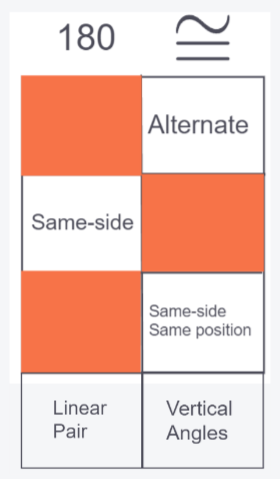
Match the definition of the angle relationship with the angle relationships it describes...
| Draggable item | arrow_right_alt | Corresponding Item |
|---|---|---|
Two angles that are adjacent and supplementary. They form astraight line! | arrow_right_alt | Vertical angles |
Two angles across from each other on intersecting lines. They share a vertex and they are always congruent! | arrow_right_alt | Supplementary angles |
Any two angles whose sum is 180° | arrow_right_alt | Complementary angles |
Two angles that share a vertex and a common side. They are next to each other | arrow_right_alt | Linear pairs |
Any two angles whose sum is 90° | arrow_right_alt | Adjacent Angles |
Name two angles that are supplementary.

Name two angles that are vertical.
Name all angles that are obtuse.
Name all angles that are acute.
Use the figure below to answer questions. Let m∠DAB= 136.
m∠CAB=
m∠CAD=
What is the values of x, y, and z?
x=
y=
z=
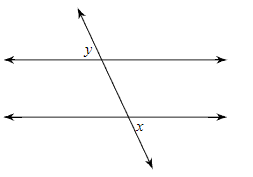
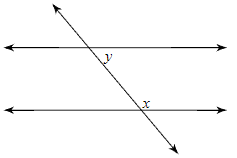
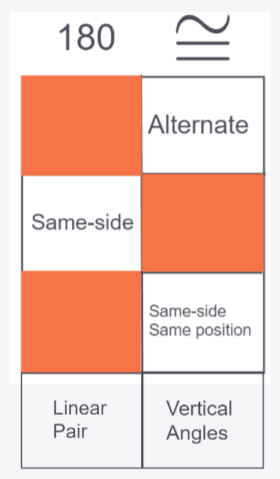
Name the angle relationship between the two indicated angles in the diagram:
These angles are on side(s) of the transversal and the other two lines. Therefore these angles are .
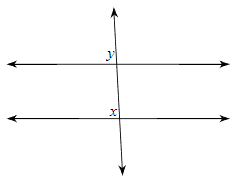
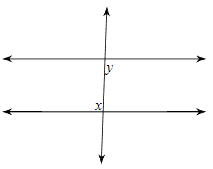
Name the angle relationship between the two indicated angles in the diagram:
These angles are on side(s) of the transversal and the other two lines. Therefore these angles are .
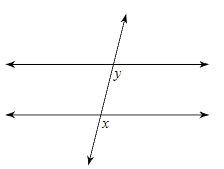
Name the angle relationship between the two indicated angles in the diagram:
These angles are on side(s) of the transversal and the other two lines. Therefore these angles are .
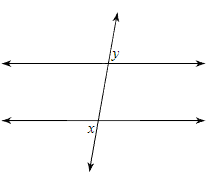
Name the angle relationship between the two indicated angles in the diagram:
These angles are on side(s) of the transversal and the other two lines. Therefore these angles are .
Name the angle relationship between the two indicated angles in the diagram:
These angles are on side(s) of the transversal and the other two lines. Therefore these angles are .
Name the angle relationship between the two indicated angles in the diagram:
These angles are on side(s) of the transversal and the other two lines. Therefore these angles are .
If m∠6 =142°, find each measure.
m∠1=
m∠2=
m∠3=
m∠4=
m∠5=
m∠7=
m∠8=
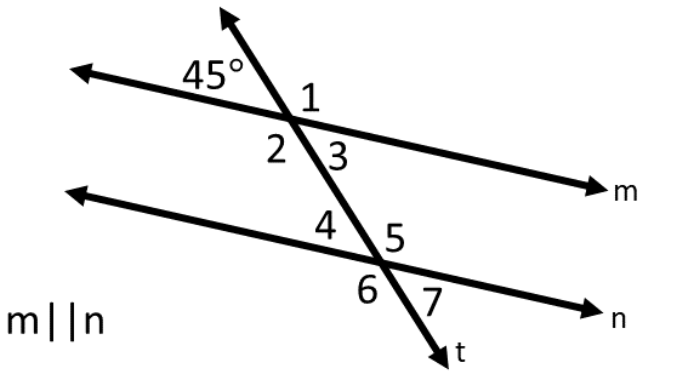
Tell why each of the angles indicated are congruent to the angle measure shown.
∠4=45° because
Tell why each of the angles indicated are congruent to the angle measure shown.
∠7=45° because
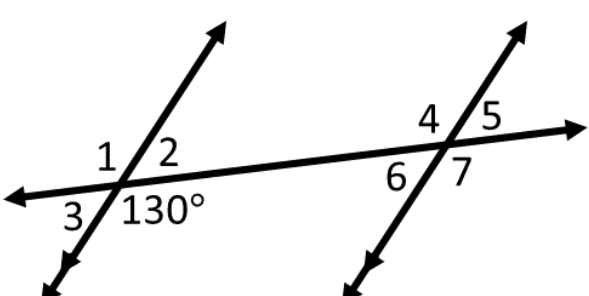
Tell why each of the angles indicated are congruent to the angle measure shown.
∠1=130° because
Tell why each of the angles indicated are congruent to the angle measure shown.
∠4=130° because
Find the value of x.
x=
Then, find the measure of each labeled angle.
(3x + 4)° =
(5x – 8)° =
Find the value of x.
x=
Then, find the measure of each labeled angle.
(6x+20)° =
(8x)° =
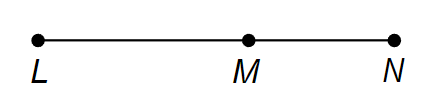
Use the diagram below to answer questions 1 and 2.
If LM = 22 and MN = 15, find LN.
LN=
If LN = 54 and LM = 31, find MN.
MN=
DF = 9x – 39.
Find these values.
x=
EF=
DF=
T is the midpoint of SU.
Find these values.
x=
ST=
UT=
SU=
Find x so that a || b.
x=
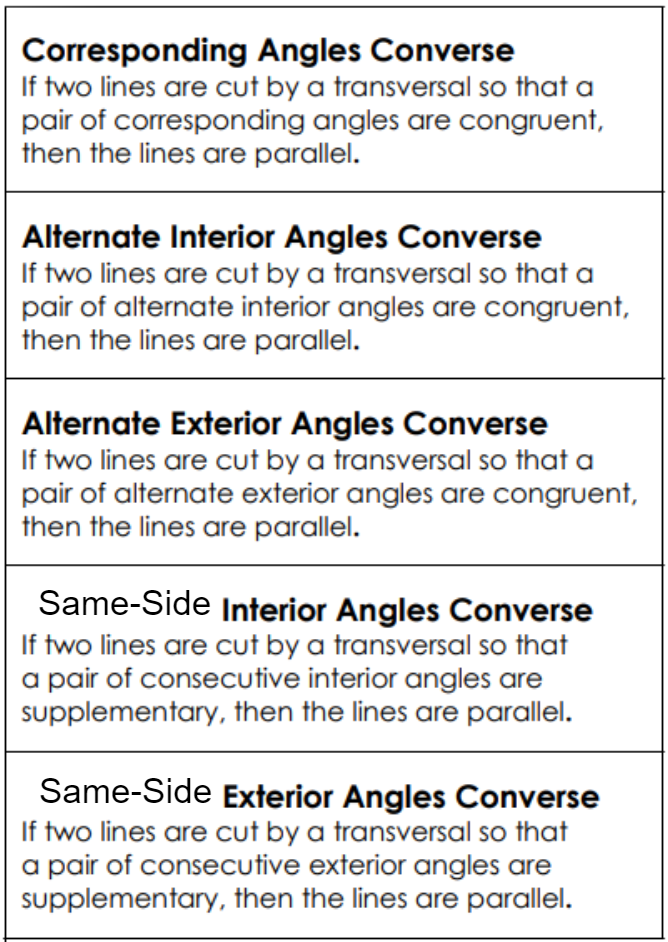
State the converse used.
Find x so that a || b.
x=
State the converse used.
Find x so that a || b.
x=
State the converse used.
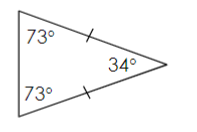
Classify this triangle by its angles and sides.
Angle:
This is a
Sides:
This is a
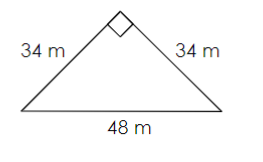
Classify this triangle by its angles and sides.
By its angles:
By its sides:
Classify this triangle by its angles and sides.
By its angles:
By its sides:
Classify this triangle by its angles and sides.
Angle:
This is a
Sides:
This is a
Classify this triangle by its angles and sides.
By its angles:
By its sides:
Find each missing measure.
Find the value of x.
Find the measure of the indicated angle.
Find the length of the indicated side.
Find the length of the indicated side.
State whether the triangles can be proven congruent, if possible, by SSS, SAS, ASA, AAS, or HL.
Are they congruent using SSS, SAS, AAS, ASA, or HL? Or not enough information?
State whether the triangles can be proven congruent, if possible, by SSS, SAS, ASA, AAS, or HL.
Are they congruent using SSS, SAS, AAS, ASA, or HL? Or not enough information?
State whether the triangles can be proven congruent, if possible, by SSS, SAS, ASA, AAS, or HL.
Are they congruent using SSS, SAS, AAS, ASA, or HL? Or not enough information?
State whether the triangles can be proven congruent, if possible, by SSS, SAS, ASA, AAS, or HL.
Are they congruent using SSS, SAS, AAS, ASA, or HL? Or not enough information?
State whether the triangles can be proven congruent, if possible, by SSS, SAS, ASA, AAS, or HL.
Are they congruent using SSS, SAS, AAS, ASA, or HL? Or not enough information?
State whether the triangles can be proven congruent, if possible, by SSS, SAS, ASA, AAS, or HL.
Are they congruent using SSS, SAS, AAS, ASA, or HL? Or not enough information?
State whether the triangles can be proven congruent, if possible, by SSS, SAS, ASA, AAS, or HL.
Are they congruent using SSS, SAS, AAS, ASA, or HL? Or not enough information?
State whether the triangles can be proven congruent, if possible, by SSS, SAS, AAS, ASA, or HL. Include a congruency statement for all congruent triangles.
What is the measure of ∠L?
m∠L=
Are they congruent using SSS, SAS, AAS, ASA, or HL? Or not enough information?
If possible write a congruency statement. If not write n/a in both blanks.
△
Use the diagram to answer these questions:
What is the measure of ∠Z?
m∠Z=
What is the measure of ∠Y?
m∠Y=
State whether the triangles can be proven congruent, if possible, by SSS, SAS, AAS, ASA, or HL. Include a congruency statement for all congruent triangles.
Are they congruent using SSS, SAS, AAS, ASA, or HL? Or not enough information?
If possible write a congruency statement. If not write n/a in both blanks.
△
Use the diagram to answer these questions:
What is the measure of ∠PNQ?
m∠PNQ=
What is the measure of ∠SQN?
m∠SQN=
State whether the triangles can be proven congruent, if possible, by SSS, SAS, AAS, ASA, or HL. Include a congruency statement for all congruent triangles.
Are they congruent using SSS, SAS, AAS, ASA, or HL? Or not enough information?
If possible write a congruency statement. If not write n/a in both blanks.
△
x=
y=
Given △MKP≅△YAC, complete each of the following statements with the corresponding parts.
KM≅
CY≅
PK≅
∠Y≅∠
∠K≅∠
∠ACY≅∠
Write the correct congruency statement.
△MPK≅△
△YAC≅△
Given △STW≅△BFN, find each missing measure.
BN=
TW=
BF=
m∠W=
m∠B=
m∠F=
Write the correct congruency statement.
△WTS≅△
△FNB≅△
Given △GHJ≅△XYZ, find each missing measure.
GJ=
XY=
ZY=
m∠H=
m∠Z=
m∠J=
Write the correct congruency statement.
△HJG≅△
△ZXY≅△