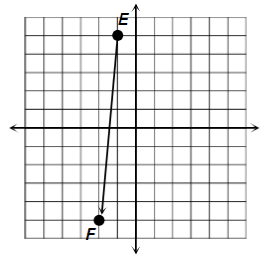
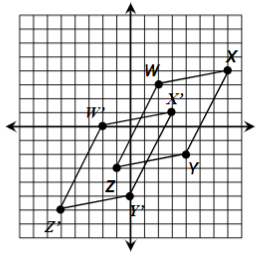
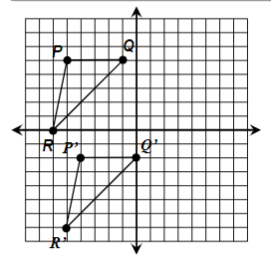
Name each vector, then write the vector in component form.
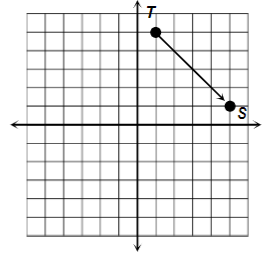
Name each vector, then write the vector in component form.
What are the three types of rigid motion?
What is another word for translation?
Rigid motion like, translations, reflections, and rotations change the size and shape of a figure.
Match the vector to its match translation
| Draggable item | arrow_right_alt | Corresponding Item |
|---|---|---|
<3,3> | arrow_right_alt | (x+2,y+3) |
<3,-3> | arrow_right_alt | (x-5,y+6) |
<1,1> | arrow_right_alt | (x+1,y-7) |
<2,3> | arrow_right_alt | (x+3,y-3) |
<-2,8> | arrow_right_alt | (x-3,y-3) |
<1,-7> | arrow_right_alt | (x+3,y+3) |
<-5,6> | arrow_right_alt | (x-2,y+8) |
<-3,-3> | arrow_right_alt | (x+1,y+1) |
Graph and label each figure and its image under the given translation. Give the
coordinates of the image.
Graph and label each figure and its image under the given translation. Give the
coordinates of the image.
Name each vector, then write the vector in component form.
Name each vector, then write the vector in component form.
Describe the translation that maps each preimage to its image in coordinate
notation.
Describe the translation that maps each preimage to its image as a vector in component form.
Describe the translation that maps each preimage to its image in coordinate
notation.
Describe the translation that maps each preimage to its image as a vector in component form.
K’(-8, 6) is the image of K after a translation along the rule (x, y) → (x – 3, y + 6). What are the coordinates of K?
P’(1, -2) is the image of P after a translation along the vector <-8,0>. What are the coordinates of P?