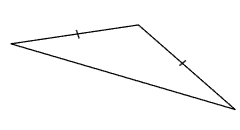
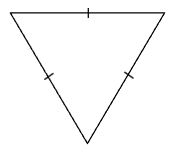
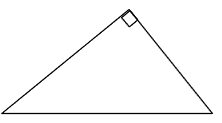
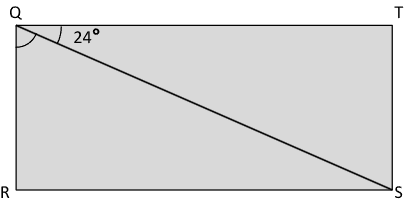
Find and draw all lines of symmetry in the following figures. If there are none, write “none.”
How many lines of symmetry does a circle have? What point do all lines of symmetry for a given circle have in common?
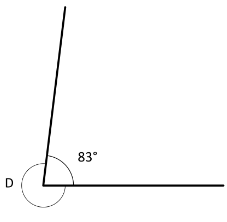
Find the measure of D and explain how the measure of angle d can be found without using a protractor.
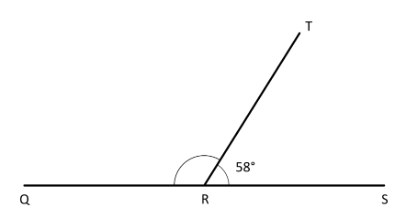
In this figure, Q, R, and S lie on a line. Find the measure of QRT and explain how the measure of the unknown angle QRT can be found without using a protractor.
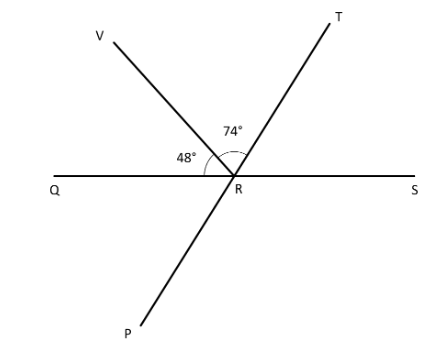
In this figure, Q, R, and S lie on a line. Find the measure of ∠QRT and explain how the measure of the unknown angle ∠QRT can be found without using a protractor.
Mike drew some two-dimensional figures. Sketch the figures and answer each part about the figures that Mike drew.
He drew a four-sided figure with four right angles. It is 4 cm long and 3 cm wide.
For question 8, what type of quadrilateral did Mike draw?
Mike drew some two-dimensional figures. Sketch the figures and answer each part about the figures that Mike drew.
He drew a quadrilateral with four equal sides and no right angles.
For question 10, what type of quadrilateral did Mike draw?
Mike drew some two-dimensional figures. Sketch the figures and answer each part about the figures that Mike drew.
He drew a triangle with one right angle and sides that measure 6 cm, 8 cm, and 10 cm.
For question 12, classify the type of triangle Mike drew based on side length and angle measure.
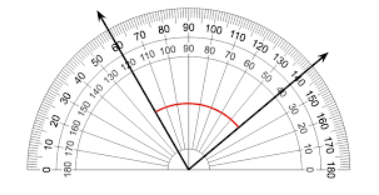
Mike used a protractor to measure ABC as shown below and said the result was exactly 130°. Do you agree or disagree? Explain your thinking.
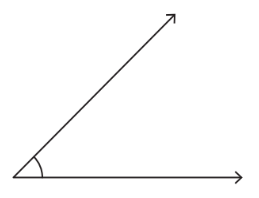
Use a protractor to find the measure of the angle.
Construct an angle that has a measure of 130°.