Asemmisa {{asɛmmisaAhyɛnsode}}
1.
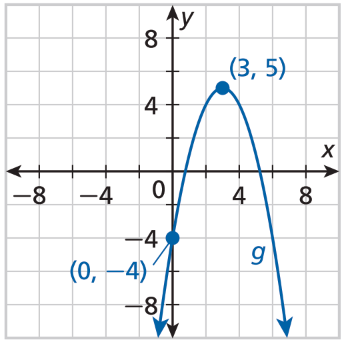
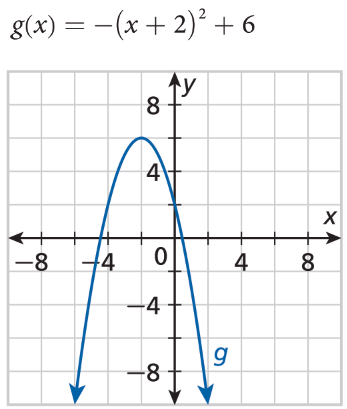
Write the vertex form of a quadratic equation for the graph.
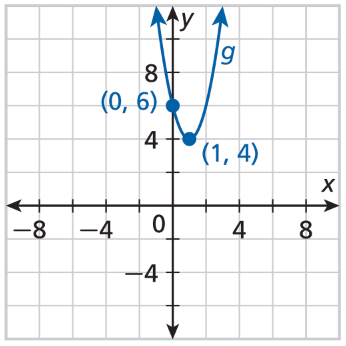
Write the vertex form of a quadratic equation for the graph.
Identify the transformation (stretch, compression, reflection, translation) of the graph of the parent function
that results in the graph of the function g.
Graph the quadratic function by using a table of values. Identify how the graph is related to the graph of the parent quadratic function. Identify the axis of symmetry and the vertex.
Graph the quadratic function by using a table of values. Identify how the graph is related to the graph of the parent quadratic function. Identify the axis of symmetry and the vertex.
The function
is in standard form. Graph the function and answer the questions below.
A. What is the axis of symmetry?
B. What is the vertex?
C. Does the function have a maximum value or a minimum value?
D. Identify any x- and y-intercepts.
Molly is practicing kicking a soccer ball. She kicks the ball with an initial vertical velocity of 40 feet per second and at a height of 2.5 feet.
A. What quadratic function, in standard form, models the height of the soccer ball?
B. What is the maximum height of the soccer ball?
C. After how many seconds does the soccer ball reach its maximum height?
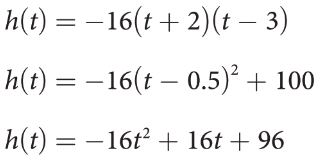
The height, in feet, of an object at time t, in seconds, after it is launched into the air can be represented by the functions below.
A. Which function would you use to find the maximum height reached by the object? What is the maximum height?
B. Which function would you use to find the time the object is in the air? How long is the object in the air?
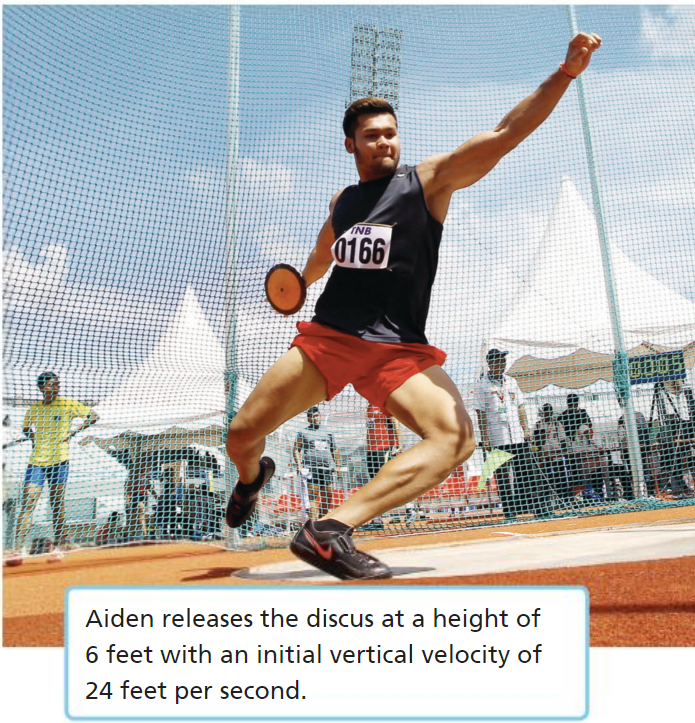
Two discus throwers are analyzing their techniques. The height, in feet, of the discus at time t, in seconds, after Jennyfer throws it can be modeled by
Aiden’s throw is described in the photo.
A. Who threw the discus higher? Explain.
B. Who threw from a higher initial height? Explain.
C. Who threw with the greater initial vertical velocity? Explain.
D. Whose throw resulted in a shorter flight time? Explain.