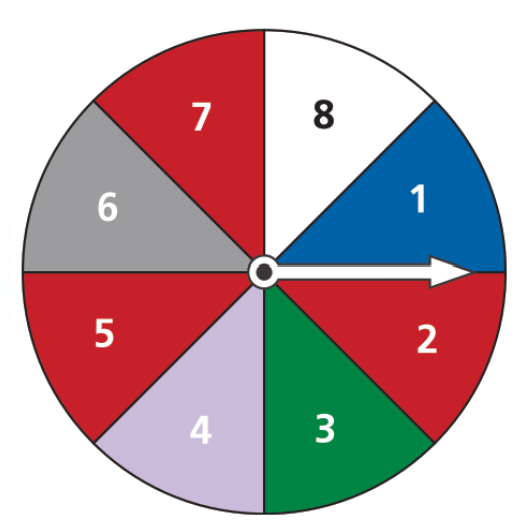
Consider the spinner shown at the right. Describe the pairs of events as mutually exclusive or inclusive.
I can use probabilities to identify events as either mutually exclusive or inclusive.
I can use probabilities to identify events as either mutually exclusive or inclusive.
List two events that are mutually exclusive. Justify your reasoning.
List two events that are inclusive. Justify your reasoning.
Consider the spinner shown at the right. Describe the pairs of events as mutually exclusive or inclusive.
P(green or odd)
P(green or even)
P(even or blue)
P(8 or pink)
P(white or red)
P(prime or odd)
P(even or not blue)
P(odd or not green)
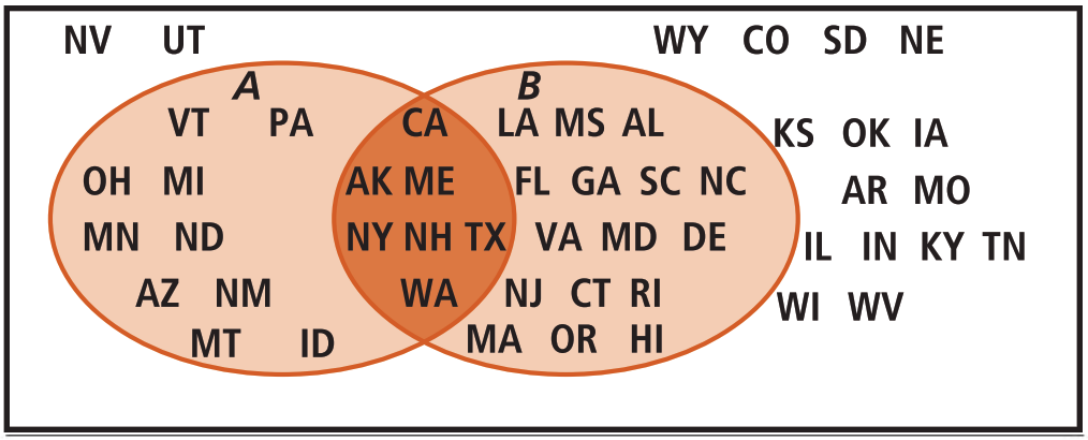
Martina is learning about the 50 states of the United States. To help her learn their locations, she created the Venn diagram shown at the right, using the postal codes of the states. Set A includes states that border Canada or Mexico, and set B includes the states that border an ocean or the Gulf of Mexico. Note that Pennsylvania and Ohio share a water border with Canada, but Wisconsin does not.
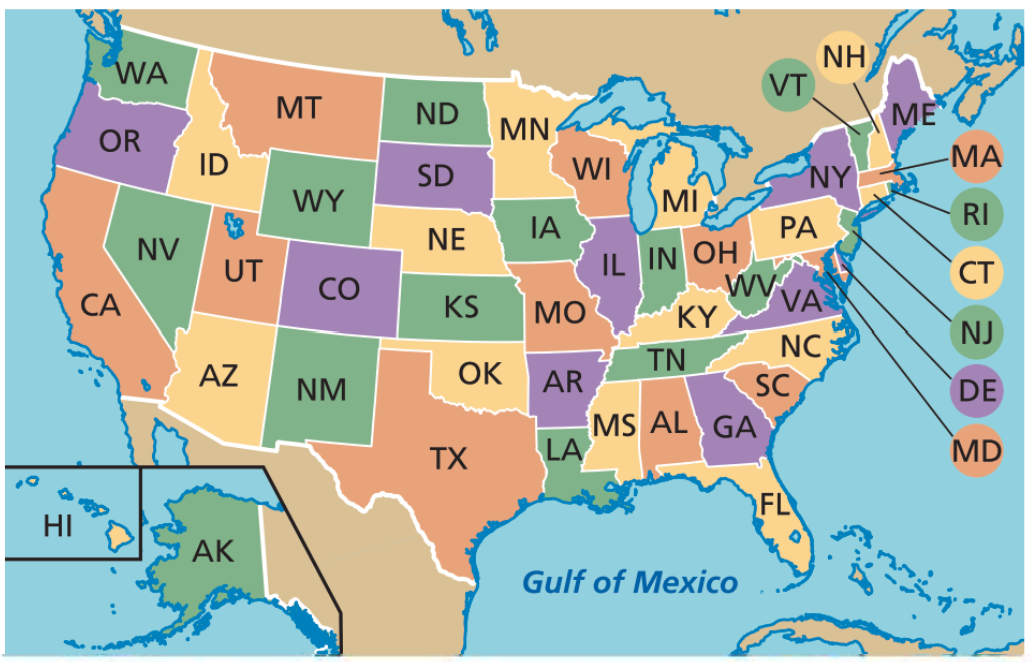
What is the probability that a randomly selected state borders Canada or Mexico or an ocean or the Gulf of Mexico?
What is the probability that a randomly selected state borders Canada or Mexico or does not border an ocean or gulf?
What is the probability that a randomly selected state borders an ocean or gulf or does not border Canada or Mexico?
What is the probability that a randomly selected state does not border Canada or Mexico or does not border the ocean or the Gulf of Mexico?

Let A be the event of randomly selecting a vowel. Let B be the event of randomly selecting a consonant. Find P(A or B).
Let A be the event of randomly selecting an E. Let B be the event of randomly selecting a letter in the word “mathematics.” Find P(A or B).
Let A be the event of randomly selecting a vowel. Let B be the event of randomly selecting a letter in the word “probability.” Find P(A or B).
Let A be the event of randomly selecting a letter in the word “exclusive.” Let B be the event of randomly selecting a letter in the word “inclusive.” Find P(A or B).