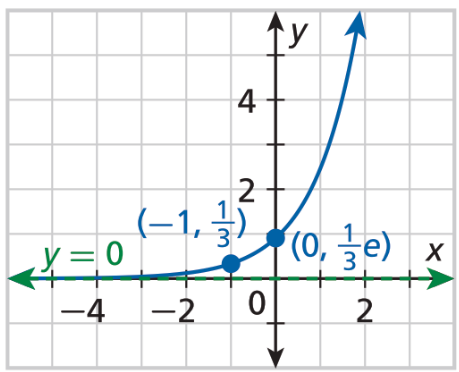
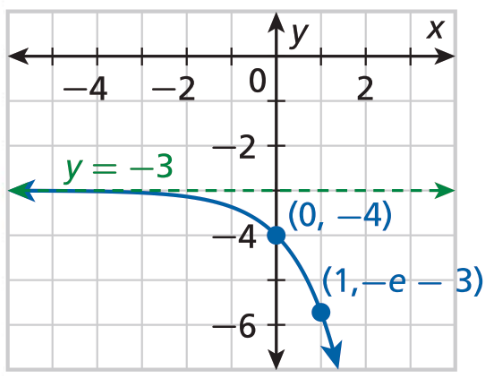
Use the reference points and the asymptote to write the function whose graph is shown.
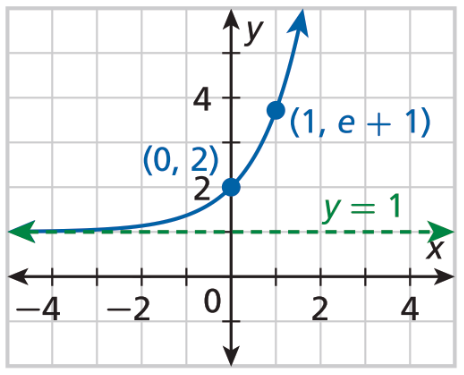
Use the reference points and the asymptote to write the function whose graph is shown.
I can graph transformations of exponential functions having base e and use the graphs to solve real-world problems.
I can graph transformations of exponential functions having base e and use the graphs to solve real-world problems.
Graph the function. Label the reference points and the horizontal asymptote.
Graph the function. Label the reference points and the horizontal asymptote.
Graph the function. Label the reference points and the horizontal asymptote.
Use the reference points and the asymptote to write the function whose graph is shown.
Use the reference points and the asymptote to write the function whose graph is shown.
Use the reference points and the asymptote to write the function whose graph is shown.
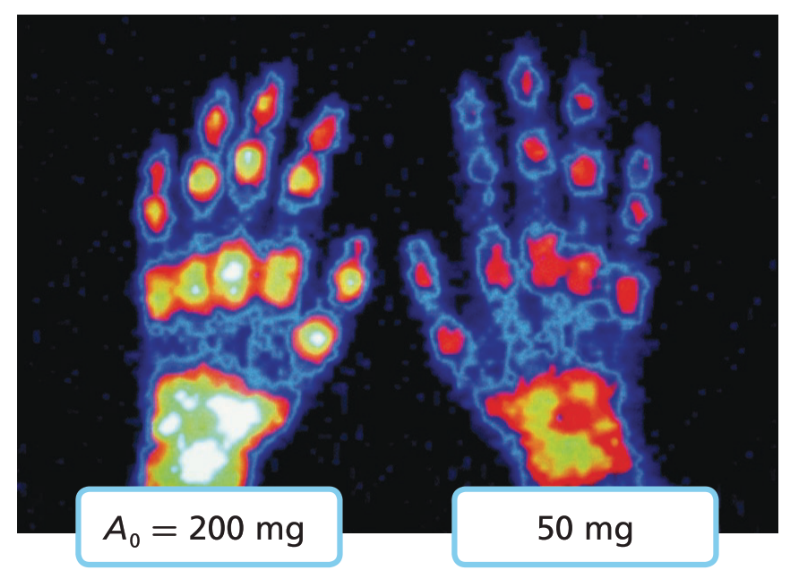
Radioactive isotopes are sometimes used in medical imaging. The amount of a radioactive isotope remaining (in milligrams) can be approximated by the function
where A subzero is the initial amount of the isotope and t is the time in hours. The initial amount of the isotope is shown. After how many hours will there be 50 milligrams of the isotope remaining?
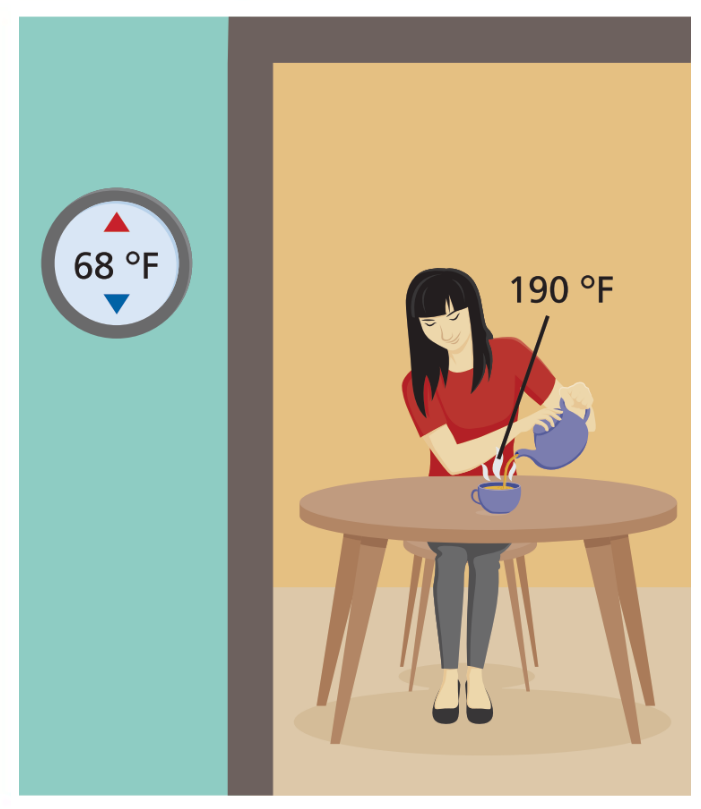
Newton’s law of cooling states that the temperature of an object can be modeled by the function
where
is the initial temperature of the object,
is the ambient temperature (the temperature around the object), t is time in minutes, and k is a constant value given by the composition of the object. A cup of tea is 190 °F when it is served. The cooling constant k for the tea is approximately 0.04.
Write an equation for the temperature of the tea as a function of time.
How long will it take for the tea to cool to
Explain how you know.
Graph the function that models the temperature of the tea and use it to determine whether the tea will ever cool to room temperature. Explain your answer.