Log in
Sign up for FREE
arrow_back
Library

Lesson 11.1 Inverse Variation

star
star
star
star
star
Last updated over 1 year ago
9 questions
Note from the author:
I can recognize when two quantities show inverse variation and write an equation to model the relationship between the quantities.
Untitled Section
1
Is this a wrench in the system?
1
1
Are we getting strung along?
1
1
We will have to labor over this one.
1
1
1
Have we reached a Boyle-ing Point?
1
Question 1
1.

Which equation below represent inverse variation?

Question 2
2.

The table shows the force needed to loosen a bolt using wrenches with handles of various lengths.
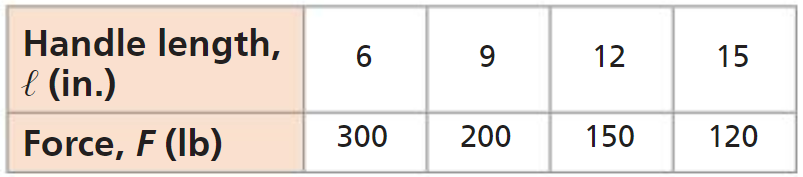
Does force vary inversely with handle length? Explain.
Question 3
3.

Predict the force required to loosen the bolt using a wrench with a handle length of 18 in.

Question 4
4.

The frequency (in vibrations per second) of a vibrating violin string varies inversely with the string’s length (in centimeters). Suppose a violin string that is 30 cm long vibrates 280 times per second.

Write an equation that gives the frequency f as a function of the string length ℓ.

Question 5
5.

What is the frequency for a violin string 25 cm long?

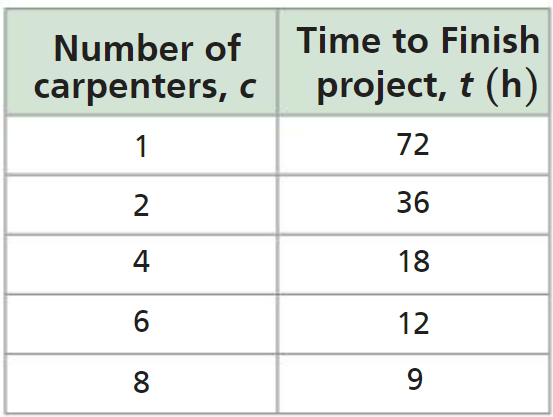
For a certain carpentry project, the time t (in hours) needed to finish the project depends on the number of carpenters c assigned to it, as shown in the table.

Question 6
6.

Does the time to finish the project vary inversely with the number of carpenters? Explain.

Question 7
7.

Write an equation that gives t as a function of c.

Question 8
8.

If the project needs to be finished in at most 3 days and the carpenters work 8 hours per day, what is the minimum number of carpenters that must be assigned to the project?

Question 9
9.

Desmos Time!

Boyle’s Law states that for a given mass of confined gas at a constant temperature, the pressure P the gas exerts varies inversely with the volume V the gas occupies. At 100 °F, a given mass of gas exerts a pressure of 125 lb/in^2 when placed in a tank with a volume of 2 ft^3. If the same mass of gas at the same temperature is placed in a tank with a volume of 5 ft^3, what pressure will the gas exert? Graph the function and use the graph to justify your answer.