Log in
Sign up for FREE
arrow_back
Library

CFU -2 for PS3.1 and 6.PS3.3

star
star
star
star
star
Last updated over 2 years ago
10 questions
1
1
1
1
1
1
1
1
1
1
Question 1
1.

Question 2
2.

Question 3
3.

Question 4
4.

Question 5
5.

Question 6
6.

Question 7
7.

Question 8
8.

Question 9
9.

Question 10
10.

Which scenario shows the release of chemical energy?
A child stretches a rubber band.
A child eats chocolate ice cream.
A person dries wet hair with a hair dryer.
A person heats water in a microwave oven.
The diagram shows a hydroelectric power plant that uses moving water to power a toaster.
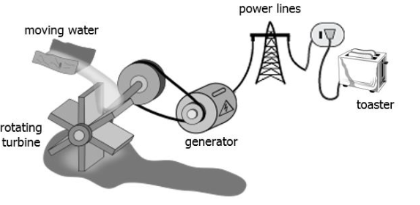

Which two sources of kinetic energy does the diagram show?
power lines and moving water
power lines and toaster
rotating turbine and toaster
moving water and rotating turbine
What can influence the electric potential energy of a system?
Temperature in the electric field
Charge of objects in the electric field
Speed of sound in the electric field
Amount of light in the electric field
A camper uses a campfire to melt a marshmallow. Which form of energy produced by the burning wood in the campfire melts the camper's marshmallow?
Electric energy
Gravitational energy
Elastic energy
Thermal energy
Students perform a lab in which they place baking soda in a balloon and vinegar in a bottle. They place the balloon on the top of the bottle and lift the balloon releasing the baking soda into the vinegar. They balloon immediately inflates. What are the sources of chemical potential energy in this lab?
the balloon and the vinegar
the balloon and the bottle
the baking soda and the vinegar
the baking soda and the balloon
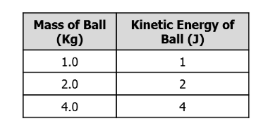
A student performs an activity to study kinetic energy. The student throws balls of different masses with a velocity of 2 m/s and records the kinetic energy, as shown.


What is the relationship between the ball and the kinetic energy of the ball?
As the mass of the ball increases, the kinetic energy of the ball triples.
As the mass of the ball increases, the kinetic energy of the ball increases.
As the mass of the ball increases, the kinetic energy of the ball decreases.
As the mass of the ball increases, the kinetic energy of the ball reduces to half.
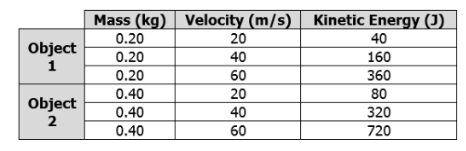
The table shows the mass, velocity, and kinetic energy of two objects.


Based on the data, how does mass relate to kinetic energy?
If the mass is doubled, the kinetic energy is doubled.
If the mass is doubled, the kinetic energy is halved.
If the mass is doubled, the kinetic energy is tripled.
If the mass is doubled, the kinetic energy remains constant.
A child is pushing a cart across the floor, and the cart moves at a certain speed. When he pushes the cart with a greater force, the cart begins to move faster. Which type of energy increases when the child applies a greater force?
Chemical energy
Electrical energy
Potential energy
Kinetic energy
What affects the amount of kinetic energy of an object?
Height and volume
Speed and volume
Speed and mass
Height and mass
If an object's speed is doubled, what happens to its kinetic energy?
It halves
It doubles
It quadruples
It remains the same