Log in
Sign up for FREE
arrow_back
Library

Particle Nature of Matter Reading Quiz

star
star
star
star
star
Last updated over 2 years ago
5 questions
Required
2
Required
2
Required
2
Required
2
Required
2
Question 1
1.

Question 2
2.

Question 3
3.

Question 4
4.

Question 5
5.

Read the passage and then select the list of words that correctly completes the blanks in the order given:
All matter has ___ and occupies space. The simplest form of matter containing only one type of atom with its own particular set of properties is called a(n) ___. A combination of two or more atoms that can be the same or different is called a(n) ___. Such combinations of atoms are held together by attractive forces, which help determine the ___ of matter.
mass; element; molecule; state
elements; atom; molecule; mass
molecules; element; particle; state
mass; particle; element; mass
A chemical formula presents information on the number and type of atoms that make up a compound or element, such as a gas.

Which of the following lists the gases in order of increasing number of atoms that make up its molecule?
CH4; Cl2; SO2; CH2O; C2H4
Cl2; SO2; CH2O; CH4; C2H4
SO2; CH2O; CH4; C2H4; Cl2
Cl2; CH4; C2H4; CH2O; SO2
Water molecules are represented below in different states of matter. Choose the statement that accurately describes the relationship between the amount of potential energy and its state of matter.
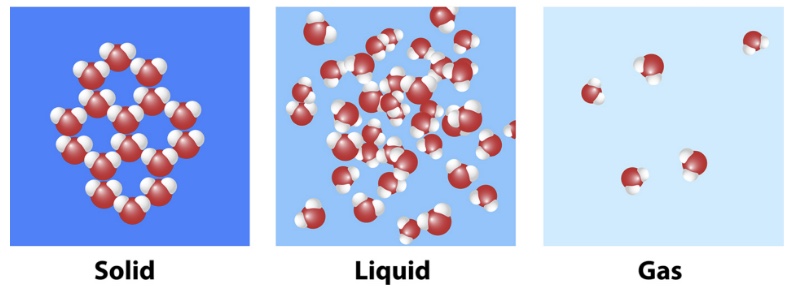
Both liquids and gases are held closer together compared to solids, which creates a stronger attraction between molecules and will have more potential energy.
Solids are held together by strong attractive forces, which increases the amount of potential energy between molecules in the substance.
Gases are held together very loosely, which increases their attractive force between molecules and potential energy.
Liquids are held together by very strong attractive forces, which will decrease the amount of potential energy between molecules in the substance.
A chemist is conducting an experiment on a system. At the beginning of the experiment, the chemist wants to determine the temperature of the system.
The system has a definite volume but no definite shape. Which of the following is most likely also true for the system?
The molecules in the system have more kinetic energy than a solid.
Heat flow into the system would eventually cause it to have a definite shape.
The molecules are held together by stronger attractive forces than a solid.
The molecules in the system have less kinetic energy than a solid.
A teacher has given a group assignment to classify certain things as matter or energy. Most of the students in the group have decided on the following classification:

Matter: atoms, sugar, water, air
Energy: heat, potential, kinetic, sound

However, there is one student who is arguing that all of the things listed in both categories can be classified as energy, and so that must mean that they can all be classified as matter, too.

Which of the following provides the best scientific explanation as to why the things classified as energy are not also classified as matter?
Energy makes matter move, and the things classified as energy only make matter move.
The things classified as matter are only used to generate energy.
You cannot hold the things classified as energy, so that must mean they cannot be classified as matter.
All matter has mass and occupies space, and the things classified as energy do not have mass and do not take up space.