1.8/1.9 Primary Productivity/Trophic Levels
star
star
star
star
star
Last updated about 1 year ago
16 Nsɛmmisa
1
1
1
1
1
1
1
1
1
1
1
1
1
1
1
1
What is the formula for Primary productivity?
Objective: To visualize the intangible concept of energy (First and Second Laws of Thermodynamics) using a concrete process, a relay race using sand.
1st Law of Thermodynamics: Often called the Law of Conservation of Energy. This Law states that energy cannot be created or destroyed, it just changes forms as it is transferred from one level to another. Thus, the total amount of energy available in any system is constant.
2nd Law of Thermodynamics: As energy changes form, it moves from more useful forms to less useful forms. It gets degraded as it moves from a higher energy state to a lower energy state (usually heat). Energy flows in one irreversible direction. It cannot be recycled or reused.
This law also predicts entropy. Entropy is the measure of disorder in a system. Because heat is lost when energy is transferred, entropy always increases with time. Eventually, because of the 2nd Law of Thermodynamics, energy in the Universe is becoming less useful over time.
In this activity, you will run a relay race.
· Divide into two groups, and line up facing each other. Spread out slightly more than arm’s length apart.
· Groups should be sorted from the tallest to the shortest. The tallest person likely has the largest hands, and the shortest the smallest.
· Each group represents a “food chain.”
· The person with the biggest hands (can hold the most energy) goes first. The person with the smallest hands goes last.
Procedure:
1. Record the original volume of the sand in the beaker in Table 1.
2. One person in each group will be the timer. Set a stopwatch to zero.
3. Start time, and the Timer will pour the entire beaker of sand onto the hands of the First Person. First Person moves as fast as possible to pass the sand to the Next Person in line, all the way to the Last Person. Try to beat the row across from you! Best time wins!
4. Last Person holds onto the sand. Pour it back in the beaker and bring it inside. We will measure and record the new volume in Table 1. Timer records end time in Table 2.
Fill out the data table
Which of the following is an accurate representation of the flow of energy in an ecosystem?
What does the arrow signify in the question above?
A trophic level is each of several hierarchical levels in an ecosystem, comprising organisms that share the same function in the food chain and the same nutritional relationship to the primary sources of energy.
Sunlight is NOT a trophic level.
The first trophic level is always the primary producer. These are plants (autotrophs) that use photosynthesis to produce their own food.
The second trophic level is always the primary consumer. These organisms are always herbivores or organisms that consume plants in order to get food.
The third trophic level is always the secondary consumer. These organisms are always carnivores or organisms that consume animals in order to get food.
The forth trophic level is always the tertiary consumer. These organisms are always carnivores or organisms that consume animals in order to get food.
Sometimes there is a fifth trophic level which is the quaternary consumer. These organisms are always carnivores or organisms that consume animals in order to get food.
Midge Larva (Eats: Algae)
Cord Grass (plant)
Herring Gull (Eats: Blue Crab)
Blue Crab (Eats: Periwinkle Snail)
Damselfly Nymph (Eats: Midge Larva)
Green Algae (plant)
Juvenile Steelhead Fish (Eats: Damselfly Nymph)
Periwinkle Snail (Eats: Cord Grass)
Resequence these in order of a food chain.
Green Algae (plant)
Midge Larva (Eats: Algae)
Damselfly Nymph (Eats: Midge Larva)
Juvenile Steelhead Fish (Eats: Damselfly Nymph)
Resequence these in order of a food chain.
Blue Crab (Eats: Periwinkle Snail)
Periwinkle Snail (Eats: Cord Grass)
Herring Gull (Eats: Blue Crab)
Cord Grass (plant)
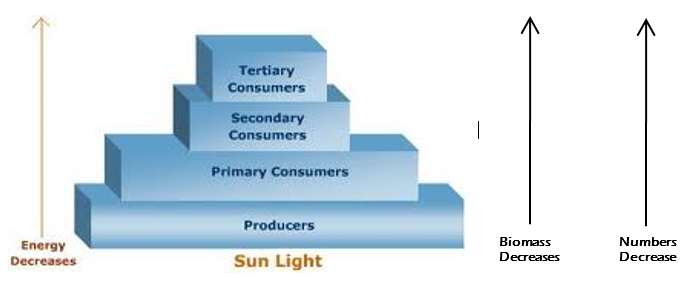
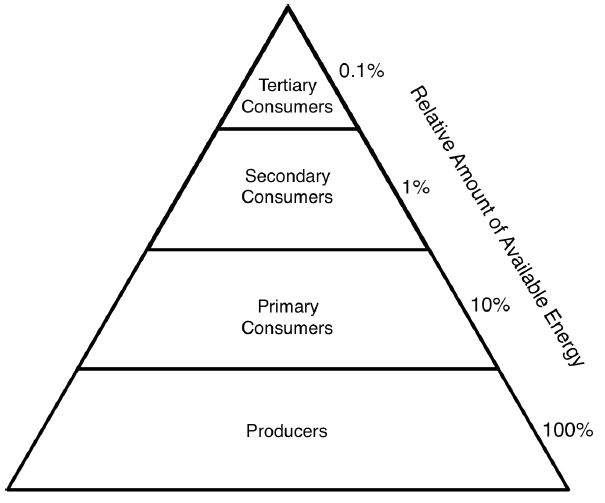
Only a small fraction of energy available at any trophic level is transferred to the next trophic level. That fraction is estimated to be about 10 percent of the available energy. The other 90 percent of the energy is needed by organisms at that trophic level for living, growing, and reproducing.
This relationship is shown in the energy pyramid above. It suggests that for any food chain the primary
producer trophic level has the most energy and the top trophic level has the least.
1st Law of Thermodynamics: Often called the Law of Conservation of Energy. This Law states that energy cannot be created or destroyed, it just changes forms as it is transferred from one level to another. Thus, the total amount of energy available in any system is constant.
2nd Law of Thermodynamics: As energy changes form, it moves from more useful forms to less useful forms. It gets degraded as it moves from a higher energy state to a lower energy state (usually heat). Energy flows in one irreversible direction. It cannot be recycled or reused.
This law also predicts entropy. Entropy is the measure of disorder in a system. Because heat is lost when energy is transferred, entropy always increases with time. Eventually, because of the 2nd Law of Thermodynamics, energy in the Universe is becoming less useful over time.
Why is a pyramid an effect model for quantifying energy flow?
Using the rule of 10% in energy transfer, determine the amount of energy the primary consumer would have if the producer started with 3,500,000 kilocalories of energy.
Using the rule of 10% in energy transfer, determine the amount of energy the secondary consumer would have if the producer started with 3,500,000 kilocalories of energy.
Using the rule of 10% in energy transfer, determine the amount of energy the tertiary consumer would have if the producer started with 3,500,000 kilocalories of energy.
What happens to energy that is not passed on to the next trophic level?
Which law describes the process of energy being lost as heat as it moves up the trophic levels?
What is the source of energy for almost all trophic pyramics on Earth?
Explain how does the available energy at the producer level affect the population sizes of organisms at different trophic levels?
Based on your understanding of the laws of energy, explain why is it so important to protect producers?