1.1 Intro to Ecosystems
star
star
star
star
star
Last updated about 1 year ago
10 Nsɛmmisa
1
1
1
1
1
1
1
1
1
1
Use the "squiggy line" tool to write in a +/-/X/0 for the effect that the relationship has on each species.
Match the relationship with its category. 3 in each category.
Two male lions fight overa female lion.
A pack of wolves and a bear fight over a dead deer.
A praying mantis stalks a grasshopper.
Oxpeckers eat ticks and parasites off of water buffalo for food and the water buffalo are free of parasites.
A butterfly drinks nectar from a flower and the flower gets pollinated.
Spring WoodsTigers vs. Northbrook Raiders
A fungus grows underneatha tree’s bark and causes the tree to grow slowly.
A tapeworm lives in the intestines of a human stealing nutrients and the human is sick and loses weight.
Barnacles live on the skin of whales so they can eat and travel to new environments. The whale is neither helped nor harmed.
Fleas suck blood from a cat.
Lichens grow on trees and are protected. The tree is not affected.
Ants milk aphids for honeydew (food) and the aphids are protected from predators by the ants.
A blue jay bird pulls an earthworm out of the ground and eats the earthworm
Harmless eyelash mites live in your eyelash follicles/roots
A lion chases, catches, kills, then eats a zebra
Mutualism
Commensalism
Predation
Competition
Parasitism
Describe how can niche partitioning increase biodiversity?
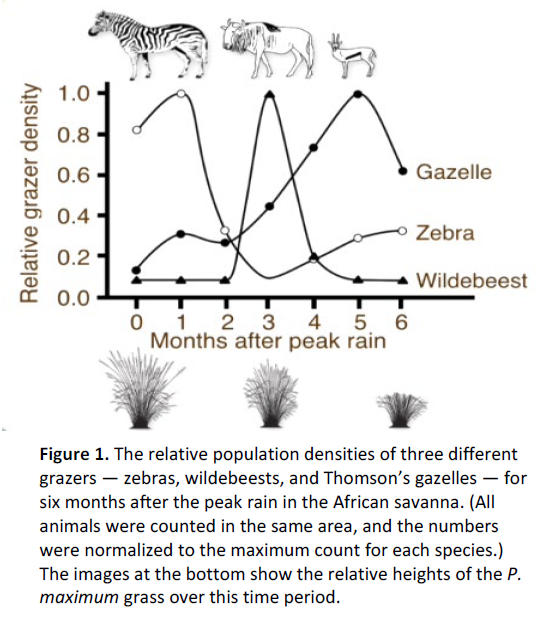
Niche Partitioning by Time and Grass Height
One type of niche partitioning in the savanna is shown in Figure 1. The resource partitioned in this example is a typical savanna grass called Panicum maximum. This grass’s growing season starts after the peak rain and continues for six months. When the grass is tall, it has lots of stems, which are relatively low-quality food for herbivores. The more nutritious parts of the grass are closer to the ground. If a grass-eating herbivore, or grazer, eats the top of the grass, the new parts of the grass that grow back are also more nutritious.
Figure 1 shows three types of grazers — zebra, wildebeest, and Thomson’s gazelle — that graze, or eat, this grass over time. Zebras, the first grazers to use this resource, thrive when the grass is tall and abundant, even if it is less nutritious. The zebras have paired upper and lower teeth that help them bite off tall stems on the tops of the grass.
Zebras can also digest food much more quickly than the other two grazers. This is because wildebeests and Thomson’s gazelles are ruminants, mammals with four-chambered stomachs that take longer to digest food. Sometimes ruminants must also regurgitate and rechew partly digested food before they can fully digest it.
However, when the ruminants digest their food (via fermentation in the foregut), they take up more nutrients and proteins than when zebras digest food (via fermentation in the hindgut). So, a ruminant can extract more energy from a smaller amount of food if that food is more nutritious. Smaller ruminants, such as Thomson’s gazelles, need less energy than larger ruminants, such as wildebeests.
Describe how the relative zebra density changes over time.
Explain which characteristics of zebras could explain why zebra densities are greatest when the P. maximum grass is tallest and most abundant?
Describe how the relative wildebeest density changes over time.
Make a claim why the relative wildebeest density spikes when it does. Support your idea with evidence from what you know about wildebeests and P. maximum grass. (Hint: Remember that the more nutritious parts of the grass are closer to the ground. The grasses continue to grow after being grazed, and the parts that grow back are also more nutritious.)
Describe how the relative Thomson’s gazelle density changes over time, in relation to the changes in the relative wildebeest density and in the grass height. Why do you think this is so?
Would you describe the interactions between zebras, wildebeests, and Thomson’s gazelles as competition or facilitation among species? Support your answer with data from Figure 1.
Using the back of the half sheet you received, draw a picture of resource partioning.