Log in
Sign up for FREE
arrow_back
Library
Law and Justice Unit 1 Test
By Carrie Dunn Mayer
star
star
star
star
star
Share
share
Last updated over 1 year ago
50 questions
Add this activity
1
1
1
1
1
1
1
1
1
1
1
1
1
1
1
1
1
1
1
1
1
1
1
1
1
1
1
1
1
1
1
1
1
1
1
1
1
1
1
1
1
1
1
1
1
1
1
1
1
1
Question 1
1.
What does the 'rule of law' principle broadly mean?
Everyone is subject to law, including government officials
Only the poor are subject to law
Everyone is exempt from the law
It governs only the public sector
Question 2
2.
Which statement aligns with the principle of Rule of Law?
Laws are selectively applied
Laws only apply to normal citizens
Laws can be changed without notice
Laws are clear, publicized, stable, and fair
Question 3
3.
What is the purpose of Good Samaritan laws?
To protect individuals who cause emergencies
To protect individuals who aid others in emergency situations
To punish individuals who don't help in emergencies
To provide financial support for persons hurt in emergencies
Question 4
4.
What is the bystander effect in social psychology?
Increased likelihood of help as witness numbers decrease
Increased aggression when in crowds
Decreased empathy during accidents
Decreased likelihood of help as witness numbers increase
Question 5
5.
Which case from the 1960s is cited as an example of the bystander effect?
The Fidel Castro's takeover
The assassination of Martin Luther King Jr.
The Stanford prison experiment
The murder of Kitty Genovese
Question 6
6.
What is the primary function of legislative bodies?
To interpret laws
To make laws
To judge individuals
To enforce laws
Question 7
7.
What is the first step in the lawmaking process?
Bill is proposed
Bill is passed by local authorities
President signs off the bill
Supreme Court reviews the bill
Question 8
8.
What is the last step in the lawmaking process in the United States?
Bill is accepted by Supreme Court
Bill is signed by the President
Senate votes on the bill
Bill is introduced in the House
Question 9
9.
Who enacts the Kentucky Revised Statutes?
Kentucky citizens
Kentucky General Assembly
Supreme Court of Kentucky
U.S. Congress
Question 10
10.
What does 'Kentucky Revised Statutes' refer to?
Laws currently in effect in Kentucky
Kentucky's constitution
Federal laws of USA
Historical laws of Kentucky
Question 11
11.
What is a 'Statute'?
An informal community rule
A formal written enactment by a legislative body
An Executive order
A court ruling
Question 12
12.
What is the meaning of 'precedent' in legal terms?
Action that precedes a court decision
Predicting the outcome of a case
Order issued by a judge
Past ruling providing a guideline for future similar cases
Question 13
13.
Who typically brings charges in a criminal case?
The defendant
The state or government
A private attorney
The victim
Question 14
14.
What is the burden of proof in a criminal trial?
Substantive evidence
Beyond a reasonable doubt
Preponderance of the evidence
Clear and convincing evidence
Question 15
15.
What is the primary focus of civil law?
Issues pertaining to human rights
Enforcement of state laws
Criminal offenses
Disputes between individuals
Question 16
16.
Which one is NOT a matter usually addressed under civil law?
Serious crimes like murder
Property disputes
Divorce proceedings
Contract breaches
Question 17
17.
What is a felony?
A misdemeanor crime
A crime that results in financial penalties only
A type of civil case
A serious crime punishable by at least one year in jail
Question 18
18.
Which of the following is typically considered a felony?
Public intoxication
Murder
Speeding
Trespassing
Question 19
19.
What is the maximum sentence for a felony crime?
1 year in jail
6 months in jail
Life imprisonment or death
5 years in prison
Question 20
20.
What is a misdemeanor?
A minor wrongdoing or petty crime
A serious crime like murder
An action taken to seek justice
A minor civil dispute
Question 21
21.
Which is a common punishment for a misdemeanor?
Capital punishment
Lifetime imprisonment
None, it's not punishable
Fine or short jail time
Question 22
22.
Who is a plaintiff in a law case?
The judge presiding over a case
The lawyer defending a case
The party who initiates a lawsuit
The person accused in a case
Question 23
23.
What is mediation in the context of law?
A process to resolve disputes outside the courtroom
A method of directing court proceedings
A law that all cases have to follow
A process only used in criminal cases
zoom_in
Question 24
24.
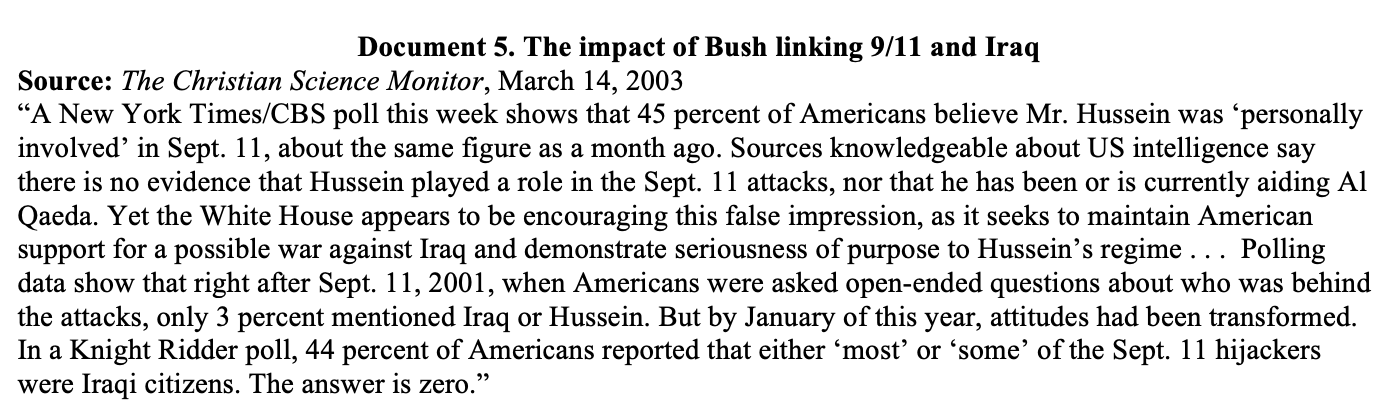
According to the document above from March 2003, what was the White House's reported stance towards Saddam Hussein's involvement in Sept. 11 attack?
No clear stance
Encouraging the false impression
Denying any involvement
Confirming definite involvement
Question 25
25.
According to the document above, how many of the Sept. 11 hijackers were actually Iraqi citizens?
Most
Zero
Some
All
Question 26
26.
Why was the Bush Administration trying to link Iraq to the 9/11/01 events?
Saddam Hussein was Bin Laden's ally
Iraq had already declared war on the US
Saddam Hussein claimed responsibility for 9/11
To justify the US invasion of Iraq
zoom_in
Question 27
27.
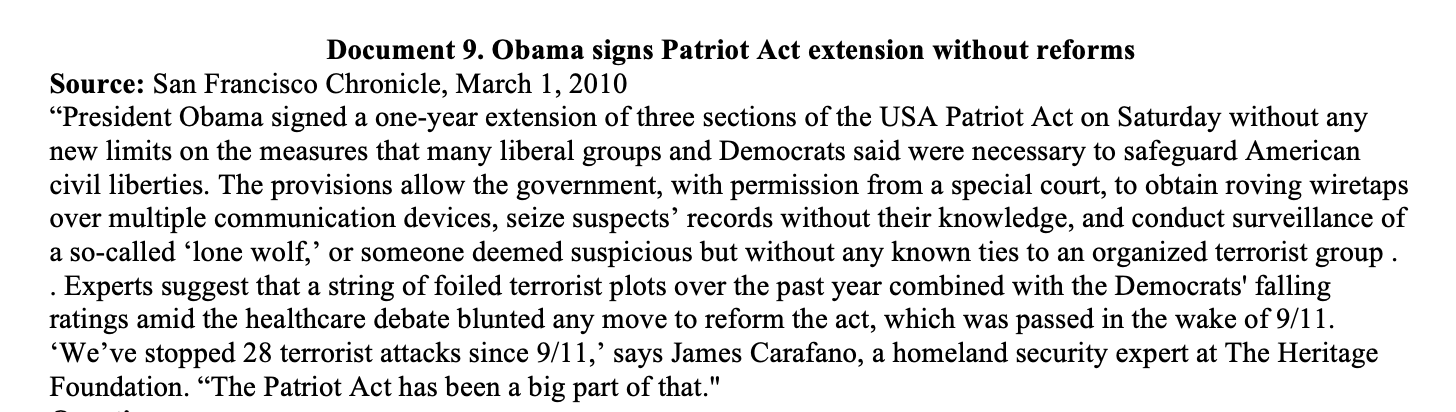
What did President Obama extend without new limits?
The National Defense Authorization Act
The Trade Promotion Authority Act
The Affordable Care Act
Three sections of the USA Patriot Act
Question 28
28.
What do the provisions of the extended act allow the government to do?
Deport suspects without trial
Obtain roving wiretaps, seize records, and conduct surveillance
Conduct military operations on US soil
Abolish civil liberties
Question 29
29.
What is a ‘lone wolf’ according to the context of the USA Patriot Act?
A leader of a terrorist cell
A single activist advocating for constitutional rights
An independent US citizen
A person deemed suspicious but without known ties to organized terrorism
Question 30
30.
Why, as the experts suggest, was there no move to reform the Patriot Act?
Due to Republican opposition
Foiled terrorist plots and falling Democratic ratings among reasons
Due to President Obama's decision
Because it was beneficial to civil liberties
Question 31
31.
What does the term 'actus reus' refer to in criminal law?
The physical act of committing a crime
The intent to commit a crime
The scene of a crime
The punishment for a crime
Question 32
32.
Which of the following can be seen as an actus reus in a hit and run case?
A person having a history of reckless driving
A person thinking about hitting a car
A person hitting someone's car and fleeing the scene
A person telling others about hitting a car
Question 33
33.
What does the term 'mens rea' refer to in criminal law?
Physical mark of crime
Forensic analysis
Body of evidence
Guilt mind or intent to commit crime
Question 34
34.
What is the primary difference between mens rea and actus reus?
One is physical, the other is verbal
One refers to intention, the other to action
One is crime scene, the other is courtroom
One involves victims, the other doesn't
Question 35
35.
Who prosecutes criminal cases?
anyone
the government
the military
only citizens
Question 36
36.
What is a principal in crime?
The person directly responsible for the crime
The victim of the crime
The judge ruling over the case
The person who reported the crime
Question 37
37.
What is an accomplice in the context of crime?
A person who reports a crime
A person who helps another in committing a crime
A person who is victim of a crime
A person monitoring the crime scene
Question 38
38.
Which of these is a common action of an accessory after the fact?
Helping the criminal to escape detection
Signaling the criminal to start the crime
Taking part in the crime themselves
Paying off the victim
Question 39
39.
In which of the following scenarios could a conspiracy crime occur?
One person embezzling money from a company
A spontaneous bar fight
A person stealing a purse
Three friends plotting to rob a store
Question 40
40.
Which is an example of first-degree murder?
Planning and executing a fatal robbery
Unplanned fight leading to death
Hit and run accident
Accidental discharge of firearm leading to death
Question 41
41.
What distinguishes first-degree and second-degree murder?
The method of killing
The culprit's prior criminal record
The victim's identity
The premeditation in first-degree murder
Question 42
42.
What is involuntary manslaughter?
Organized crime
Theft leading to death
Unintended killing due to negligent actions
Premeditated murder
Question 43
43.
What does the crime 'kidnapping' involve?
Taking someone against their will
Bugging a phone
Borrowing something without asking
Digital theft
Question 44
44.
What does the term 'cyberstalking' refer to?
Tracking someone's physical location using technology
Hacking into governmental databases
Buying things online without permission
Harassment or stalking of someone online
Question 45
45.
What is the primary factor that defines statutory rape?
Age of consent
Victim's gender
Use of weapons
Violence involved
Question 46
46.
Why would consensual sex with a minor constitute statutory rape?
Minors legally can't give consent
It usually involves violence
Parents can't approve of the relationship
Minors always resist sexual activity
Question 47
47.
Which of the following would be an example of vandalism?
Spray painting graffiti on a wall
Breaking into a house
Stealing a car
Cyber hacking
Question 48
48.
What is essential in the definition of robbery that is generally lacking in larceny?
Just taking without permission
Presence and threat of physical harm
Use of a weapon regardless of threat
Stealing in secret
Question 49
49.
If someone steals your bike from your garage without you being aware, what crime was committed?
Burglary followed by robbery
Assault
Robbery
Larceny
Question 50
50.
Which of the following cases will NOT typically classify as 'receiving stolen property'?
A person purposefully purchases stolen electronics online
A person unknowingly buys stolen goods from a garage sale
A person knowingly purchases a stolen bike from a friend
A pawn shop knowingly buys stolen jewelry