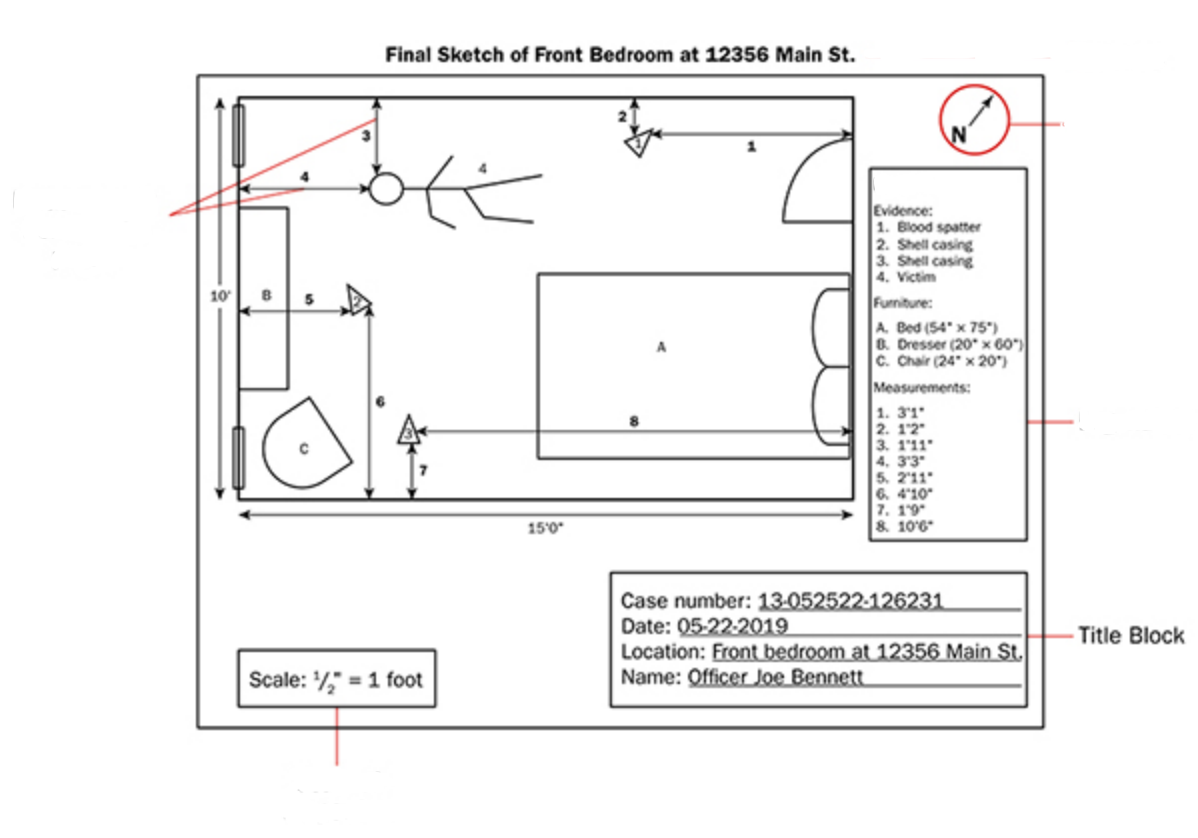
Drag the correct labels onto the crime scene sketch below!
Mmuae Afoforo a Wobɛpaw:
distance scale
true north
measurement from 2 fixed points
legend
This is your opportunity to show off what you've learned about evidence collection and crime scene processing - WOOOOO!!!
This is your opportunity to show off what you've learned about evidence collection and crime scene processing - WOOOOO!!!
Locard’s Principle of Exchange states that cross-transfers provide useful evidence as well as clues that indicate when the exchange occurred.
It is the duty of the first responding law enforcement officer to secure the crime scene.
Detectives document the crime scene in detail and collect physical evidence.
Crime scene reconstruction involves ______.
Evidence that is consistent when it is retested and was properly collected and analyzed using accepted protocols is considered _____.
Knowing the shoe size of a bloody footprint tells us that someone with that shoe size was at the scene, allowing us to exclude persons with other shoe sizes, which is an example of _____.
Crime scenes that are staged will contain evidence that is _____.
Trace evidence from brushing past a pot of flowers will be _____.
A(n) ______, also called a druggist's fold, is used for packaging evidence that has been allowed to air dry.
A person is accused of breaking into someone else's backyard and stealing avocados last night. Select all of the following choices that are forms of direct evidence against the suspect:
Select all of the following options that are examples of physical, trace evidence:
List the 7 S's of crime scene investigation in order (top to bottom).
Sketch the scene
See the scene (photograph evidence)
Search the scene
Scan the scene
Secure the scene
Separate the Witnesses
Secure the evidence
Saliva is a type of ________ evidence because it contains DNA that identifies a unique individual.
The 2nd part of Locard's Principle of Exchange implies that _______.
A crime-scene sketch should include all of the following except
A suspect is linked to a murder by the presence of hair found on a chair at the victim’s house and a fingerprint found on the coffee table. Crime-scene investigators found a fingerprint consistent with a suspect’s fingerprint, and they found the hair to be similar to the hair from the head of the same suspect. Provide arguments supporting the claim that this evidence is not sufficient to prove the suspect was the murderer. Include the following terms in your answer:
Circumstantial evidence
Class evidence
Individual evidence
Direct evidence
Drag the correct labels onto the crime scene sketch below!
A struggling forensics student is attempting to scale down their triangulation measurements. Using a scale of 0.25 inches = 1 foot, how many inches should the 5' and 11' lines be when sketched by the student? Type your answer as a decimal.
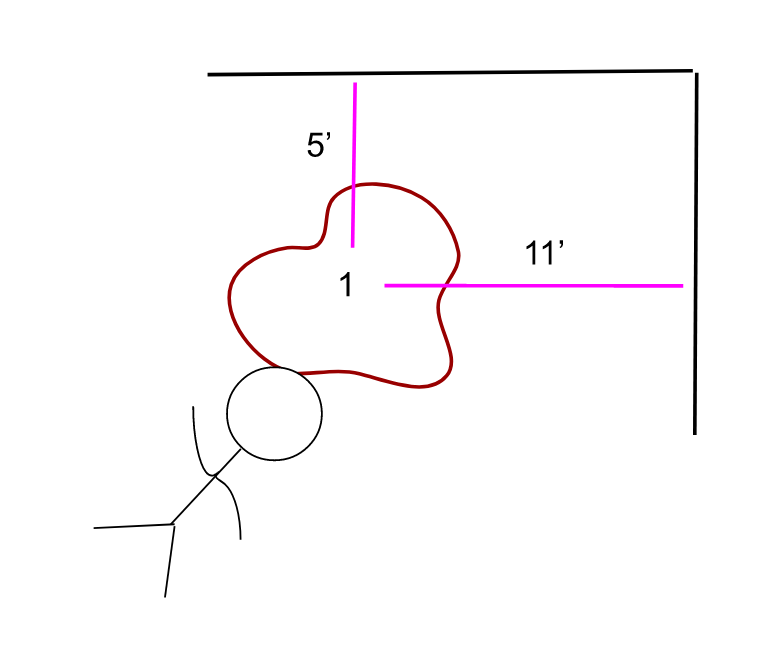
5' =>
11' =>