Log in
Sign up for FREE
arrow_back
Library

LT 1.2 Macromolecules Quiz

star
star
star
star
star
Last updated over 1 year ago
10 questions
Required
1
1.2a
Required
1
1.2a
Required
1
1.2a
Required
1
1.2a
Required
1
1.2a
Required
1
1.2b
Required
1
1.2b
Required
1
1.2b
Required
1
1.2b
Required
1
1.2b
Question 1
1.

Question 2
2.

Question 3
3.

Question 4
4.

Question 5
5.

Question 6
6.

Question 7
7.

Question 8
8.

Question 9
9.

Question 10
10.

Unlike carbohydrates and fats, proteins contain what element?
Oxygen
Nitrogen
Hydrogen
Carbon
A macromolecule is insoluble in water and made mostly of carbon and hydrogen atoms.  What is this molecule?
Carbohydrate
Protein
Nucleic acid
Lipid
Students were given a list of seven elements and asked to identify the four elements that are the most abundant in macromolecules.  Which table correctly identifies the four most abundant elements in macromolecules.
Which correctly shows the elemental ratio of carbohydrates?
1H: 2C: 2O
1C: 2H: 1O
1O : 2C: 1H
1C: 2H : 2O
A store sells a variety of sets for building molecular models. The sets are described by the diagram below.
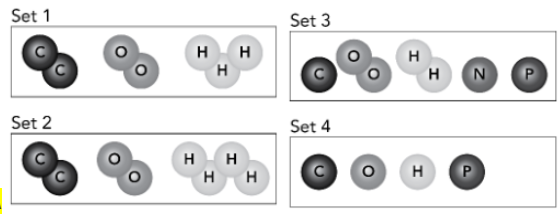
Which change to one of the kits would make it more useful for modeling proteins?
Set 2, add a box for sulfur (S) atoms
Set 3, replace the box of phosphorous atoms (P) with a box of sulfur (S) atoms
Set 1, add a box for phosphorous (P) atoms
Set 4, replace the box of oxygen (O) atoms with a box of nitrogen (N) atoms
You are given 4 test tubes containing purified biological macromolecules. The test tubes are unlabeled except for a number between 1 and 4. You are told that one test tube contains a protein, one contains a lipid, one contains a carbohydrate, and one contains a nucleic acid. You then perform some tests on the macromolecules and collect the following information.
  • Test tubes #2 and #4 contain nitrogen, but the other tubes do not
  • Test tube #3 is not soluble in water, but the other tubes are soluble in water
  • The contents of tube #1 can be broken down into monomer subunits of C, H, and O in a 1:2:1 ratio
  • Test tube #4 contains phosphorus, but the other tubes do not

Based on the data you collected choose the correct identity of each test tube.
#1 – carbohydrate, #2 – nucleic acid, #3 – lipid, #4 – protein
#1 – lipid, #2 – nucleic acid, #3 – protein, #4 – carbohydrate
#1 – carbohydrate, #2 – protein, # 3 –lipid, #4 – nucleic acid
#1 – lipid, #2 –carbohydrate, #3-nuclic acid, #4- protein
Which of the following is the monomer of a protein?
nucleotide
fatty acid
amino acid
monosaccharide
In addition to serving as waterproof coverings or as parts of biological membranes, lipids:
store energy for long periods of time.
supply immediate energy for chemical reactions.
store glucose and other sugars for short periods of time.
transmit hereditary information.
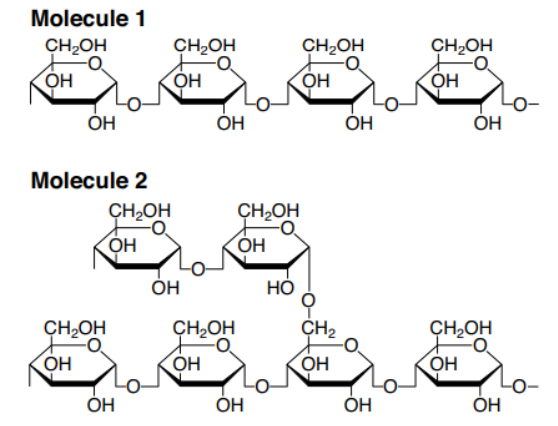
The structural formulas shown below represent parts of two different complex macromolecules. Molecules 1 and 2 differ in their overall structure.


Due to the differences in structure, each of these molecules most likely...
is composed of different molecular bases
performs a different function
contains different elements
performs a different protein
Athletes are often concerned with the question of how much protein they need in their diets because of the requirement of growing muscles for protein. Just as muscles need the basic building block of protein, protein itself has basic building blocks. Which of the following are the basic building blocks of protein?
nucleotides
amino acids
simple sugars
monosaccharides