Log in
Sign up for FREE
arrow_back
Library

LT 1.3a Enzyme Quiz

star
star
star
star
star
Last updated over 1 year ago
5 questions
1
1.3a
1
1.3a
1
1.3a
1
1.3a
1
1.3a
Question 1
1.

Draggable itemarrow_right_altCorresponding Item
arrow_right_alt
arrow_right_alt
arrow_right_alt
arrow_right_alt
arrow_right_alt
Question 2
2.

Question 3
3.

Question 4
4.

Question 5
5.

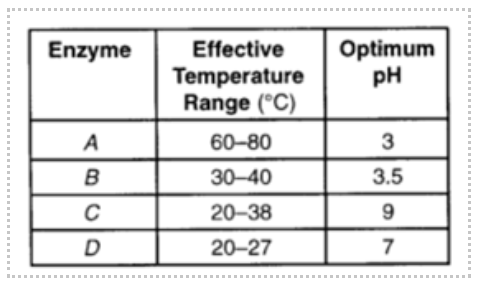
According to the data table below the table shows the optimum conditions of temperature and pH for enzyme A, B,C & D. What would happen if you were asked to move enzyme B and put it with enzyme A conditions? Explain your answer in complete sentences using CER strategy.

Match the letters in this chemical reaction to their part of the enzyme mediated chemical reaction in the diagram.
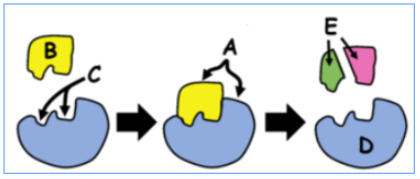
C
enzyme-substrate complex
A
substrate(s)
E
active site
B
enzyme
D
product(s)
An enzyme, amylase, will affect the breakdown of carbohydrates, but it will not affect the breakdown of proteins. Which of the following can explain this kind of relation between enzyme and substrate?
Proteins are diverse in their structure and function, but carbohydrates are limited in shape and structure.
The substrate shape always has amino acids that interact with specific enzyme’s active site.
Enzymes are made of carbohydrate, so the active site can interact only with carbohydrates.
The enzyme active site has a specific sequence of amino acids that form a specific shape that interacts with specific molecules.
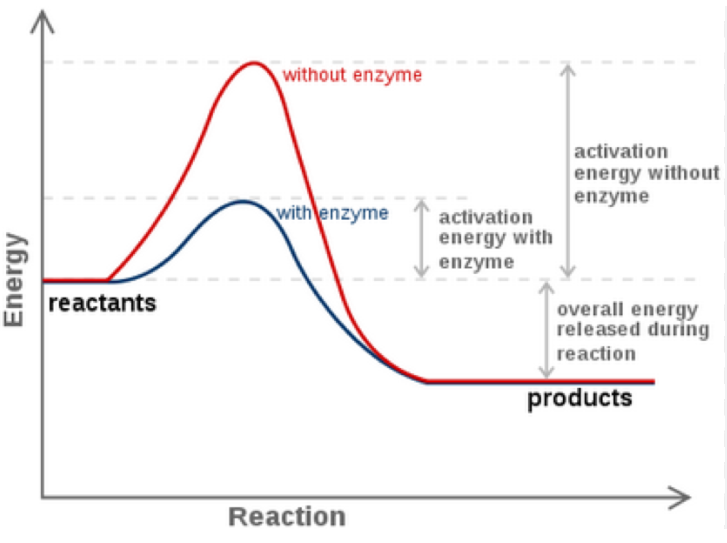
The diagram represents the energy levels that are involved in a biochemical reaction. Which statement about the effects of the enzyme on this reaction is correct?
The enzyme will decrease the activation energy and speed up the rate of the reaction.
The enzyme will not affect the activation, energy, or the rate of the reaction.
The enzyme will release the activation energy and slow down the rate of the reaction.
The enzyme will increase the activation energy and speed up the rate of the reaction.
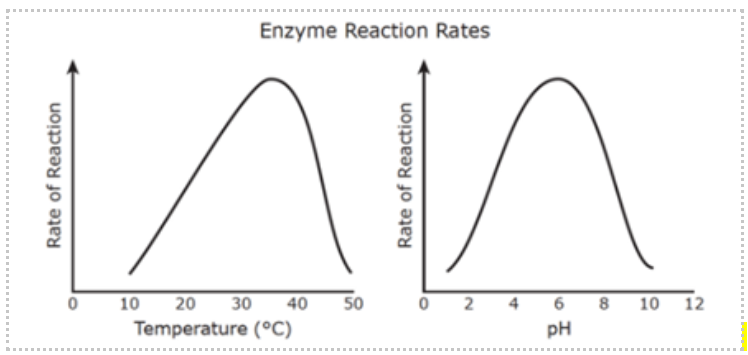
The graphs below show the reaction rate for an enzyme across a range of temperatures and pH. Based on the graphs, this enzyme functions best at what temperature and pH?

Temperature of 36 ℃ and pH of 6
Temperature of 30 ℃ and pH of 8
Temperature of 36  ℃ and pH of 4
Temperature of 25 ℃ and pH of 4