2
2
2
2
2
2
¿Qué le gusta hacer a ella? (2 actividades)
¿Qué le gusta hacer a ella? (2 actividades)
¡Hola! This year, we have learned to talk about four different topics in Spanish. They are:
✔ Greetings, introductions, and the Spanish basics (alphabet, numbers, time, seasons, months, days)
✔ Your Spanish identity and how to discuss what you and your friends are like
✔ What you and your friends like to do and do not like to do (verbs)
✔ School life (your classes, school, school supplies, and classroom objects)
Each section of this test is based around one of these four core units. As you move through each section, be sure to work slowly and carefully. As I’ve mentioned before, small errors occur when you rush through the questions. If you’re not positive how to spell a vocabulary word, do your best.
✔ Remember, it is most important that you communicate your answers clearly. Re-read your work and make sure it sounds correct as you read it over.
The situation for every tasks in this test: You’re in college, and you have just received your letter of acceptance to the study abroad program you applied to! You’re going to be studying in Madrid, España. The letter tells you that next week, you will receive a phone call from one of the program’s directors. She is going to ask you some questions to see if you remember the Spanish basics.
¡Buena suerte!
PART A: You’ve just received your first phone call. It’s hard to hear the director, Sra. Molinero over the phone, so you have to ask her how to spell your host mother and father’s first names. Write the letters out as you hear them being spelled. You will hear each name twice.
(Write out the first name you hear in the space below)
(Write out the second name you hear in the space below)
PART B: You also have to write down your host family’s phone numbers. Listen as the director states the numbers out loud and write them in the following spaces. You do NOT have to write the numbers as words.
(Write the phone number on the following line)
(Write the phone number on the following line)
(Write the phone number on the following line)
PART C
La Señora Molinero calls you back from Spain a week later. You pick up the phone. Answer her questions.
PART D: The director reads you a sample schedule of the school. You quickly note what times the different classes are so that you are prepared for your first day. Choose the time that you hear. You will hear each statement twice.
Tienes la clase de español a las _____.
Tienes la clase de historia a las _____.
Tienes la clase de inglés a las _____.
Tienes la clase de biología a las _____.
Tienes la clase de arte a la/las _____.
Tienes la clase de educación física a las _____.
PART E:
You also hear people saying different words that you have learned in Spanish I this quarter. As you hear each word, choose whether it is masculine or feminine. You will hear each word twice.
Choose whether the word you hear is masculine or femenine:
Choose whether the word you hear is masculine or femenine:
Choose whether the word you hear is masculine or femenine:
Choose whether the word you hear is masculine or femenine:
Choose whether the word you hear is masculine or femenine:
PART F:
You finally landed in Spain. Before going anywhere else, you realize that you need to exchange your US dollars for Euros. While waiting in the line, you hear the bank teller calling out different amounts of money. Write down the number that you hear in questions 25 through 29. You will hear each number twice.
PART G: You want to immerse yourself in Spanish, so you find a documentary in which students from different places in Spanish Speaking countries describe what they have in their backpacks.
¿Qué tiene Paola en su mochila? Select all that apply
¿Qué tiene Maria Laura en su mochila? Select all that apply
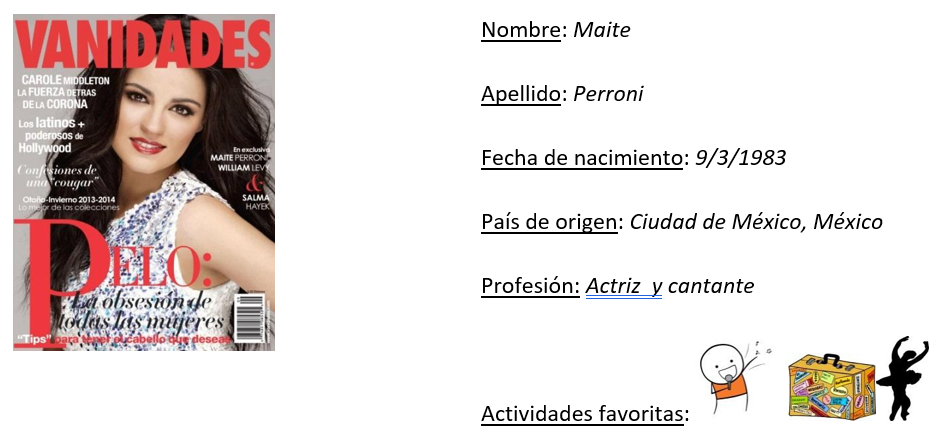
To prepare for your upcoming trip next semester, you pick up a copy of Vanidades, a Spanish magazine. You flip to an interview with the Mexican actress. At the top of the interview, the magazine has written information about her. In complete sentences, answer the following questions about the actress.
¿Qué le gusta hacer a ella? (2 actividades)
PARTE A: Your host sister, Matilda, picks you up at the train station. She’s excited to show you around the city and the school you will be attending. She wants to get to know you as quickly as possible so she asks you a lot of questions in a row. Read her questions below and answer them in Spanish to the best of your ability.
PARTE B: You finally arrive at your host family’s house! After meeting everyone, it’s time for lunch. Matilda’s brother, Francisco, a university student, comes over for lunch with the family. He is talking with Natalia, his little sister, in the kitchen. You overheard their conversation as you are setting the table.
For the following questions, read this conversation between Francisco and his little sister Natalia and respond to the questions in full sentences that follow.
Francisco: ¿Tú conoces (do you know) a mi amigo Manuel?
Natalia: ¿Es español?
Francisco: No, es hondureño. Él es de Copán. Es un muy buen amigo. Es simpático y divertido. También es muy atlético. Le gusta jugar tenis y nadar.
Natalia: ¿Dónde está Copán?
Francisco: Copán está en Honduras.
Natalia: ¿A Manuel le gusta hablar francés o italiano?
Francisco: Él es de Honduras. ¡Le gusta hablar español!
Natalia: ¿A los hondureños les gusta hablar español?
Francisco: Sí, hablan español en Honduras. A veces hablan inglés también.
Natalia: Entonces, ¿A Manuel le gusta mucho jugar tenis en Copán?
Francisco: ¡Sí, mucho!
Natalia: ¡Interesante!, pero a mi no me gusta jugar tenis. ¡Es muy difícil!
¿Cómo se llama el amigo de Francisco?
¿Cuál es la nacionalidad de Manuel?
¿Cómo es Manuel?
PARTE A: Matilda wants to make sure that you are ready for your first day of school. You decide to show her everything in your backpack.
For each item, choose the response with the correct indefinite article (un/una/unos/unas) and the correct vocabulary word that accurately describes the picture. If there are multiple items, make sure they are plural!






PARTE B: Matilda shows you a picture of a typical Spanish classroom so you will know what to expect. Write a description in Spanish of the classroom saying at least 5 items that are in the classroom and 2 items that are not in the classroom. Use the expressions in Spanish for « there is/are » and « there is not/are not »
¿Qué hay en el salón de clase? (Remember to include at least 5 items)
¿Qué no hay en el salón de clase? (Remember to include at least 2 items)
You are asked to get in touch with other exchange students to start making new friends. Look at the notes posted on the program website by four other exchange students to find out about their interests. Select the one most compatible with you and write them an email.
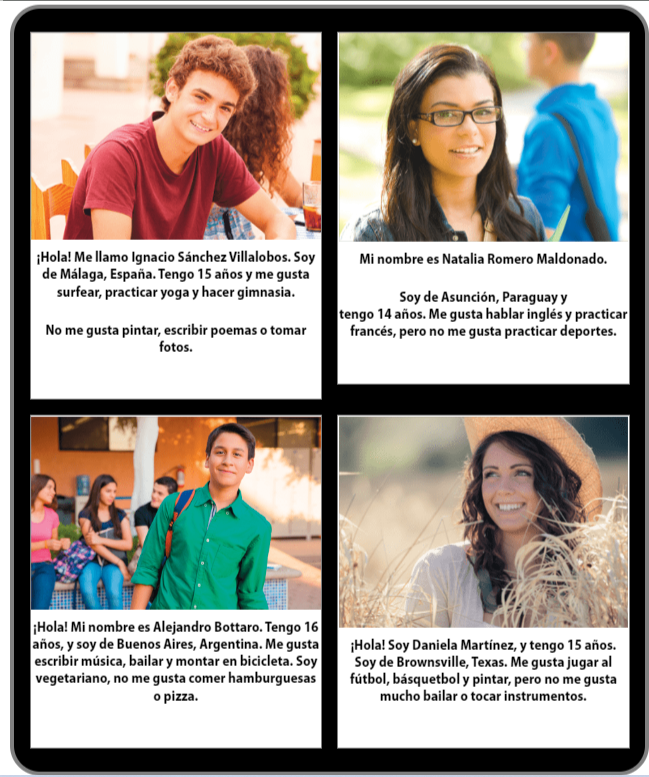
Be sure to cover the following topics:
A greeting
Say your name
Say where you’re from
Tell them what you are like: personality
Comment on the things they like and how it is similar or different to you. Use: A mi también OR A mi tampoco.
Say what you like and don’t like to do and when, when or with who
Say which classes you like and why
Say which classes you don't like and why
Talk about one of your teachers:
- what is his/ her name
- where he/she is from
- his-her personality
10. Ask them: where they are from, how old they are, what they like to do.
11. Say nice to meet you and that you hope to meet them in person soon (Espero conocerte pronto en persona).
12. Say good-bye
Remember: Try to use advanced grammar and vocabulary. If you write the minimum, you will get 16/20 but if you write extra and use complex sentence structures, you can get 20/20.
Example:
I am smart. I am not studious. = 16/20
I am smart sometimes, but I am not studious because my classmates are very social in Spanish class. = 20/20
Write as much as you can and be as descriptive as possible.
(Write your response in the space below)
¿Cómo se llama ella?
¿Cuando es su cumpleaños? *Remember the order of dates in Spanish
¿Cuál es su nacionalidad?
¿De dónde es ella?
¿Cuántos años tiene ella?
¿Qué idioma le gusta hablar a Manuel?
¿A Manuel le gusta jugar tenis?