Log in
Sign up for FREE
arrow_back
Library

Topic 1 States of matter C (solubility)

star
star
star
star
star
Last updated 4 months ago
14 questions
2
Question 1
1.

3
Question 2
2.

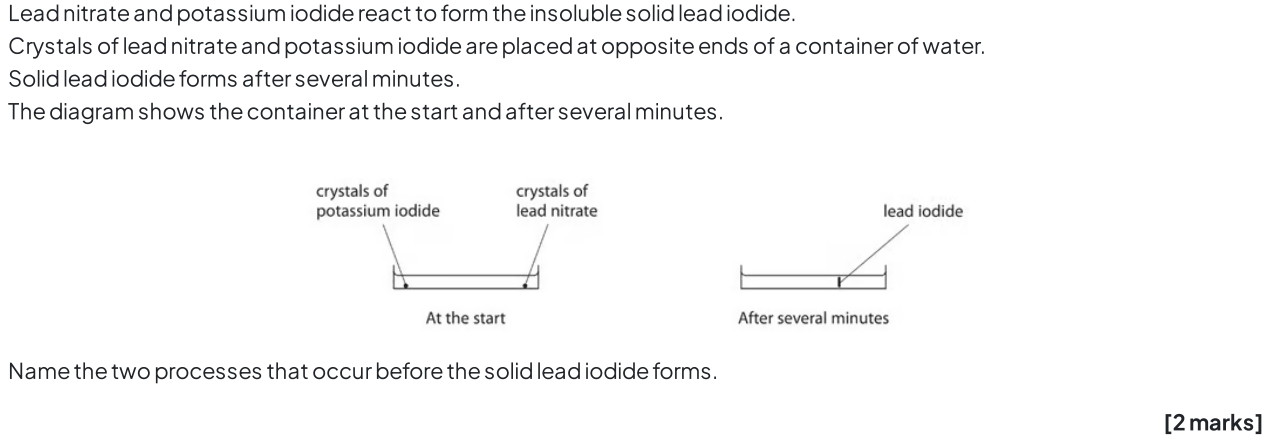
Explain why solid lead iodide takes less time to form when the reaction is repeated using water at a higher temperature.
1
1
1
2
Question 6
6.

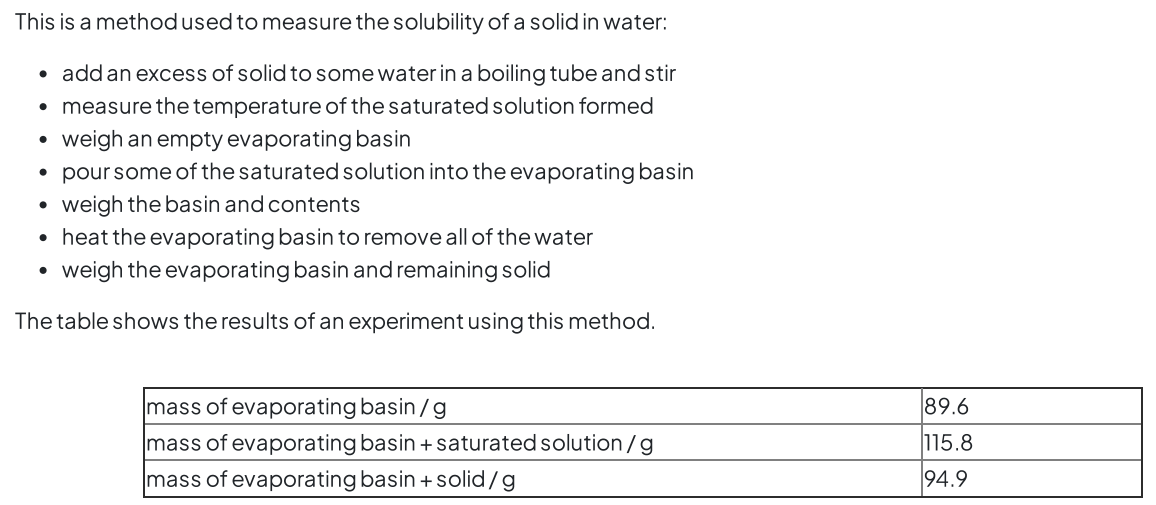
Calculate the mass of solid obtained and the mass of water removed.

2
Question 7
7.

3
Question 8
8.

3
Question 9
9.

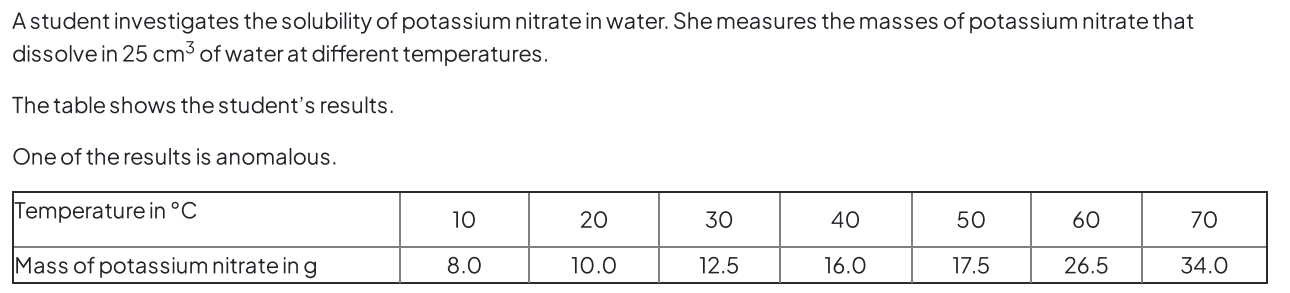
Plot the results on the grid.
Draw a circle around the anomalous result
Ignoring the anomalous result, draw a curve of best fit

2
Question 10
10.

Suggest two possible mistakes that could have caused the anomalous result.

2
Question 11
11.

Use your graph to find the maximum mass of potassium nitrate that dissolves in 25 cm of water at 75 °C. Show on your graph how you obtained your answer.

2
2
Question 13
13.

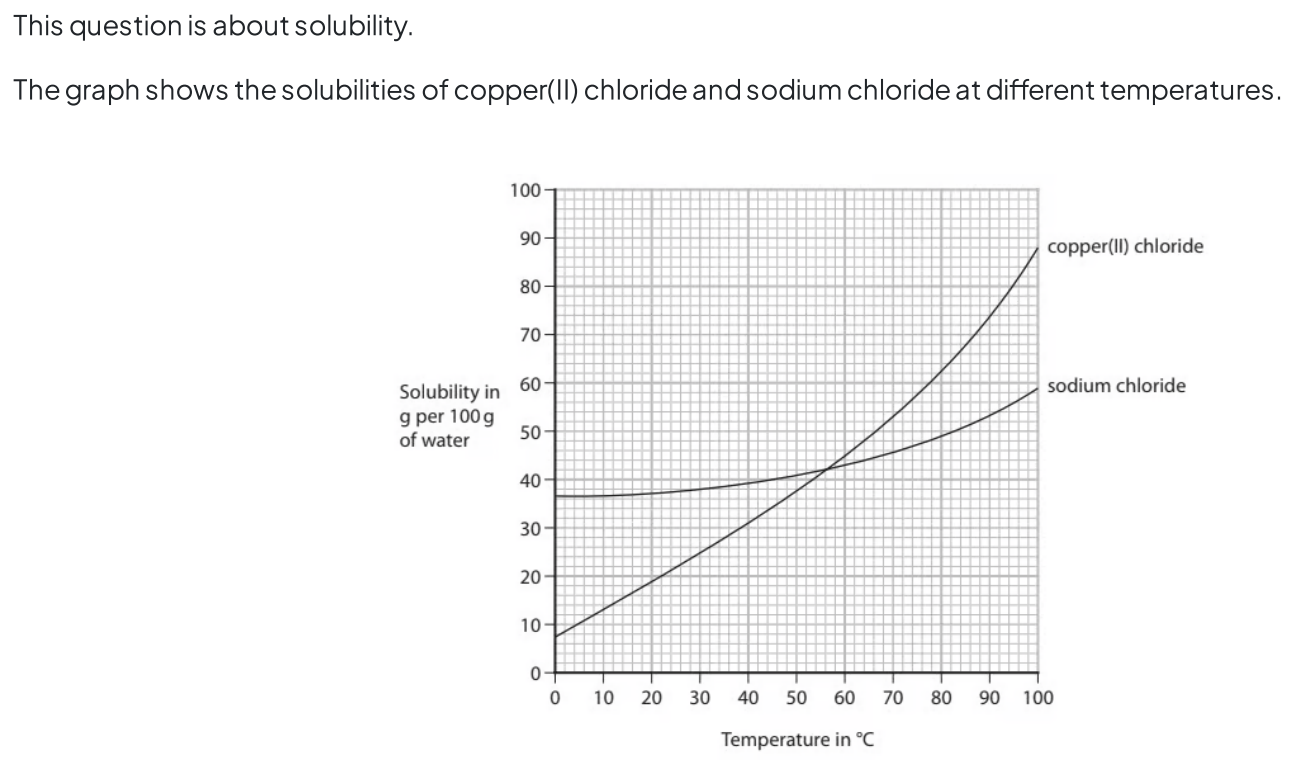
Determine the temperature at which copper(II) chloride and sodium chloride have the same solubility. Show on the graph how you obtained your answer.

2
Question 14
14.

A saturated solution of copper(II) chloride in 100 g of water is cooled from 40 °C to10 °C. Determine the mass, in grams, of copper(II) chloride that crystallises

Question 3
3.

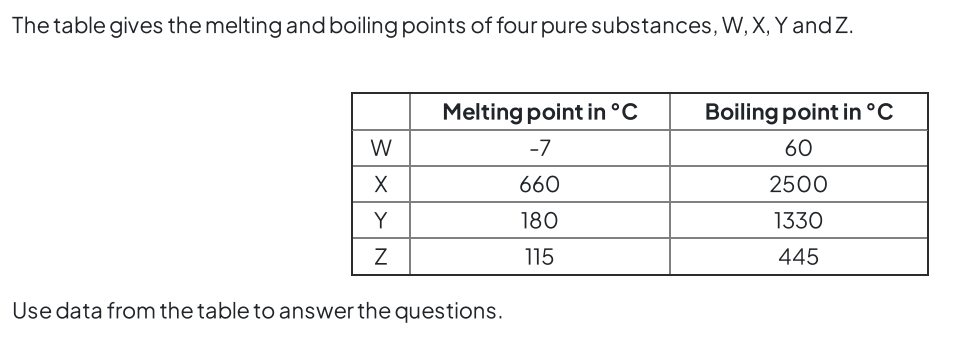
Which substanceis a gas at 100 °C?

Question 4
4.

Which substance is a liquid for the largest range of temperature?

Question 5
5.

Which substance is a liquid at 1000 °C and a gas at2000 °C?

Question 12
12.

Use your graph to calculate the solubility of potassium nitrate in g per 100 g of water at25 °C. [1.0 cm of water has a mass of 1.0 g]