Projectiles are analyzed using their _________ and ___________ components of motion.
Question 2
2.
The shape of a trajectory of a simple projectile is a __________________.
Question 3
3.
3. A ball is thrown through the air. At the top of its path, its vertical acceleration is
Question 4
4.
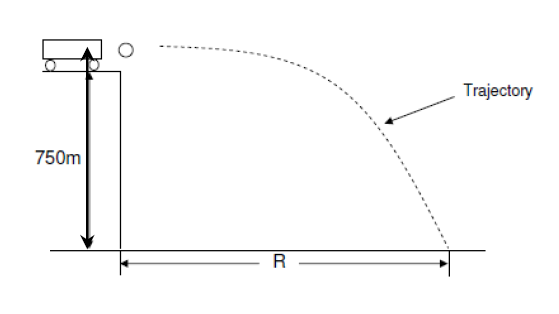
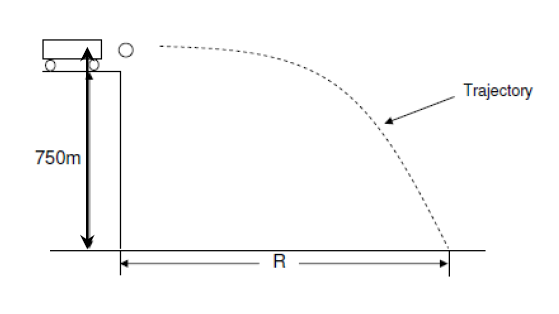
The diagram below shows a cannon firing a cannon ball at 135 m/s horizontally from a height of 750 meters.
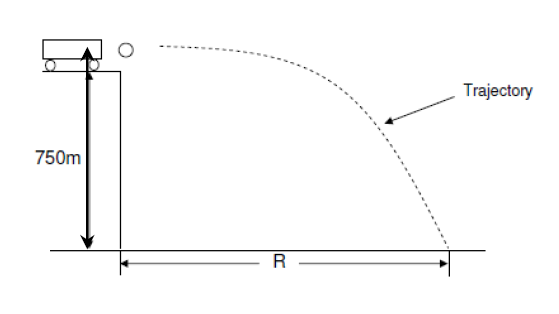
What is the initial velocity of the cannon in the “y” direction (vertical velocity)?
Question 5
5.
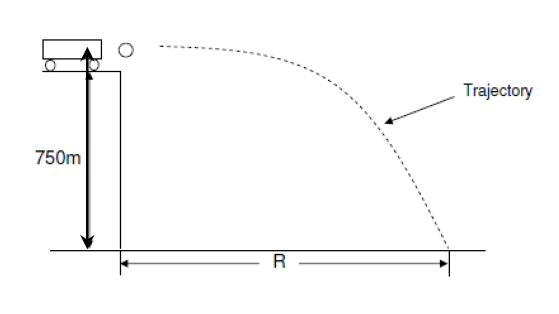
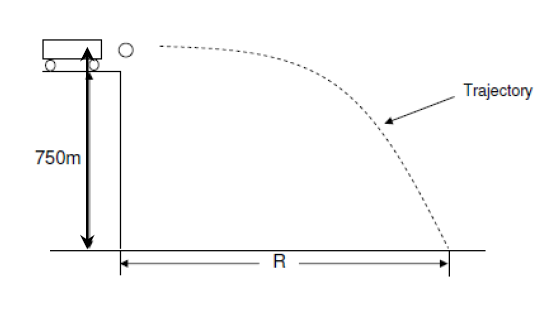
The diagram below shows a cannon firing a cannon ball at 135 m/s horizontally from a height of 750 meters.
What is the evdience for the initial velocity of the cannon in the “y” direction (vertical velocity)?
Question 6
6.
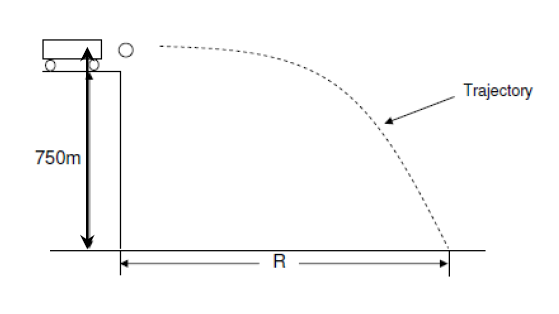
The diagram below shows a cannon firing a cannon ball at 135 m/s horizontally from a height of 750 meters.
What is the reasoning for the evdience for the initial velocity of the cannon in the “y” direction (vertical velocity)?
Question 7
7.
The diagram below shows a cannon firing a cannon ball at 135 m/s horizontally from a height of 750 meters.
What is the final velocity of the cannon ball in the “x” direction (horizontal velocity)?
Question 8
8.
The diagram below shows a cannon firing a cannon ball at 135 m/s horizontally from a height of 750 meters.
What is the evidence for the final velocity of the cannon ball in the “x” direction (horizontal velocity)?
Question 9
9.
The diagram below shows a cannon firing a cannon ball at 135 m/s horizontally from a height of 750 meters.
What is the reasoning for the evidence for the final velocity of the cannon ball in the “x” direction (horizontal velocity)?
Question 10
10.
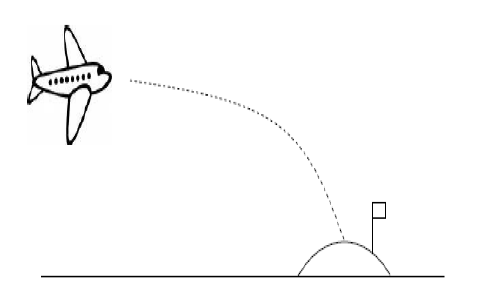
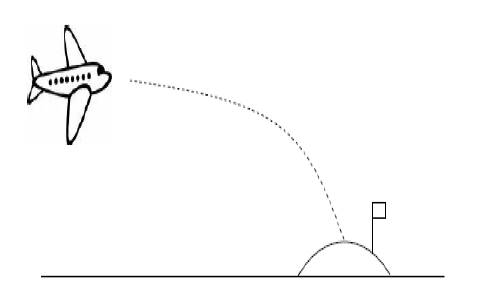
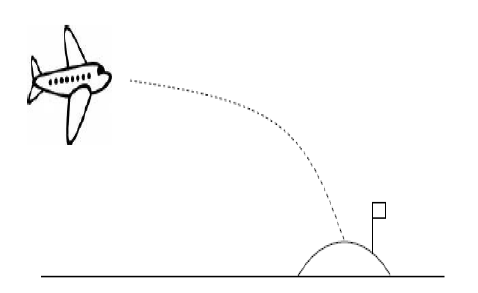
An airplane is going to drop supplies to a remote island in the south pacific as shown below. If the airplane is flying with a constant horizontally at 125 m/s and it takes the package 6.5 s to fall, answer the following questions.
How far from the island horizontally does the pilot release the package?
Question 11
11.
An airplane is going to drop supplies to a remote island in the south pacific as shown below. If the airplane is flying with a constant horizontally at 125 m/s and it takes the package 6.5 s to fall, answer the following questions.
Where is the plane when the package lands hits the island?
Question 12
12.
An airplane is going to drop supplies to a remote island in the south pacific as shown below. If the airplane is flying with a constant horizontally at 125 m/s and it takes the package 6.5 s to fall, answer the following questions.
Which of the graphs below represents the horizontal velocity of the projectile as it varies with time?
Question 13
13.
An airplane is going to drop supplies to a remote island in the south pacific as shown below. If the airplane is flying with a constant horizontally at 125 m/s and it takes the package 6.5 s to fall, answer the following questions.
Which of the graphs below represents the vertical velocity of the projectile as it varies with time?
Question 14
14.
Question 15
15.
Question 16
16.
Question 17
17.
A gardener holds the nozzle of a hose constant at a small angle above the horizontal and observes the stream of water coming from the nozzle. If the pressure of the water is increased so that the water leaves the nozzle at a greater speed,
Question 18
18.
A car traveling at the legal speed limit has a velocity of -vcar with respect to the road. You are traveling in the opposite direction at the legal speed limit with respect to the road. As the first car approaches you, what is its velocity relative to you?
Question 19
19.
A passenger on a bus moving east sees a man standing on a curb. From the man’s perspective, the passenger appears to
Question 20
20.
A ball is kicked off the ground at an initial velocity of 15.0 m/s at an angle of 30 degrees to the horizontal. It miraculously lands on the center of a goal post 2m above the ground.
What are the givens?
Question 21
21.
A ball is kicked off the ground at an initial velocity of 15.0 m/s at an angle of 30 degrees to the horizontal. It miraculously lands on the center of a goal post 2m above the ground. How far horizontally did the ball travel?
Which is the unknown?
Question 22
22.
A ball is kicked off the ground at an initial velocity of 15.0 m/s at an angle of 30 degrees to the horizontal. It miraculously lands on the center of a goal post 2m above the ground.
Which equation would you use to find the time to reach the max height of the projectile's path?
Question 23
23.
A ball is kicked off the ground at an initial velocity of 15.0 m/s at an angle of 30 degrees to the horizontal. It miraculously lands on the center of a goal post 2m above the ground.
Which final equation would you use to find the time to reach the max height of the projectile's path?
Question 24
24.
A ball is kicked off the ground at an initial velocity of 15.0 m/s at an angle of 30 degrees to the horizontal. It miraculously lands on the center of a goal post 2m above the ground.
Find the time to reach the max height of the projectile's path to the nearest hundreth.
Question 25
25.
A ball is kicked off the ground at an initial velocity of 15.0 m/s at an angle of 30 degrees to the horizontal. It miraculously lands on the center of a goal post 2m above the ground.
Which equation would you use to find the max height of the projectile's path?
Question 26
26.
A ball is kicked off the ground at an initial velocity of 15.0 m/s at an angle of 30 degrees to the horizontal. It miraculously lands on the center of a goal post 2m above the ground.
Find the max height of the projectile's path to the nearest tenth.
Question 27
27.
A ball is kicked off the ground at an initial velocity of 15.0 m/s at an angle of 30 degrees to the horizontal. It miraculously lands on the center of a goal post 2m above the ground.
Find the height the projectile falls to the goal post to the nearest tenth.
Question 28
28.
A ball is kicked off the ground at an initial velocity of 15.0 m/s at an angle of 30 degrees to the horizontal. It miraculously lands on the center of a goal post 2m above the ground.
Which equation would you use to find the time from the heighest point that the projectile falls to the goal post?
Question 29
29.
A ball is kicked off the ground at an initial velocity of 15.0 m/s at an angle of 30 degrees to the horizontal. It miraculously lands on the center of a goal post 2m above the ground.
Find the time from the heighest point that the projectile falls to the goal post to the nearest hundreth.
Question 30
30.
A ball is kicked off the ground at an initial velocity of 15.0 m/s at an angle of 30 degrees to the horizontal. It miraculously lands on the center of a goal post 2m above the ground.
Find the total time in the air to the nearest hundreth.
Question 31
31.
A ball is kicked off the ground at an initial velocity of 15.0 m/s at an angle of 30 degrees to the horizontal. It miraculously lands on the center of a goal post 2m above the ground.
Which equation would you use to find the horizontal distance traversed by the ball?
Question 32
32.
A ball is kicked off the ground at an initial velocity of 15.0 m/s at an angle of 30 degrees to the horizontal. It miraculously lands on the center of a goal post 2m above the ground. How far horizontally did the ball travel? (nearest tenth)
Question 33
33.
A riverboat is crossing a river moving 47 m/s at 15 degrees north of east. It encounters a current moving 5 m/s at 150 degrees north of east.
What is the x-component of the riverboat's velocity? (nearest hundreth)
Question 34
34.
A riverboat is crossing a river moving 47 m/s at 15 degrees north of east. It encounters a current moving 5 m/s at 150 degrees north of east.
What is the x-component of the current's velocity? (nearest hundreth)
Question 35
35.
A riverboat is crossing a river moving 47 m/s at 15 degrees north of east. It encounters a current moving 5 m/s at 150 degrees north of east.
What is the x-component of the velocity relative to shore (Full velocity)? (nearest hundreth)
Question 36
36.
A riverboat is crossing a river moving 47 m/s at 15 degrees north of east. It encounters a current moving 5 m/s at 150 degrees north of east.
What is the y-component of the riverboat's velocity? (nearest hundreth)
Question 37
37.
A riverboat is crossing a river moving 47 m/s at 15 degrees north of east. It encounters a current moving 5 m/s at 150 degrees north of east.
What is the y-component of the current's velocity? (nearest hundreth)
Question 38
38.
A riverboat is crossing a river moving 47 m/s at 15 degrees north of east. It encounters a current moving 5 m/s at 150 degrees north of east.
What is the y-component of the velocity relative to shore (Full velocity)? (nearest hundreth)
Question 39
39.
A riverboat is crossing a river moving 47 m/s at 15 degrees north of east. It encounters a current moving 5 m/s at 150 degrees north of east. The river is 250m across.
What is the time to cross the river? (nearest hundreth)
Question 40
40.
A riverboat is crossing a river moving 47 m/s at 15 degrees north of east. It encounters a current moving 5 m/s at 150 degrees north of east. The river is 250m across. How far downstream will the riverboat have travelled once it reaches the far shore? (nearest hundreth)
4.9 m/s^2, downward
9.8 m/s, downward
Most of the initial velocity is in the x-direction.
The x and y direciton motions are dependent on each other.
The horizontal velocity changes.
The only force acting is gravity which is a horizontal force and produces an x-direction acceleration.
719 m
Just past the island
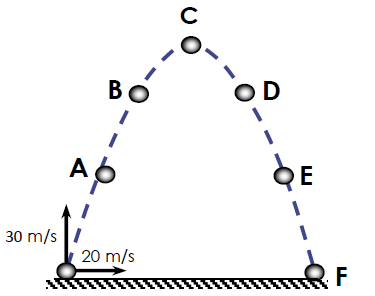
A projectile is launched into the air with a horizontal velocity of 20 m/s and a vertical velocity of 30 m/s, as shown. The figures shows the positions of the ball at 1 second intervals. The acceleration due to gravity is 10 m/s2.
Use the positions shown to answer the following:
Where is the vertical velocity 20 m/s up?
A
E
B
D
A projectile is launched into the air with a horizontal velocity of 20 m/s and a vertical velocity of 30 m/s, as shown. The figures shows the positions of the ball at 1 second intervals. The acceleration due to gravity is 10 m/s2.
Use the positions shown to answer the following:
Where is the vertical velocity zero?
B
E
F
C
A projectile is launched into the air with a horizontal velocity of 20 m/s and a vertical velocity of 30 m/s, as shown. The figures shows the positions of the ball at 1 second intervals. The acceleration due to gravity is 10 m/s2.
Use the positions shown to answer the following:
Where is the horizontal velocity 20 m/s?
At all points
C
D
A
Move east at a speed that is less than the bus’s speed
Move west at a speed that is equal to the bus’s speed