Log in
Sign up for FREE
arrow_back
Library

Forces Test2020 ReTest

star
star
star
star
star
Last updated about 3 hours ago
40 questions
1
1
1
1
1
1
1
1
1
1
1
1
1
1
1
4
1
3
1
3
1
3
1
3
4
1
3
1
3
1
1
1
3
5
1
1
1
1
1
2
Question 1
1.

An apple weighs 1 N. When the apple is at rest on a horizontal surface, what is the net force on the apple?

Question 2
2.

An unfortunate bug splatters against the windshield of a moving car. How does the force of the bug on the car compare to the force of the car on the bug?

Question 3
3.

An unfortunate bug splatters against the windshield of a moving car. How does the force of the bug on the car compare to the force of the car on the bug?

Question 4
4.

An apple weighs 1 N. When the apple is at rest on a horizontal surface, what is the evdence for what the net force on the apple would be?

Question 5
5.

An apple weighs 1 N. When the apple is at rest on a horizontal surface, what is the reasoning for the evdence for what the net force on the apple would be?

Question 6
6.

A 50-N net force is exerted on a 1400-kg elephant and 0.1-kg mouse. Which experiences the bigger acceleration?

Question 7
7.

What net force is required to accelerate a 2-kg object to an acceleration of 6.0 m/s^2?

Question 8
8.

Compared to its mass on earth, the mass of a 10-kg object on the moon is

Question 9
9.

An unfortunate bug splatters against the windshield of a moving car. How does the force of the bug on the car compare to the force of the car on the bug?

Question 10
10.

An unfortunate bug splatters against the windshield of a moving car. What is the evidence for how the force of the bug on the car compare to the force of the car on the bug?

Question 11
11.

An unfortunate bug splatters against the windshield of a moving car. What is the reasoning for the evidence for how the force of the bug on the car compare to the force of the car on the bug?

Question 12
12.

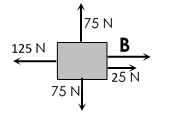
The figure below shows the free-body diagram for an object that is moving with constant velocity. What magnitude must the force labeled B have?
Question 13
13.

If the net force acting on an object doubles, what happens to the acceleration of the object?

Question 14
14.

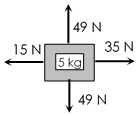
Four forces are exerted on a box as shown in the free-body diagram. Which of the following statements is true?

Question 15
15.

A person is attracted towards the earth by a 500-N gravitational force. The force with which the earth is attracted to the person is

Question 16
16.

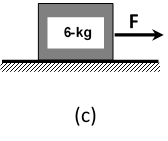
Horizontal force F = 10 N pulling on mass. Mass NOT moving. (round to nearest hundredth)

Draw the labeled Free Body Diagram for this situation.

Question 17
17.

Horizontal force F = 10 N pulling on mass. Mass NOT moving. (round to nearest hundredth)

Which equation would you use to find the gravitational force (weight) acting on the mass?

Question 18
18.

Horizontal force F = 10 N pulling on mass. Mass NOT moving. (round to nearest hundredth)

Find the gravitational force (weight) acting on the mass?

Question 19
19.

Horizontal force F = 10 N pulling on mass. Mass NOT moving. (round to nearest hundredth)

Which equation would you use to find the Normal Force acting on the mass?

Question 20
20.

Horizontal force F = 10 N pulling on mass. Mass NOT moving. (round to nearest hundredth)

Find the Normal Force acting on the mass?

Question 21
21.

The force F is increased to 350 N, and the box begins to move. The frictional force acting on it is now 10 N. (round to nearest hundredth)

Which equation would you use to find the Net Force acting on the box?

Question 22
22.

The force F is increased to 350 N, and the box begins to move. The frictional force acting on it is now 10 N. (round to nearest hundredth)

Find the Net Force acting on the box?

Question 23
23.

The force F is increased to 350 N, and the box begins to move. The frictional force acting on it is now 10 N. (round to nearest hundredth)

Which equation would you use to find the acceleration acting on the box?

Question 24
24.

The force F is increased to 340 N, and the box begins to move. The frictional force acting on it is now 10 N. (round to nearest hundredth)

Find the acceleration acting on the box?

Question 25
25.

A plane of mass 22000 kg starts from rest and travels east in a straight line 550 km for 5 hours. If the plane encounters a head wind which exerts a force of 15 N against the front of the plane, and it does not change altitude, what is the force provided by the engines?

Draw the Freebody Diagram for the plane.

Question 26
26.

A plane of mass 22000 kg starts from rest and travels east in a straight line 550 km for 5 hours. If the plane encounters a head wind which exerts a force of 15 N against the front of the plane, and it does not change altitude, what is the force provided by the engines?

Which equation would you use to find the net acceleration?

Question 27
27.

A plane of mass 22000 kg starts from rest and travels east in a straight line 550 km for 5 hours. If the plane encounters a head wind which exerts a force of 15 N against the front of the plane, and it does not change altitude, what is the force provided by the engines?

Find the net acceleration? (nearest thousandth)

Question 28
28.

A plane of mass 22000 kg starts from rest and travels east in a straight line 550 km for 5 hours. If the plane encounters a head wind which exerts a force of 15 N against the front of the plane, and it does not change altitude, what is the force provided by the engines?

Which equation would you use to find the net force on the plane?

Question 29
29.

A plane of mass 22000 kg starts from rest and travels east in a straight line 550 km for 5 hours. If the plane encounters a head wind which exerts a force of 15 N against the front of the plane, and it does not change altitude, what is the force provided by the engines?

Find the net force on the plane? (nearest hundreth)

Question 30
30.

A plane of mass 22000 kg starts from rest and travels east in a straight line 550 km for 5 hours. If the plane encounters a head wind which exerts a force of 15 N against the front of the plane, and it does not change altitude, what is the force provided by the engines?

Which is the the Fnet equation in the y-direction for the plane?

Question 31
31.

A plane of mass 22000 kg starts from rest and travels east in a straight line 550 km for 5 hours. If the plane encounters a head wind which exerts a force of 15 N against the front of the plane, and it does not change altitude, what is the force provided by the engines?

Which is the the Fnet equation in the x-direction for the plane?

Question 32
32.

A plane of mass 22000 kg starts from rest and travels east in a straight line 550 km for 5 hours. If the plane encounters a head wind which exerts a force of 15 N against the front of the plane, and it does not change altitude, what is the force provided by the engines?

Which is the the Fnet equation used to find the Force of the engines?

Question 33
33.

A plane of mass 22000 kg starts from rest and travels east in a straight line 550 km for 5 hours. If the plane encounters a head wind which exerts a force of 15 N against the front of the plane, and it does not change altitude, what is the force provided by the engines?

Find the net force on the plane? (nearest hundreth)

Question 34
34.

A 400 N sign is hanging from two cables. Each cable makes a 15° angle with the horizontal. Find the tension in the cables.

Draw the Freebody Diagram for the sign.

Question 35
35.

A 400 N sign is hanging from two cables. Each cable makes a 15° angle with the horizontal. Find the tension in the cables.

Which is the Fnet equation in the x-direction for the sign?

Question 36
36.

A 400 N sign is hanging from two cables. Each cable makes a 15° angle with the horizontal. Find the tension in the cables.

Which is the equation in the x-direction that shows the relationship between the two tensions on the sign?

Question 37
37.

A 400 N sign is hanging from two cables. Each cable makes a 15° angle with the horizontal. Find the tension in the cables.

Which is the Fnet equation in the y-direction for the sign?

Question 38
38.

A 400 N sign is hanging from two cables. Each cable makes a 15° angle with the horizontal. Find the tension in the cables.

Which is the Fnet equation after substitution in the y-direction for the sign?

Question 39
39.

A 400 N sign is hanging from two cables. Each cable makes a 15° angle with the horizontal. Find the tension in the cables.

Which is the equation used to find each tension for the sign?

Question 40
40.

A 400 N sign is hanging from two cables. Each cable makes a 15° angle with the horizontal. Find the tension in the cables.

Find each tension for the sign? (nearest hundreth)

0 N
0.33 N
75 N
25 N
150 N
It quarters
It stays the same.