Log in
Sign up for FREE
arrow_back
Library

Friction and Atwoods ReTest

star
star
star
star
star
Last updated about 3 hours ago
30 questions
1
1
1
1
1
1
5
1
1
1
1
3
2
5
1
1
1
1
1
1
1
1
2
2
1
1
1
1
2
2
Question 1
1.

A crate is sliding down an inclined ramp at a constant speed of 0.55 m/s. The vector sum of all the forces acting on this crate must point

Question 2
2.

A block of mass m sits at rest on a rough inclined ramp that makes an angle 60° with the horizontal. What must be true about normal force F on the block due to the ramp

Question 3
3.

Which force must you overcome to begin moving?

Question 4
4.

Which force must you overcome to continue moving?

Question 5
5.

Which coefficient of friction is greater for a particular material?

Question 6
6.

Two objects have masses m and 5m, respectively. They both are placed side by side on a frictionless inclined ramp and allowed to slide down from rest without any air resistance. Which one of the following statements about these objects is correct?

Question 7
7.

A box is being held on a 70° sloped ramp by a rope and a person. Suddenly the rope is cut and the box and the person begin to slide down the ramp (the person is not strong enough to prevent the sliding of the box). The box is 10.0 kg and the person applies a 27.0 N force against the box up the ramp as they slide down. If the μk = 0.18, what is the magnitude of the acceleration of the box as it moves down the ramp against the person?
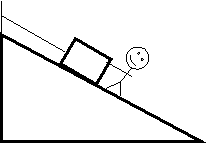
Draw the Free Body Diagram for the Box.
Question 8
8.

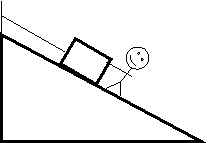
A box is being held on a 70° sloped ramp by a rope and a person. Suddenly the rope is cut and the box and the person begin to slide down the ramp (the person is not strong enough to prevent the sliding of the box). The box is 10.0 kg and the person applies a 27.0 N force against the box up the ramp as they slide down. If the μk = 0.18, what is the magnitude of the acceleration of the box as it moves down the ramp against the person?
Which of the following is the Fnet equation for the box in the y-direction?

Question 9
9.

A box is being held on a 70° sloped ramp by a rope and a person. Suddenly the rope is cut and the box and the person begin to slide down the ramp (the person is not strong enough to prevent the sliding of the box). The box is 10.0 kg and the person applies a 27.0 N force against the box up the ramp as they slide down. If the μk = 0.18, what is the magnitude of the acceleration of the box as it moves down the ramp against the person?
Which of the following is the equation proving there is no Fnet in the y-direction?

Question 10
10.

A box is being held on a 70° sloped ramp by a rope and a person. Suddenly the rope is cut and the box and the person begin to slide down the ramp (the person is not strong enough to prevent the sliding of the box). The box is 10.0 kg and the person applies a 27.0 N force against the box up the ramp as they slide down. If the μk = 0.18, what is the magnitude of the acceleration of the box as it moves down the ramp against the person?
Which of the following is the Fnet equation for the box in the x-direction?

Question 11
11.

A box is being held on a 70° sloped ramp by a rope and a person. Suddenly the rope is cut and the box and the person begin to slide down the ramp (the person is not strong enough to prevent the sliding of the box). The box is 10.0 kg and the person applies a 27.0 N force against the box up the ramp as they slide down. If the μk = 0.18, what is the magnitude of the acceleration of the box as it moves down the ramp against the person?
Which of the following is the equation for the acceleration of the box?

Question 12
12.

A box is being held on a 70° sloped ramp by a rope and a person. Suddenly the rope is cut and the box and the person begin to slide down the ramp (the person is not strong enough to prevent the sliding of the box). The box is 10.0 kg and the person applies a 27.0 N force against the box up the ramp as they slide down. If the μk = 0.18, what is the magnitude of the acceleration of the box as it moves down the ramp against the person?
Find the acceleration of the box? (nearest hundreth and you may leave the direction as a "+" or "-")

Question 13
13.

Mr. Dewey and Mr. Kehr decided to demonstrate a half atwoods machine to their students. They attached a pulley to the edge of the roof. Mr. Dewey sat in a chair on the roof and attached a rope to the chair and had Mr. Kehr grab the other end and step off the roof. Mr. Kehr has a mass of 90 Kg, and Mr. Dewey has a mass of 80 Kg. If the chair rode up a ramp at an incline of 50 degrees and achieved an acceleration of 1 m/s^2, what was the coefficient of kinetic friction between the chair and the ramp?

Draw the Free Body Diagram for Mr. Kehr.

Question 14
14.

Mr. Dewey and Mr. Kehr decided to demonstrate a half atwoods machine to their students. They attached a pulley to the edge of the roof. Mr. Dewey sat in a chair on the roof and attached a rope to the chair and had Mr. Kehr grab the other end and step off the roof. Mr. Kehr has a mass of 90 Kg, and Mr. Dewey has a mass of 80 Kg. If the chair rode up a ramp at an incline of 50 degrees and achieved an acceleration of 1 m/s^2, what was the coefficient of kinetic friction between the chair and the ramp?
Draw the Free Body Diagram for Mr. Dewey.

Question 15
15.

Mr. Dewey and Mr. Kehr decided to demonstrate a half atwoods machine to their students. They attached a pulley to the edge of the roof. Mr. Dewey sat in a chair on the roof and attached a rope to the chair and had Mr. Kehr grab the other end and step off the roof. Mr. Kehr has a mass of 90 Kg, and Mr. Dewey has a mass of 80 Kg. If the chair rode up a ramp at an incline of 50 degrees and achieved an acceleration of 1 m/s^2, what was the coefficient of kinetic friction between the chair and the ramp?

Which of the following is the Fnet equation for Mr. Dewey in the y-direction?

Question 16
16.

Mr. Dewey and Mr. Kehr decided to demonstrate a half atwoods machine to their students. They attached a pulley to the edge of the roof. Mr. Dewey sat in a chair on the roof and attached a rope to the chair and had Mr. Kehr grab the other end and step off the roof. Mr. Kehr has a mass of 90 Kg, and Mr. Dewey has a mass of 80 Kg. If the chair rode up a ramp at an incline of 50 degrees and achieved an acceleration of 1 m/s^2, what was the coefficient of kinetic friction between the chair and the ramp?

Which of the following is the equation proving there is no Fnet in the y-direction for Mr. Dewey?

Question 17
17.

Mr. Dewey and Mr. Kehr decided to demonstrate a half atwoods machine to their students. They attached a pulley to the edge of the roof. Mr. Dewey sat in a chair on the roof and attached a rope to the chair and had Mr. Kehr grab the other end and step off the roof. Mr. Kehr has a mass of 90 Kg, and Mr. Dewey has a mass of 80 Kg. If the chair rode up a ramp at an incline of 50 degrees and achieved an acceleration of 1 m/s^2, what was the coefficient of kinetic friction between the chair and the ramp?
Which of the following is the Fnet equation for Mr. Dewey in the x-direction?

Question 18
18.

Mr. Dewey and Mr. Kehr decided to demonstrate a half atwoods machine to their students. They attached a pulley to the edge of the roof. Mr. Dewey sat in a chair on the roof and attached a rope to the chair and had Mr. Kehr grab the other end and step off the roof. Mr. Kehr has a mass of 90 Kg, and Mr. Dewey has a mass of 80 Kg. If the chair rode up a ramp at an incline of 50 degrees and achieved an acceleration of 1 m/s^2, what was the coefficient of kinetic friction between the chair and the ramp?

Which of the following is the Fnet equation for Mr. Kehr in the y-direction?

Question 19
19.

Mr. Dewey and Mr. Kehr decided to demonstrate a half atwoods machine to their students. They attached a pulley to the edge of the roof. Mr. Dewey sat in a chair on the roof and attached a rope to the chair and had Mr. Kehr grab the other end and step off the roof. Mr. Kehr has a mass of 90 Kg, and Mr. Dewey has a mass of 80 Kg. If the chair rode up a ramp at an incline of 50 degrees and achieved an acceleration of 1 m/s^2, what was the coefficient of kinetic friction between the chair and the ramp?

Which of the following is the Fnet equation for Mr. Kehr in the x-direction?

Question 20
20.

Mr. Dewey and Mr. Kehr decided to demonstrate a half atwoods machine to their students. They attached a pulley to the edge of the roof. Mr. Dewey sat in a chair on the roof and attached a rope to the chair and had Mr. Kehr grab the other end and step off the roof. Mr. Kehr has a mass of 90 Kg, and Mr. Dewey has a mass of 80 Kg. If the chair rode up a ramp at an incline of 50 degrees and achieved an acceleration of 1 m/s^2, what was the coefficient of kinetic friction between the chair and the ramp?
Which of the following is the Fnet equation for the entire system?

Question 21
21.

Mr. Dewey and Mr. Kehr decided to demonstrate a half atwoods machine to their students. They attached a pulley to the edge of the roof. Mr. Dewey sat in a chair on the roof and attached a rope to the chair and had Mr. Kehr grab the other end and step off the roof. Mr. Kehr has a mass of 90 Kg, and Mr. Dewey has a mass of 80 Kg. If the chair rode up a ramp at an incline of 50 degrees and achieved an acceleration of 1 m/s^2, what was the coefficient of kinetic friction between the chair and the ramp?
Which of the following is the equation for finding the coefficient of friction?

Question 22
22.

Mr. Dewey and Mr. Kehr decided to demonstrate a half atwoods machine to their students. They attached a pulley to the edge of the roof. Mr. Dewey sat in a chair on the roof and attached a rope to the chair and had Mr. Kehr grab the other end and step off the roof. Mr. Kehr has a mass of 90 Kg, and Mr. Dewey has a mass of 80 Kg. If the chair rode up a ramp at an incline of 50 degrees and achieved an acceleration of 1 m/s^2, what was the coefficient of kinetic friction between the chair and the ramp?
Find the coefficient of friction? (nearest thousandth)

Question 23
23.

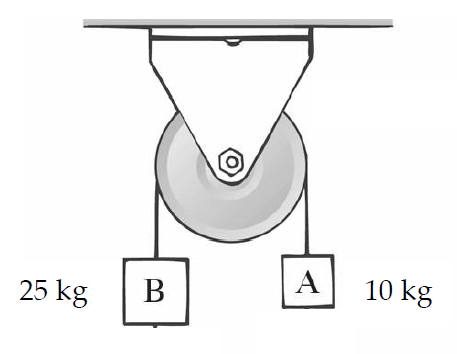
Two blocks, light connecting ropes, and a light frictionless pulley comprise a system, as shown in the figure. Block B accelerates downward at a constant acceleration.
a) What is the magnitude of the acceleration for the system?
b) What is the magnitude of the Tension in the rope?


Draw the Free Body Diagram for Block B.

Question 24
24.

Two blocks, light connecting ropes, and a light frictionless pulley comprise a system, as shown in the figure. Block B accelerates downward at a constant acceleration.
a) What is the magnitude of the acceleration for the system?
b) What is the magnitude of the Tension in the rope?


Draw the Free Body Diagram for Block A.

Question 25
25.

Two blocks, light connecting ropes, and a light frictionless pulley comprise a system, as shown in the figure. Block B accelerates downward at a constant acceleration.
a) What is the magnitude of the acceleration for the system?
b) What is the magnitude of the Tension in the rope?


Which is the Fnet equation for block A in the y-direction?

Question 26
26.

Two blocks, light connecting ropes, and a light frictionless pulley comprise a system, as shown in the figure. Block B accelerates downward at a constant acceleration.
a) What is the magnitude of the acceleration for the system?
b) What is the magnitude of the Tension in the rope?


Which is the Fnet equation for block B in the y-direction?

Question 27
27.

Two blocks, light connecting ropes, and a light frictionless pulley comprise a system, as shown in the figure. Block B accelerates downward at a constant acceleration.
a) What is the magnitude of the acceleration for the system?
b) What is the magnitude of the Tension in the rope?


Which is the Fnet equation for the entire system?

Question 28
28.

Two blocks, light connecting ropes, and a light frictionless pulley comprise a system, as shown in the figure. Block B accelerates downward at a constant acceleration.
a) What is the magnitude of the acceleration for the system?
b) What is the magnitude of the Tension in the rope?


Which is the equation for the acceleration for the entire system?

Question 29
29.

Two blocks, light connecting ropes, and a light frictionless pulley comprise a system, as shown in the figure. Block B accelerates downward at a constant acceleration.
a) What is the magnitude of the acceleration for the system?
b) What is the magnitude of the Tension in the rope?


Find the magnitude of the acceleration for the entire system. (nearest hundreth)

Question 30
30.

Two blocks, light connecting ropes, and a light frictionless pulley comprise a system, as shown in the figure. Block B accelerates downward at a constant acceleration.
a) What is the magnitude of the acceleration for the system?
b) What is the magnitude of the Tension in the rope?


Find the magnitude of the Tension for the entire system. (nearest hundreth)

perpendicular to the ramp.
up the ramp.
F = mg cos 60
F = mg sin 60
F > mg cos 60
F < mg
It takes the heavier object 10 times longer to reach the bottom of the ramp than the lighter.
It takes the lighter object 10 times longer to reach the bottom of the ramp than the heavier.
It takes the heavier object 5 times longer to reach the bottom of the ramp than the lighter.