Log in
Sign up for FREE
arrow_back
Library
1-D Motion Test
By Joshua Kehr
star
star
star
star
star
Share
share
Last updated about 3 hours ago
34 questions
Add this activity
5
6
7
zoom_in
1
1
1
1
2
3
4
zoom_in
1
1
1
1
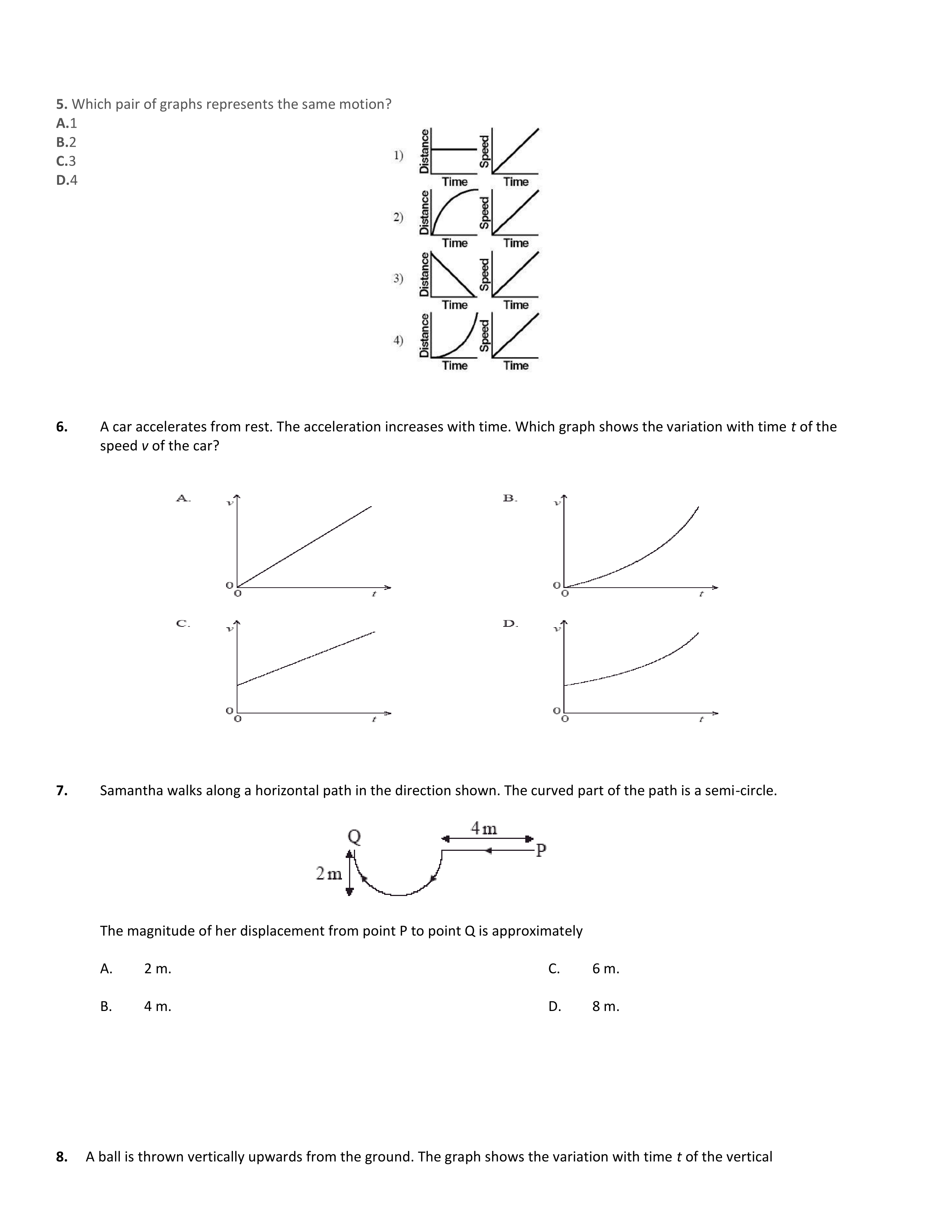
Question 5
5.
Answer question 5
D
C
B
A
Question 6
6.
Answer question 6
C
A
B
D
Question 7
7.
Answer question 7
D
B
A
C
8
9
10
11
12
zoom_in
1
1
1
1
1
13
14
15
20
25
27
30
16
17
18
19
21
22
23
24
26
28
29
31
32
zoom_in
1
1
1
1
1
1
1
2
1
1
1
1
2
3
1
1
1
3
1
1
33
34
zoom_in
3
Question 33
33.
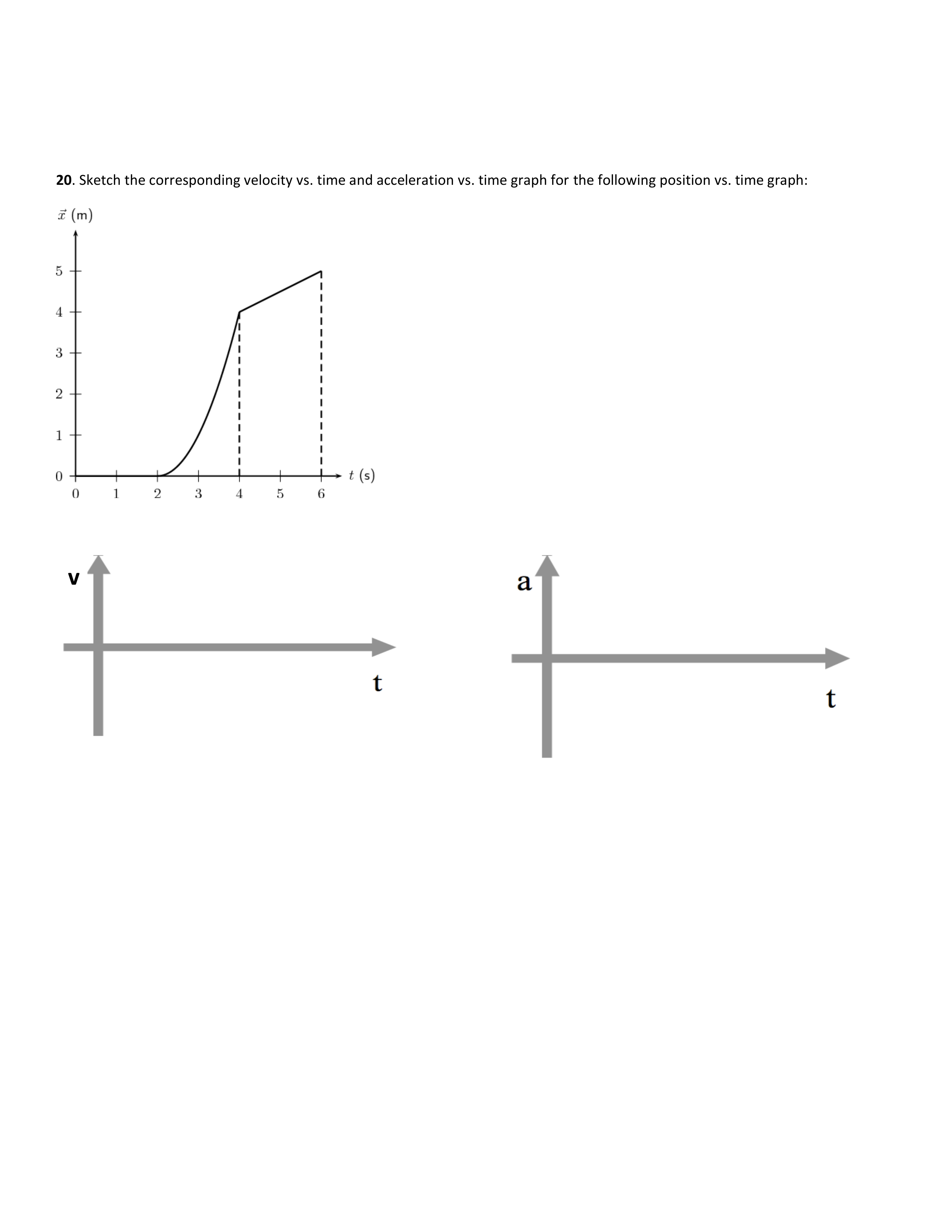
Draw the VvT graph that corresponds to the given XvT graph.
visibility
View drawing
3
Question 34
34.
Draw the AvT graph that corresponds to the given XvT graph.
visibility
View drawing
Question 1
1.
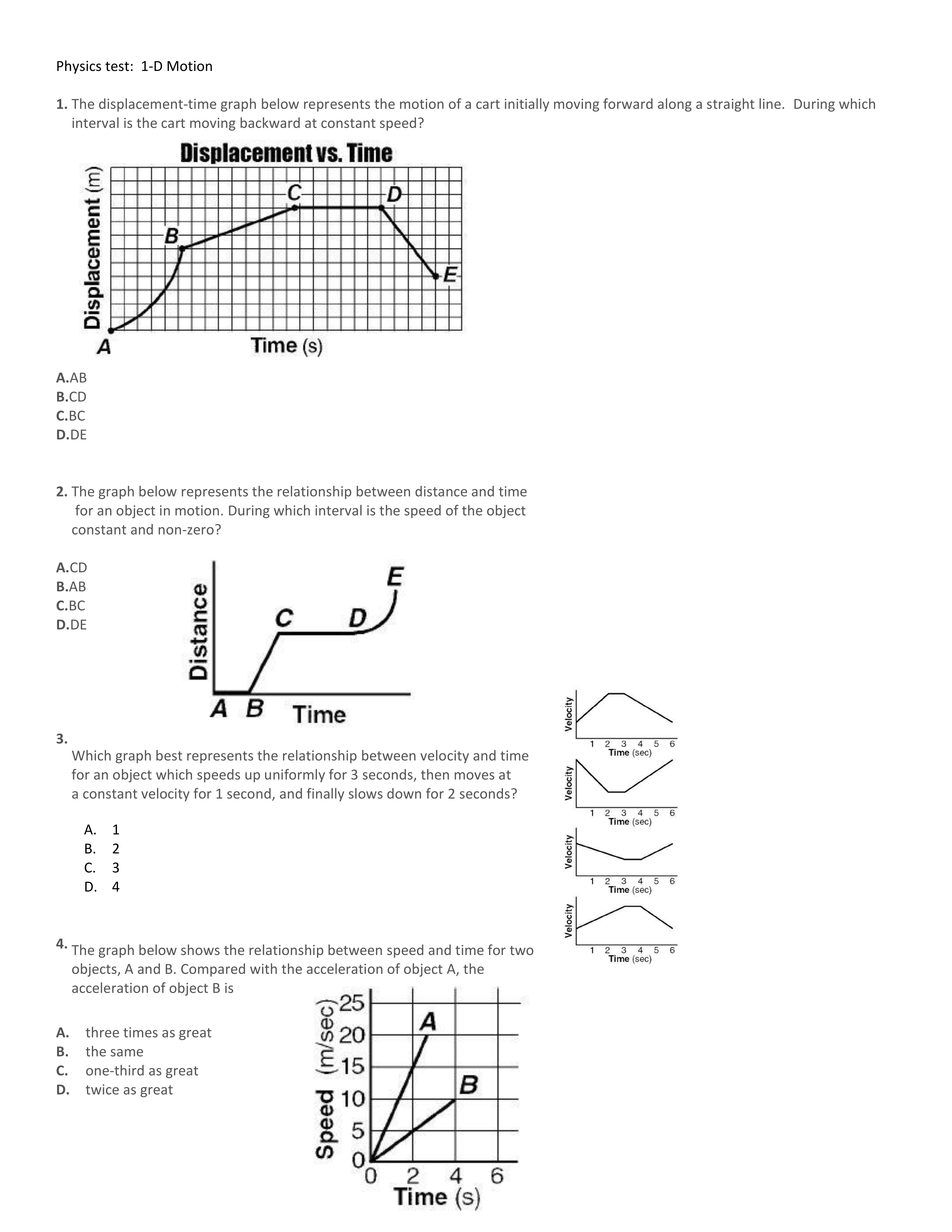
Answer question 1
A
C
D
B
Question 2
2.
Answer question 2
A
D
B
C
Question 3
3.
Answer question 3. (the top graph is 1 and the bottom graph is 4)
D
C
A
B
Question 4
4.
Answer question 4
A
D
C
B
Question 8
8.
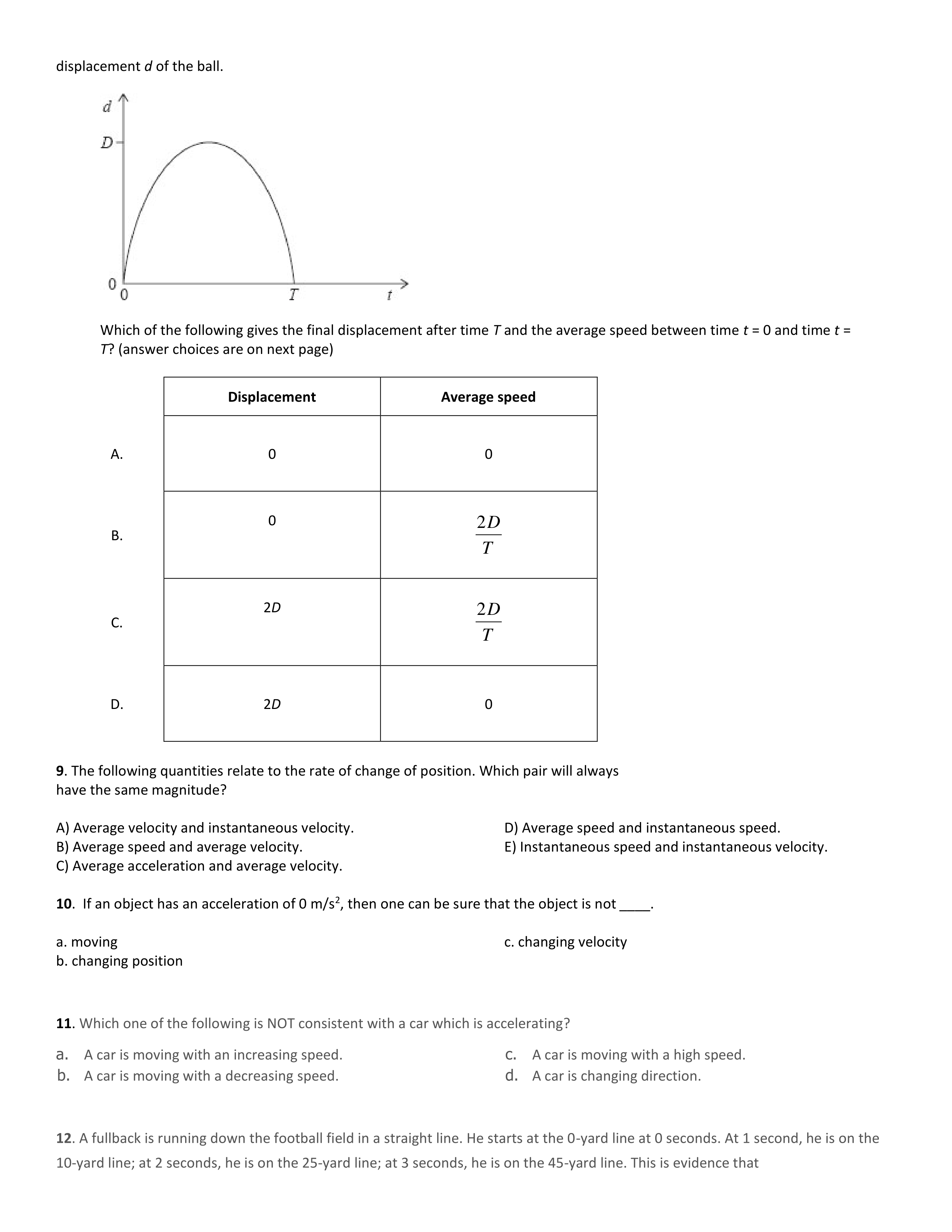
Answer question 8
C
D
A
B
Question 9
9.
Answer question 9
A
C
D
Question 10
10.
Answer question 10
B
A
C
Question 11
11.
Answer question 11
B
D
A
C
Question 12
12.
Answer question 12. (the answer choices are on the next page)
A
C
B
Question 13
13.
Answer question 13
B
C
A
D
Question 14
14.
Answer question 14
A
B
C
D
Question 15
15.
Answer question 15
D
B
A
C
Question 16
16.
For question 16), what are your givens? (select all that apply)
Question 17
17.
Which of the follow is the unknown for question 16 ?
t
d
Question 18
18.
Which equation will you use for question 16 ?
Question 19
19.
Which of the follwing would be the final equation used to solve question 16 ?
Question 20
20.
Answer question 16 to the nearest hundreth.
Question 21
21.
For question 17a), what are your givens? (select all that apply)
Question 22
22.
Which of the follow is the unknown for question 17a) ?
d
t
Question 23
23.
Which equation will you use for question 17a) ?
Question 24
24.
Which of the follwing would be the final equation used to solve question 17a) ?
Question 25
25.
Answer question 17a) to the nearest hundreth.
Question 26
26.
Answer question 17b).
Question 27
27.
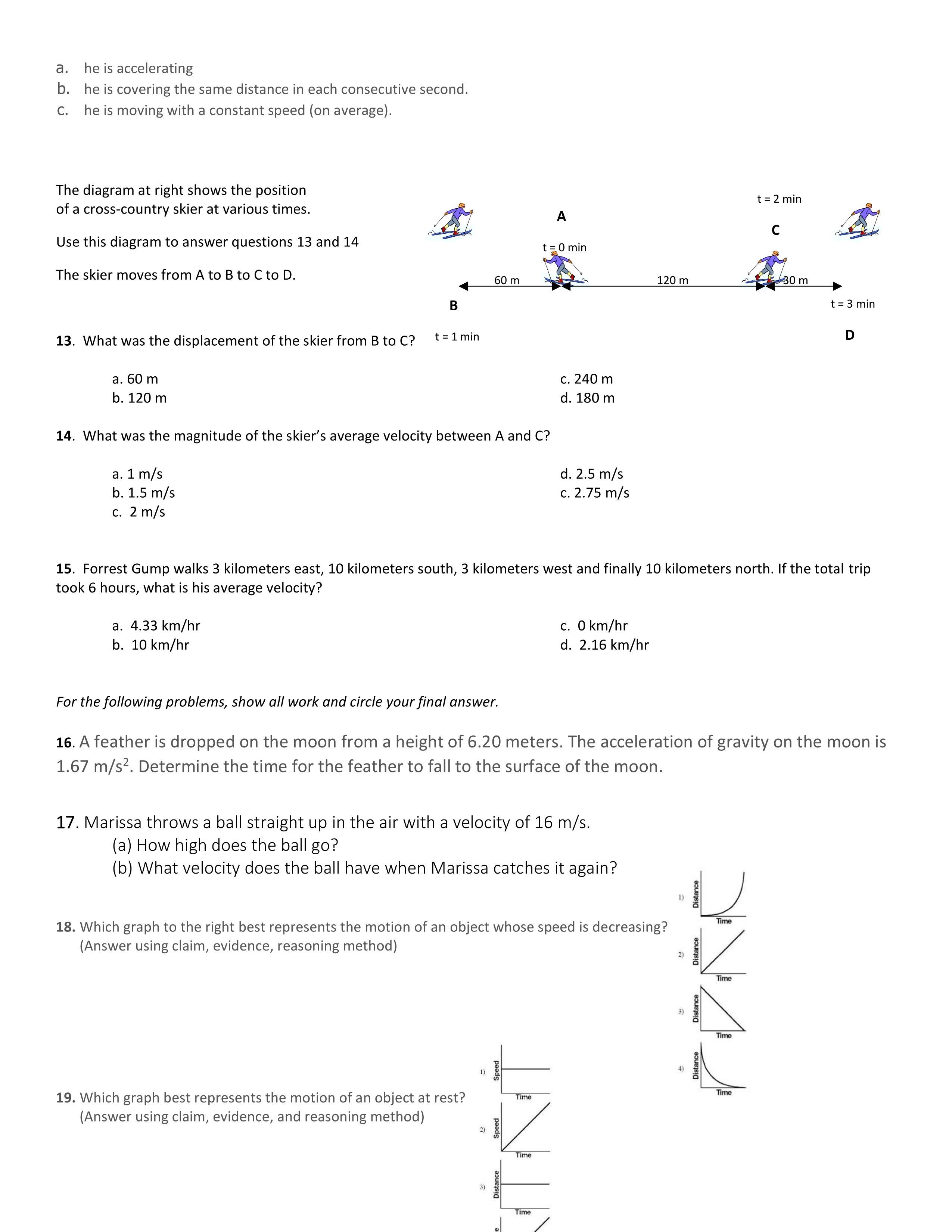
Which graph best represents the motion of an object whose speed is decreasing?
2
4
1
3
Question 28
28.
Which of the following would be the evidence for question 18 ?
The slope starts large and decreases.
The slope is starting small and increases.
The slope is constant.
The slope is zero.
Question 29
29.
Which of the following would be the reasoning of the evidence for question 18 ?
The slope of a velocity vs time graph is acceleration. Therefore, if the slope is increasing, so is the acceleration.
The slope of a velocity vs time graph is acceleration. Therefore, if the slope is decreasing, so is the acceleration.
The slope of a position vs time graph is velocity. Therefore, if the slope is increasing, so is the velocity.
The slope of a position vs time graph is velocity. Therefore, if the slope is decreasing, so is the velocity.
Question 30
30.
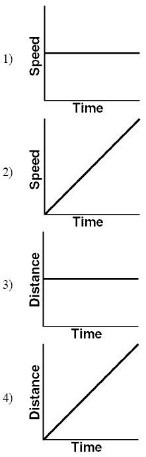
Answer question 19.
Here is the graph (bottom was cut off on page during upload):
4
2
1
3
Question 31
31.
Which of the following would be the evidence for question 19 ?
The slope of the VvT graph is constant.
The XvT graph starts small and increases.
The VvT graph is starting small and increases.
The slope of the XvT graph is constant.
Question 32
32.
Which of the following would be the reasoning of the evidence for question 19 ?
The slope of a position vs time graph is velocity. Therefore, if the slope is increasing, so is the acceleration.
The slope of a position vs time graph is velocity. Therefore, if the slope is decreasing, so is the velocity.
The slope of a position vs time graph is velocity. Therefore, if the slope is increasing, so is the velocity.
The slope of a position vs time graph is velocity. Therefore, if the slope is constant, the velocity is zero.
B
E