Log in
Sign up for FREE
arrow_back
Library

1-D Motion Test V2

star
star
star
star
star
Last updated about 2 hours ago
34 questions
1
1
1
1
1
1
1
1
1
1
1
1
1
1
1
1
1
1
1
3
1
1
1
1
3
3
1
1
1
1
1
1
3
3
Question 1
1.

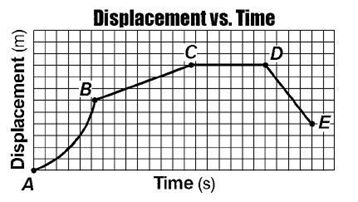
The displacement-time graph below represents the motion of a cart initially moving forward along a straight line. During which interval is the cart moving forward at constant speed?
Question 2
2.

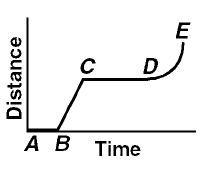
The graph below represents the relationship between distance and time for an object in motion. During which interval is the speed of the object non-constant and non-zero?

Question 3
3.

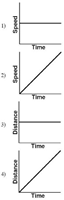
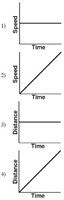
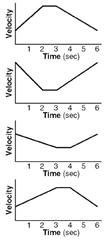
Which graph best represents the relationship between velocity and time for an object which speeds up uniformly for 2 seconds, then moves at a constant velocity for 1 second, and finally slows down for 3 seconds? (Graph 1 is at top and graph 4 is at bottom)

Question 4
4.

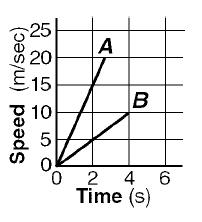
The graph below shows the relationship between speed and time for two objects, A and B. Compared with the acceleration of object B, the acceleration of object A is

Question 5
5.

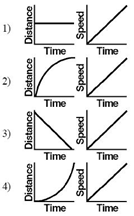
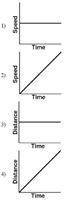
Which pair of graphs represents the same motion?

Question 6
6.

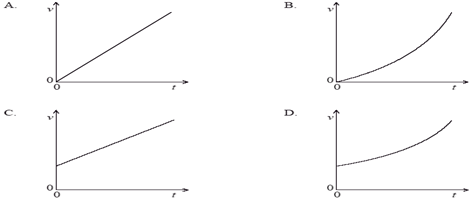
A car accelerates from rest. The acceleration stays constant with time. Which graph shows the variation with time t of the speed v of the car?

Question 7
7.

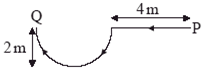
Samantha walks along a horizontal path in the direction shown. The curved part of the path is a semi-circle.

The magnitude of her displacement 3/4 of the way from point P to point Q is approximately

Question 8
8.

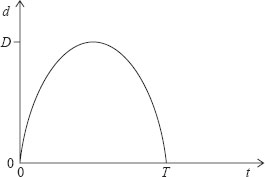
A ball is thrown vertically upwards from the ground. The graph shows the variation with time t of the vertical displacement d of the ball.

Which of the following gives the final displacement after time T and the average speed between time t = 0 and time t = 0?

Question 9
9.

The following quantities relate to the rate of change of position. Which pair will always have the same magnitude?

Question 10
10.

If an object has an acceleration of 0 m/s2, then one can be sure that the object is not ____.

Question 11
11.

Which one of the following is NOT consistent with a car which is accelerating?

Question 12
12.

A fullback is running down the football field in a straight line. He starts at the 0-yard line at 0 seconds. At 1 second, he is on the 10-yard line; at 2 seconds, he is on the 25-yard line; at 3 seconds, he is on the 45-yard line. This is evidence that

Question 13
13.

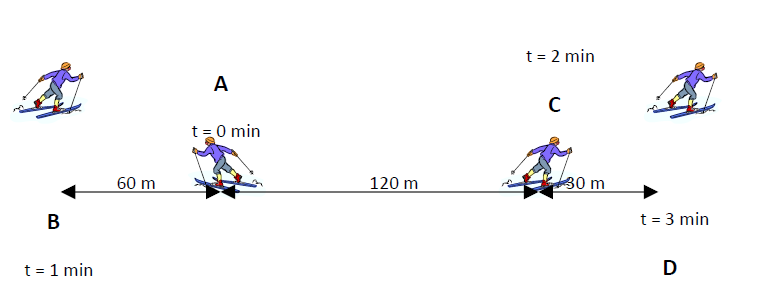
The skier moves from A to B to C to D.
What was the displacement of the skier from A to C?

Question 14
14.

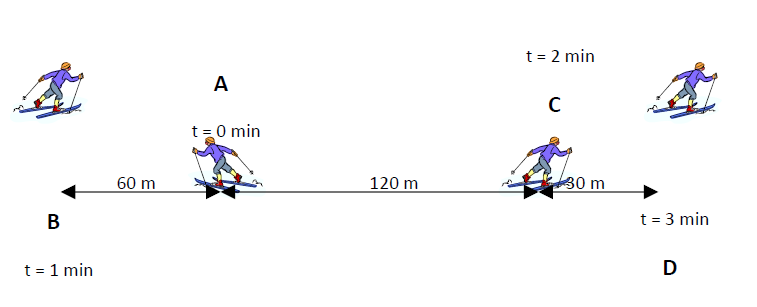
The skier moves from A to B to C to D.
What was the magnitude of the skier’s average velocity between B and C?

Question 15
15.

Forrest Gump walks 3 kilometers east, 10 kilometers south, 3 kilometers west and finally 10 kilometers north. If the total trip took 6 hours, what is his average velocity?

Question 16
16.

A feather is dropped on the moon and takes 3.54s to hit the ground. The acceleration of gravity on the moon is 1.67 m/s2.

What are your givens? (select all that apply)

Question 17
17.

A feather is dropped on the moon and takes 3.54s to hit the ground. The acceleration of gravity on the moon is 1.67 m/s2. Determine the displacement the feather ungoes.

Which of the follow is the unknown?

Question 18
18.

A feather is dropped on the moon and takes 3.54s to hit the ground. The acceleration of gravity on the moon is 1.67 m/s2. Determine the displacement the feather ungoes.

Which of the kinematic equations would you use?

Question 19
19.

A feather is dropped on the moon and takes 3.54s to hit the ground. The acceleration of gravity on the moon is 1.67 m/s2. Determine the displacement the feather ungoes.

Which of the follwing would be the final equation?

Question 20
20.

A feather is dropped on the moon and takes 3.54s to hit the ground. The acceleration of gravity on the moon is 1.67 m/s2. Determine the displacement the feather ungoes.
Answer to nearest hundreth.

Question 21
21.

Marissa throws a ball straight up in the air with a velocity of 5 m/s. How high does the ball go?

What are your givens? (select all that apply)

Question 22
22.

Marissa throws a ball straight up in the air with a velocity of 5 m/s. How high does the ball go?

Which of the follow is the unknown?

Question 23
23.

Marissa throws a ball straight up in the air with a velocity of 5 m/s. How high does the ball go?

Which of the kinematic equations would you use?

Question 24
24.

Marissa throws a ball straight up in the air with a velocity of 5 m/s. How high does the ball go?

Which of the follwing would be the final equation?

Question 25
25.

Marissa throws a ball straight up in the air with a velocity of 5 m/s.
How high does the ball go? (nearest hundreth)

Question 26
26.

Marissa throws a ball straight up in the air with a velocity of 5 m/s.
What velocity does the ball have when Marissa catches it again?

Question 27
27.

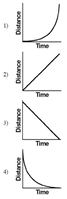
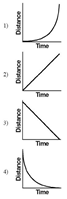
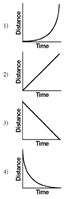
Which graph best represents the motion of an object whose speed is decreasing?

Question 28
28.

Which of the following would be the evidence for which graph best represents the motion of an object whose speed is decreasing?

Question 29
29.

Which of the following would be the reasoning of the evidence for which graph best represents the motion of an object whose speed is decreasing?

Question 30
30.

Which graph best represents the motion of an object at rest?

Question 31
31.

Which of the following would be the evidence for which graph best represents the motion of an object at rest?

Question 32
32.

Which of the following would be the reasoning of the evidence for which graph best represents the motion of an object at rest?

Question 33
33.

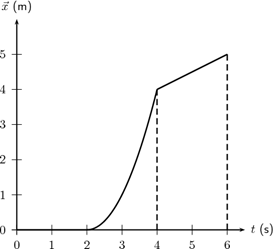
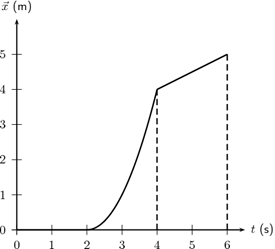
Draw the VvT graph that corresponds to the given XvT graph.

Question 34
34.

Draw the AvT graph that corresponds to the given XvT graph.

A
2m
displacement=0m and average speed= 0m/s
displacement=2D and average speed= 2D/T
Average speed and instantaneous speed
Average velocity and instantaneous velocity
1.5m/s
2.75m/s
2m/s
t= 3.45s
The slope of a position vs time graph is velocity. Therefore, if the slope is decreasing, so is the velocity.