Log in
Sign up for FREE
arrow_back
Library

Work and Energy ReTest

star
star
star
star
star
Last updated about 3 hours ago
32 questions
1
1
1
1
1
1
1
1
1
1
1
1
1
1
1
1
3
1
3
1
2
1
4
1
3
1
1
1
3
1
1
2
Question 1
1.

Rudolf the Red Nosed Reindeer (m=100kg) travels with a velocity of 10 m/s. If his smaller reindeer friend (m=50kg) is traveling with Rudolf at the same speed, what is his kinetic energy in comparison to Rudolf’s?

Question 2
2.

A 20 kg object falls 2.0 meters to the floor. At what point in its fall does the kinetic energy of the object equal its potential energy at a single moment in time?

Question 3
3.

An object falls without friction near Earth’s surface. The loss of its potential energy is equal to its ______.

Question 4
4.

The action that would require no work to be done is _______________.

Question 5
5.

Running up a flight of stairs, Maria generates 250 watts of power. If it takes her 4 seconds to go up the stairs, the amount of work she does in running up the stairs is _______.

Question 6
6.

Which requires more work: lifting a 50 kg sack vertically 2 meters or lifting a 25 kg sack vertically 4 meters?

Question 7
7.

Which has greater kinetic energy, a car traveling at 15 m/s or a half-as-massive car traveling at 30 m/s?

Question 8
8.

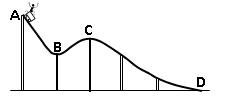
A roller coaster car is released from rest at position A, and moves through positions B, C, and D (friction negligible)

At what point is the kinetic energy the least?
Question 9
9.

A roller coaster car is released from rest at position A, and moves through positions B, C, and D (friction negligible)

At what point is the potential energy the least?

Question 10
10.

A roller coaster car is released from rest at position A, and moves through positions B, C, and D (friction negligible)

Rank the positions from highest speed to lowest:

Question 11
11.

Potential energy is the energy an object has because of its ________.

Question 12
12.

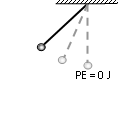
As a pendulum swings back and forth ___________.

Question 13
13.

According to the first law of thermodynamics, the difference between energy transferred to or from a system by heat and energy transferred to or from a system by work is equivalent to which of the following?

Question 14
14.

A cup of water is scooped up from a swimming pool. Compare the temperature T and the internal energy U of the water in both the cup, and the swimming pool.

Question 15
15.

When mechanical work is done on a system (for example, the compression of air within a bicycle tire pump),

Question 16
16.

Which of the following best describes the relationship between two systems in thermal equilibrium?

Question 17
17.

A gas in a large cylinder which contains a piston has 4578 J of Internal energy. The piston which has a surface area of 1.4 m2 exerts a pressure of 25 P on the gas and moves 3.5 m. The new internal energy was 1883 J.

What is the change in internal energy for the gas?

Question 18
18.

A gas in a large cylinder which contains a piston has 4578 J of Internal energy. The piston which has a surface area of 1.4 m2 exerts a pressure of 25 P on the gas and moves 3.5 m. The new internal energy was 1883 J.

What is the equation to find the work done by the piston on the gas?

Question 19
19.

A gas in a large cylinder which contains a piston has 4578 J of Internal energy. The piston which has a surface area of 1.4 m2 exerts a pressure of 25 P on the gas and moves 3.5 m. The new internal energy was 1883 J.

Find the work done by the piston on the gas to the nearest tenth of a joule.

Question 20
20.

A gas in a large cylinder which contains a piston has 4578 J of Internal energy. The piston which has a surface area of 1.4 m2 exerts a pressure of 25 P on the gas and moves 3.5 m. The new internal energy was 1883 J.

What is the equation to find the heat released by the gas?

Question 21
21.

A gas in a large cylinder which contains a piston has 4578 J of Internal energy. The piston which has a surface area of 1.4 m2 exerts a pressure of 25 P on the gas and moves 3.5 m. The new internal energy was 1883 J.

Find the heat released by the gas to the nearest tenth of a joule.

Question 22
22.

If the total heat produced by an internal combustion engine was the answer to the previous problem, then what is the efficiency of the engine if it does 1529.5J of work and 2288J of heat leaves the tailpipe? (to nearest tenth of a percent)

Question 23
23.

A 14.5kg book is pushed 23.3m across a table by an applied force of 1546N. Tthe initial velocity of the book is 0.85m/s and µk is 0.03.

Draw the FBD for this situation.

Question 24
24.

A 14.5kg book is pushed 23.3m across a table by an applied force of 1546N. Tthe initial velocity of the book is 0.85m/s and µk is 0.03.

Which of these is the Fnet equation in the x-direction?

Question 25
25.

A 14.5kg book is pushed 23.3m across a table by an applied force of 1546N. Tthe initial velocity of the book is 0.85m/s and µk is 0.03.

Find the net Force in the x-direction to the nearest hundreth of a newton.

Question 26
26.

A 14.5kg book is pushed 23.3m across a table by an applied force of 1546N. Tthe initial velocity of the book is 0.85m/s and µk is 0.03.

Which of these is the Fnet equation in the y-direction?

Question 27
27.

A 14.5kg book is pushed 23.3m across a table by an applied force of 1546N. Tthe initial velocity of the book is 0.85m/s and µk is 0.03.

Which of these is the work-kinetic energy theorem?

Question 28
28.

A 14.5kg book is pushed 23.3m across a table by an applied force of 1546N. Tthe initial velocity of the book is 0.85m/s and µk is 0.03.

Which of these is the equation to find the book's final velocity?

Question 29
29.

A 14.5kg book is pushed 23.3m across a table by an applied force of 1546N. Tthe initial velocity of the book is 0.85m/s and µk is 0.03.

Find the book's final velocity to nearest hundreth m/s.

Question 30
30.

Ever the life of the party, Isaac Newton jumps off of a 10 m tall roof with an initial speed of 2.3 m/s into a bounce-house below. He lands on the floor of the bounce house, 1.5 meters above the ground, and compresses it by 0.6 meters. The spring constant of the bounce-house is 3.12 x 10^4 N/m.

Which of the following is the appropriate conservation of energy equation for this situation?

Question 31
31.

Ever the life of the party, Isaac Newton jumps off of a 5 m tall roof with an initial speed of 2.3 m/s into a bounce-house below. He lands on the floor of the bounce house, 1.5 meters above the ground, and compresses it by 0.3 meters. The spring constant of the bounce-house is 3.12 x 10^4 N/m.

Which of the following is the appropriate equation to find the mass of Isaac Newton?

Question 32
32.

Ever the life of the party, Isaac Newton jumps off of a 10 m tall roof with an initial speed of 2.3 m/s into a bounce-house below. He lands on the floor of the bounce house, 1.5 meters above the ground, and compresses it by 0.6 meters. The spring constant of the bounce-house is 3.12 x 10^4 N/m.

Find the mass of Isaac Newton to nearest tenth of a kg.

PE turns into KE as it swings down
its energy is all PE at the top of its swing
all of these statements are true
TPool > Tcup and U is same.
T is same, U is same.