
Four identical balls (m = 1 kg) are shown in the figure above.
Which ball has the most gravitational potential energy?
Four identical balls (m = 1 kg) are shown in the figure above.
Which ball has the most gravitational potential energy?
Energy changes from one form to another within a system with no net gain or loss. This statement is
A 500-kg car traveling with a speed of 10 m/s has 25,000 J of kinetic energy. How much kinetic energy does it have if its speed is doubled?
Four identical balls (m = 1 kg) are shown in the figure above.
Which ball has the most gravitational potential energy?
Four identical balls (m = 1 kg) are shown in the figure above.
Which ball has the least kinetic energy?
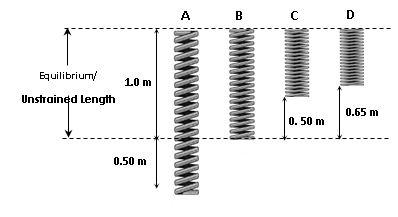
Four identical springs are shown above (k = 10,000 N/m).
Which other spring has the same potential energy stored as spring A?
Four identical springs are shown above (k = 10,000 N/m).
Which spring has the most potential energy stored in it?
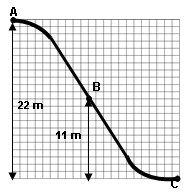
Alicia (m = 75 kg) rides a waterslide, shown below. Assuming the slide is frictionless, and that her initial speed at point A is 0 m/s,
Find the height at Position A to nearest meter.
Alicia (m = 75 kg) rides a waterslide, shown below. Assuming the slide is frictionless, and that her initial speed at point A is 0 m/s,
Find the height at Position B to nearest meter.
Alicia (m = 75 kg) rides a waterslide, shown below. Assuming the slide is frictionless, and that her initial speed at point A is 0 m/s,
Find the height at Position C to nearest meter.
Alicia (m = 75 kg) rides a waterslide, shown below. Assuming the slide is frictionless, and that her initial speed at point A is 0 m/s,
Find the PEg at Position B to nearest joule.
Alicia (m = 75 kg) rides a waterslide, shown below. Assuming the slide is frictionless, and that her initial speed at point A is 0 m/s,
Find the PEg at Position C to nearest joule.
Alicia (m = 75 kg) rides a waterslide, shown below. Assuming the slide is frictionless, and that her initial speed at point A is 0 m/s,
Find the PEg at Position A to nearest J.
Alicia (m = 75 kg) rides a waterslide, shown below. Assuming the slide is frictionless, and that her initial speed at point A is 0 m/s,
Find the KE at Position A to nearest J.
Alicia (m = 75 kg) rides a waterslide, shown below. Assuming the slide is frictionless, and that her initial speed at point A is 0 m/s,
Find the KE at Position B to nearest J.
Alicia (m = 75 kg) rides a waterslide, shown below. Assuming the slide is frictionless, and that her initial speed at point A is 0 m/s,
Find the KE at Position C to nearest J.
Alicia (m = 75 kg) rides a waterslide, shown below. Assuming the slide is frictionless, and that her initial speed at point A is 0 m/s,
Find the Total ME at Position C to nearest J.
Alicia (m = 75 kg) rides a waterslide, shown below. Assuming the slide is frictionless, and that her initial speed at point A is 0 m/s,
Find the Total ME at Position B to nearest J.
Alicia (m = 75 kg) rides a waterslide, shown below. Assuming the slide is frictionless, and that her initial speed at point A is 0 m/s,
Find the Total ME at Position A to nearest J.
Alicia (m = 75 kg) rides a waterslide, shown below. Assuming the slide is frictionless, and that her initial speed at point A is 0 m/s,
Find the speed at Position A to nearest hundreth m/s.
Alicia (m = 75 kg) rides a waterslide, shown below. Assuming the slide is frictionless, and that her initial speed at point A is 0 m/s,
Find the speed at Position B to nearest hundreth m/s.
Alicia (m = 75 kg) rides a waterslide, shown below. Assuming the slide is frictionless, and that her initial speed at point A is 0 m/s,
Find the speed at Position C to nearest hundreth m/s.