The forces that act on a box are shown below. If these forces act for 10 seconds, what is the impulse delivered to the box?
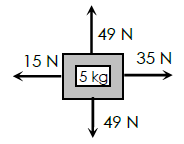
The forces that act on a box are shown below. If these forces act for 10 seconds, what is the impulse delivered to the box?
Which of the following has the largest momentum relative to the Earth's surface?
A freight train rolls along a track with considerable momentum. If it rolls with the same speed but has twice as much mass, its momentum is looking
A rifle recoils while firing a bullet. The speed of the rifle's recoil is small because the
A 2250 kg pickup truck has a velocity of 25 m/s to the east. What is the momentum of the truck?
An egg thrown with an initial velocity of 15 m/s comes to a full stop when hitting a wall and when hitting a sheet. The change in momentum is greater for the egg hitting the
A 4-kg ball has a momentum of 12 kg m/s. What is the ball’s speed?
The forces that act on a box are shown below. If these forces act for 10 seconds, what is the impulse delivered to the box?
A karate expert executes a swift blow and breaks a cement block with her bare hand. The magnitude of the force experienced by her hand is
A 1-kg chunk of putty moving at 1 m/s collides with and sticks to a 5-kg bowling ball initially at rest. The bowling ball and putty then move with a momentum of
A large metal ball is shot from a cannon with a short barrel. If the same ball were to be shot from cannon with a longer barrel, its velocity would be
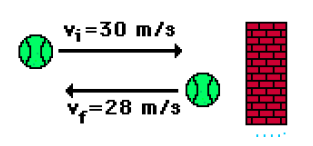
A 2.0-kg ball strikes a wall with a velocity of 30 m/s, and bounces back in the other direction with a velocity of 28 m/s, as shown:
What is the change in momentum of the ball?
A soccerball of mass 2 kg is travelling with a velocity of 3.6 m/s at 25 degrees N of E. After it is kicked the ball then travels with a velocity of 6.2 m/s at 39 degrees W of N.
What is the x-component of the initial velocity? (nearest hundreth)
A soccerball of mass 2 kg is travelling with a velocity of 3.6 m/s at 25 degrees N of E. After it is kicked the ball then travels with a velocity of 6.2 m/s at 39 degrees W of N.
What is the y-component of the initial velocity? (nearest hundreth)
A soccerball of mass 2 kg is travelling with a velocity of 3.6 m/s at 25 degrees N of E. After it is kicked the ball then travels with a velocity of 6.2 m/s at 39 degrees W of N.
What is the x-component of the final velocity? (nearest hundreth)
A soccerball of mass 2 kg is travelling with a velocity of 3.6 m/s at 25 degrees N of E. After it is kicked the ball then travels with a velocity of 6.2 m/s at 39 degrees W of N.
What is the y-component of the final velocity? (nearest hundreth)
A soccerball of mass 2 kg is travelling with a velocity of 3.6 m/s at 25 degrees N of E. After it is kicked the ball then travels with a velocity of 6.2 m/s at 39 degrees W of N.
What is the magnitude of the change in velocity? (nearest hundreth)
A soccerball of mass 2 kg is travelling with a velocity of 3.6 m/s at 25 degrees N of E. After it is kicked the ball then travels with a velocity of 6.2 m/s at 39 degrees W of N.
What is the direction of the change in velocity? (nearest hundreth and from 0 degrees)
A soccerball of mass 2 kg is travelling with a velocity of 3.6 m/s at 25 degrees N of E. After it is kicked the ball then travels with a velocity of 6.2 m/s at 39 degrees W of N.
What is the magnitude of the change in momentum? (nearest hundreth)
A soccerball of mass 2 kg is travelling with a velocity of 3.6 m/s at 25 degrees N of E. After it is kicked the ball then travels with a velocity of 6.2 m/s at 39 degrees W of N.
What is the magnitude of the impact force if the time of impact was 3 seconds? (nearest hundreth)
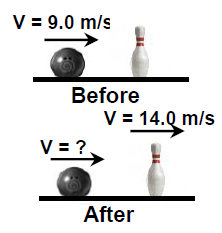
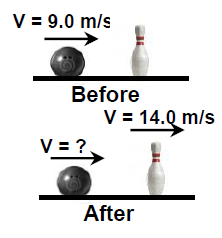
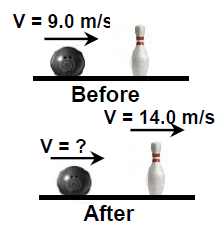
Jeanne rolls a 7.0 kg bowling ball down the alley for the league championship. One pin, of mass 2 kg is still standing, and the bowling ball hits it head-on with a velocity of 9.0 m/s The pin acquires a forward velocity of 14.0 m/s. What is the new velocity of the bowling ball?
Which is the correct equation for conservation of momentum in this situation?
Jeanne rolls a 7.0 kg bowling ball down the alley for the league championship. One pin, of mass 2 kg is still standing, and the bowling ball hits it head-on with a velocity of 9.0 m/s The pin acquires a forward velocity of 14.0 m/s. What is the new velocity of the bowling ball?
Which is the correct equation for finding the new velocity of the bowling ball?
Jeanne rolls a 7.0 kg bowling ball down the alley for the league championship. One pin, of mass 2 kg is still standing, and the bowling ball hits it head-on with a velocity of 9.0 m/s The pin acquires a forward velocity of 14.0 m/s. What is the new velocity of the bowling ball? (nearest hundreth)
A 30230-kg truck collides head on with a 1050-kg parked car. The vehicles entangle together and slide a linear distance of 5.6 meters before coming to rest. Assuming a uniform coefficient of friction of 0.550 between the road surface and the vehicles, determine the pre-collision speed of the truck.
Which equation would you use to figure out the deceleration of the post-crash vehicles?
A 30230-kg truck collides head on with a 1050-kg parked car. The vehicles entangle together and slide a linear distance of 5.6 meters before coming to rest. Assuming a uniform coefficient of friction of 0.550 between the road surface and the vehicles, determine the pre-collision speed of the truck.
Find the deceleration of the post-crash vehicles? (nearest hundreth)
A 30230-kg truck collides head on with a 1050-kg parked car. The vehicles entangle together and slide a linear distance of 5.6 meters before coming to rest. Assuming a uniform coefficient of friction of 0.550 between the road surface and the vehicles, determine the pre-collision speed of the truck.
Which equation would you use to figure out the speed of the post-crash vehicles when they began to slide?
A 30230-kg truck collides head on with a 1050-kg parked car. The vehicles entangle together and slide a linear distance of 5.6 meters before coming to rest. Assuming a uniform coefficient of friction of 0.550 between the road surface and the vehicles, determine the pre-collision speed of the truck.
Find the speed of the post-crash vehicles when they began to slide? (nearest hundreth)
A 30230-kg truck collides head on with a 1050-kg parked car. The vehicles entangle together and slide a linear distance of 5.6 meters before coming to rest. Assuming a uniform coefficient of friction of 0.550 between the road surface and the vehicles, determine the pre-collision speed of the truck.
Which is the correct equation for conservation of momentum in this situation
A 30230-kg truck collides head on with a 1050-kg parked car. The vehicles entangle together and slide a linear distance of 5.6 meters before coming to rest. Assuming a uniform coefficient of friction of 0.550 between the road surface and the vehicles, determine the pre-collision speed of the truck.
Which is the correct equation for finding the pre-collision speed of the truck?
A 30230-kg truck collides head on with a 1050-kg parked car. The vehicles entangle together and slide a linear distance of 5.6 meters before coming to rest. Assuming a uniform coefficient of friction of 0.550 between the road surface and the vehicles, determine the pre-collision speed of the truck.
Find the pre-collision speed of the truck? (nearest hundreth)
A 258 kg child is standing on a 543 kg raft that is drifting with a velocity of 21.1 m/s north relative to the water. The child then walks on the raft with a net velocity of 0.21 m/s west relative to the water. Fluid friction between the raft and water is negligible.
What is the magnitude of the final momentum of the raft? (nearest hundreth)
A 258 kg child is standing on a 543 kg raft that is drifting with a velocity of 21.1 m/s north relative to the water. The child then walks on the raft with a net velocity of 0.21 m/s west relative to the water. Fluid friction between the raft and water is negligible.
What is the direction of the final momentum of the raft? (nearest hundreth and from 0 degrees)
A 258 kg child is standing on a 543 kg raft that is drifting with a velocity of 21.1 m/s north relative to the water. The child then walks on the raft with a net velocity of 0.21 m/s west relative to the water. Fluid friction between the raft and water is negligible.
What is the magnitude of the final velocity of the raft? (nearest hundreth)