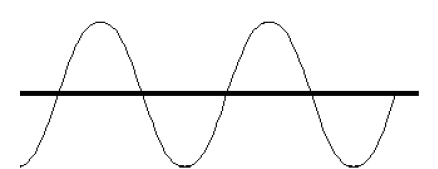
Given the wave snapshot shown, draw a wave that has three times the amplitude:
Given the wave snapshot shown, draw a wave that has three times the amplitude:
What is the difference between a longitudinal wave and a transverse wave?
Which of the following descriptions are true about wave motion? Select all that apply.
Given the wave snapshot shown, draw a wave that has three times the amplitude:
Given the wave snapshot shown, draw a wave with half the amplitude:
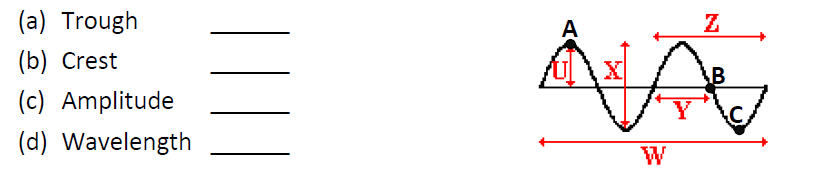
Using the diagram below, drag the letter to the corresponding category.
Z
A
C
U
Wavelength
Amplitude
Crest
Trough
A wave is moving through a medium. A point on the medium is undergoing many up and down oscillations in a short amount of time. This is conclusive evidence that the wave has a relatively large _________.
The speed of a wave depends upon the ________. Select the most appropriate answer:
A transverse wave is generated on a slinky. A coil of the slinky makes 12 complete up and down cycles in 4 seconds.
Find the period of the wave to the nearest hundreth.
A transverse wave is generated on a slinky. A coil of the slinky makes 12 complete up and down cycles in 4 seconds.
Find the frequency of the wave to the nearest hundreth.
Two boats – Boat A and Boat B – are anchored a distance of 33 meters apart. The incoming water water waves force the boats to oscillate up and down, making one complete cycle every 30 seconds. When Boat A is at its peak, Boat B is at its low point, AND there is a crest in between the two boats. The vertical distance between Boat A and Boat B at their extremes is 8 meters.
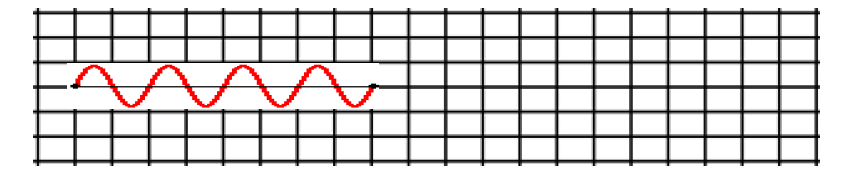
Use this figure to plot possible positions for Boats A and B:
Two boats – Boat A and Boat B – are anchored a distance of 33 meters apart. The incoming water water waves force the boats to oscillate up and down, making one complete cycle every 30 seconds. When Boat A is at its peak, Boat B is at its low point, AND there is a crest in between the two boats. The vertical distance between Boat A and Boat B at their extremes is 8 meters.
What is the wavelength of the waves to nearest meter?
Two boats – Boat A and Boat B – are anchored a distance of 33 meters apart. The incoming water water waves force the boats to oscillate up and down, making one complete cycle every 30 seconds. When Boat A is at its peak, Boat B is at its low point, AND there is a crest in between the two boats. The vertical distance between Boat A and Boat B at their extremes is 8 meters.
What is the frequency of the waves to nearest thousandth?
Two boats – Boat A and Boat B – are anchored a distance of 33 meters apart. The incoming water water waves force the boats to oscillate up and down, making one complete cycle every 30 seconds. When Boat A is at its peak, Boat B is at its low point, AND there is a crest in between the two boats. The vertical distance between Boat A and Boat B at their extremes is 8 meters.
What is the amplitude of the waves to nearest meter?
Two boats – Boat A and Boat B – are anchored a distance of 33 meters apart. The incoming water water waves force the boats to oscillate up and down, making one complete cycle every 30 seconds. When Boat A is at its peak, Boat B is at its low point, AND there is a crest in between the two boats. The vertical distance between Boat A and Boat B at their extremes is 8 meters.
What is the period of the waves to nearest second?
Two boats – Boat A and Boat B – are anchored a distance of 33 meters apart. The incoming water water waves force the boats to oscillate up and down, making one complete cycle every 30 seconds. When Boat A is at its peak, Boat B is at its low point, AND there is a crest in between the two boats. The vertical distance between Boat A and Boat B at their extremes is 8 meters.
How fast are the waves traveling to nearest hundreth?