Appearance, texture, and density are classified as __________
Question 2
2.
At what temperature does water freeze?
_______ °C
Question 3
3.
Question 4
4.
Samuel plays video games on his computer after he finishes his chores. Choose the term that correctly completes the sentence.
The computer changes electrical energy to __________ in order for Samuel to see his video game.
Question 5
5.
Choose the words or phrases that make the sentence correct.
A salad is a __________ because it is made of two or more substances that can be separated.
Question 6
6.
Choose the answer from the menu.
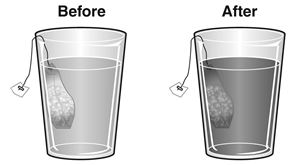
Guillermo was making a drink and placed a tea bag in a glass of water. After a few minutes, Guillermo noticed the water had turned light brown. Particles from the tea dissolved in the water and changed its color.
The term that BEST describes what formed when the teabag was placed in the water is __________
Question 7
7.
Question 8
8.
Question 9
9.
Question 10
10.
Question 11
11.
Question 12
12.
Question 13
13.
Question 14
14.
Question 15
15.
Question 16
16.
A student fills a beaker with 500 mL of water. The student drops an iron nail in the beaker followed by a piece of foam, as shown.
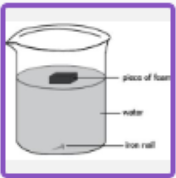
Drag the labels to order the materials from least dense to most dense.
(least dense on top and most dense on bottom)
piece of foam
water
iron nail
Which mixture could be separated using a magnet?
Pepper and sugar
Sand grains and seashells
Iron filings and pepper
Pebbles and marbles
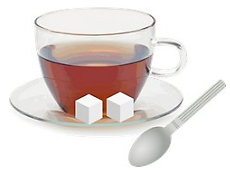
A glass of unsweetened tea has a mass of 225 g. If 15 g of sugar are added to the tea and stirred until fully dissolved, what is the mass of the glass of tea now?
More than 240 g
Between 226 g and 239 g
225 g
240 g
A common treatment for a sore throat is to place salt in warm water and gargle the solution to relieve the pain. Which property of the salt will remain the same when it forms the solution with water?
The size of the salt crystals
The texture of the salt
The taste of the salt
The shape of the salt crystals
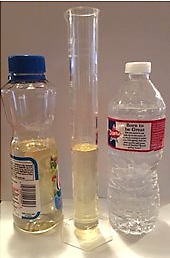
A teacher pours 55mL of cooking oil into a graduated cylinder. He then pours in 35 mL of water and lets the mixture sit for 30 minutes.
What will most likely happen to the liquids in the graduated cylinder?
The oil will rise to the top because it is less dense than water.
The oil will remain on the bottom because there is more of it.
The oil will remain on the bottom because it was poured in first.
The oil will mix with the water and form a solution.
Which of these best describes the change in salt grains as they dissolve in water?
The grains get higher in temperature until they melt into a liquid.
The grains get smaller in size until they can no longer be seen.
The grains are washed clean until they are perfectly clear.
The grains change their chemicals until they become water.
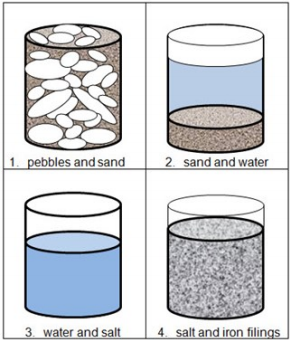
Which of the mixtures in the image above maintained all of the physical properties of their ingredients?
Pebbles and sand, sand and water, salt and iron filings
Sand and water, water and salt, salt and iron filings
Pebbles and sand, salt and iron filings
Pebbles and sand, sand and water, water and salt, salt and iron filings
A cook may add more salt to soup before serving it. How does salt change when it is added to soup?
The salt disappears.
The mass of the salt changes.
The taste of the salt changes.
The grain size of the salt changes.
A student made a mixture of sand and sugar where the individual crystals of each are approximately the same size. What is the easiest way to separate the sugar and sand mixture?
Use a pair of tweezers to separate the individual crystals into two piles
Put the mixture in water and filter the sand out of the water
Use a magnet to pull the sugar crystals out of the mixture
Use a filter that has holes large enough to allow the sugar through but small enough to trap the sand
What occurs with the physical properties of sugar when it is mixed with water?
The sugar dissolves and can no longer be seen as a solid
The sugar no longer tastes sweet
The sugar evaporates into the water
The physical properties of sugar do not change
Cindy and Mary decided to put corks and bolts into a large plastic container. Later, Mary decided that the corks should be separated from the bolts. The corks and bolts can be separated by —