Log in
Sign up for FREE
arrow_back
Library

7th: 1.1 Rigid Motion Transformations End of Topic Assessment-Melle

star
star
star
star
star
Last updated over 2 years ago
13 questions
True False and Short Answer Section
Required
1
8.10.B
Required
1
8.10.B
Multiple Choice Section
Required
2
8.10.C
Required
2
8.10.A
Required
2
8.10.C
Required
2
8.10.C
Required
2
8.10.C
Required
2
Free Response/Fill-in-the-blank Section
Required
4
8.10.A
8.10.B
8.10.C
Required
2
8.10.C
Required
2
8.10.C
BONUS Section!
0
0

***IMPORTANT***

When entering answers, only enter spaces between words. If you are entering an answer for an algebraic rule, ordered pairs/coordinates, or any numbers enter your response with no spaces.

Use parentheses where appropriate!

Examples:

Rule: (x+1,y+1) or (-y,x), or (-x,y)

There are no spaces between any characters.


Ordered Pairs/Coordinates: (-1,2)

There are no spaces between any characters.

Question 1
1.

Question 2
2.

Give an example of a rigid motion transformation.

Question 3
3.

Question 4
4.

Question 5
5.

Question 6
6.

Question 7
7.

Question 8
8.

Question 9
9.
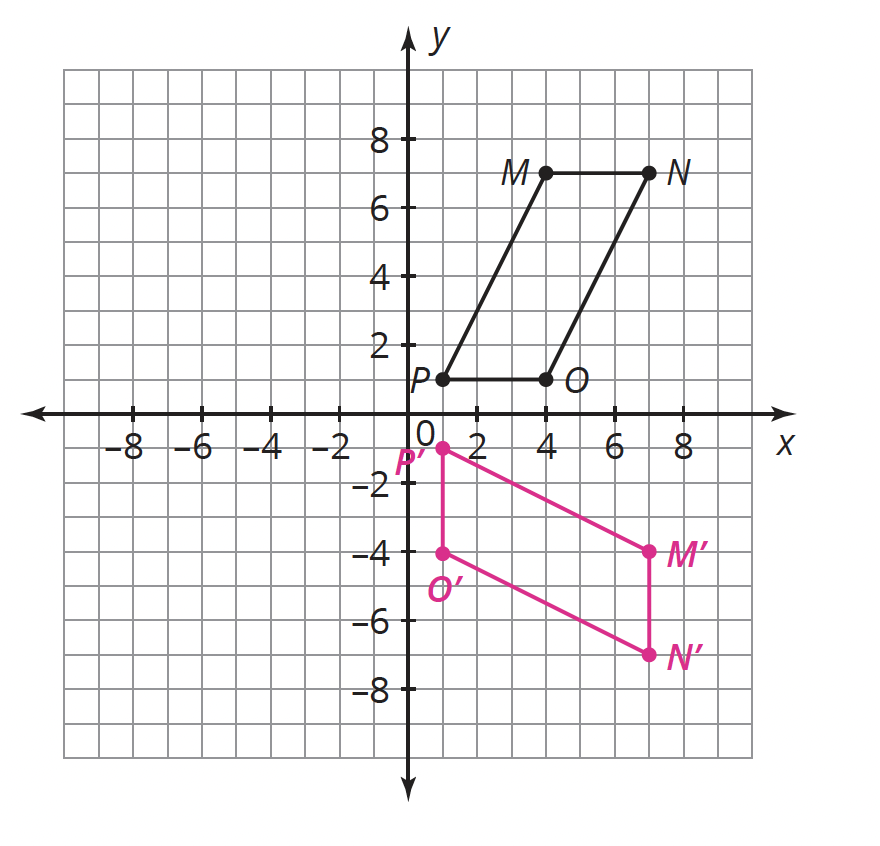
Look at the parallelograms shown on the coordinate plane.


The transformation depicted is a __________. The image is __________ to the pre-image. The orientation __________. The image is located in __________.
Question 10
10.

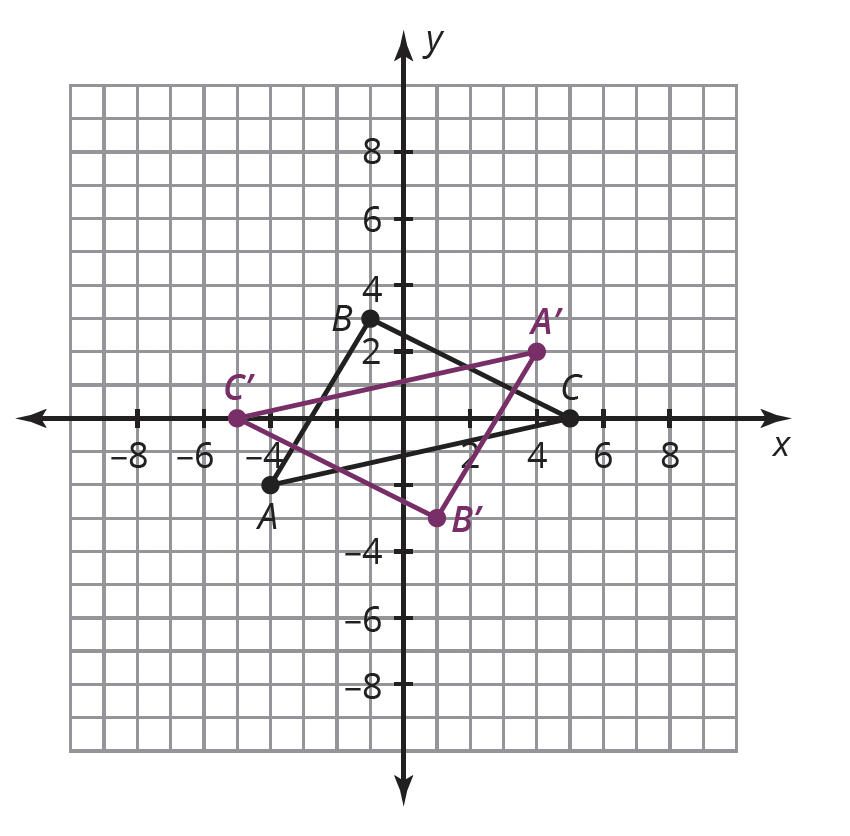
Triangle ABC has vertices A (−4, −2), B (−1, 3), and C (5, 0) .


What clockwise angle of rotation about the origin was performed on triangle ABC to create triangle A′B′C′?

Question 11
11.

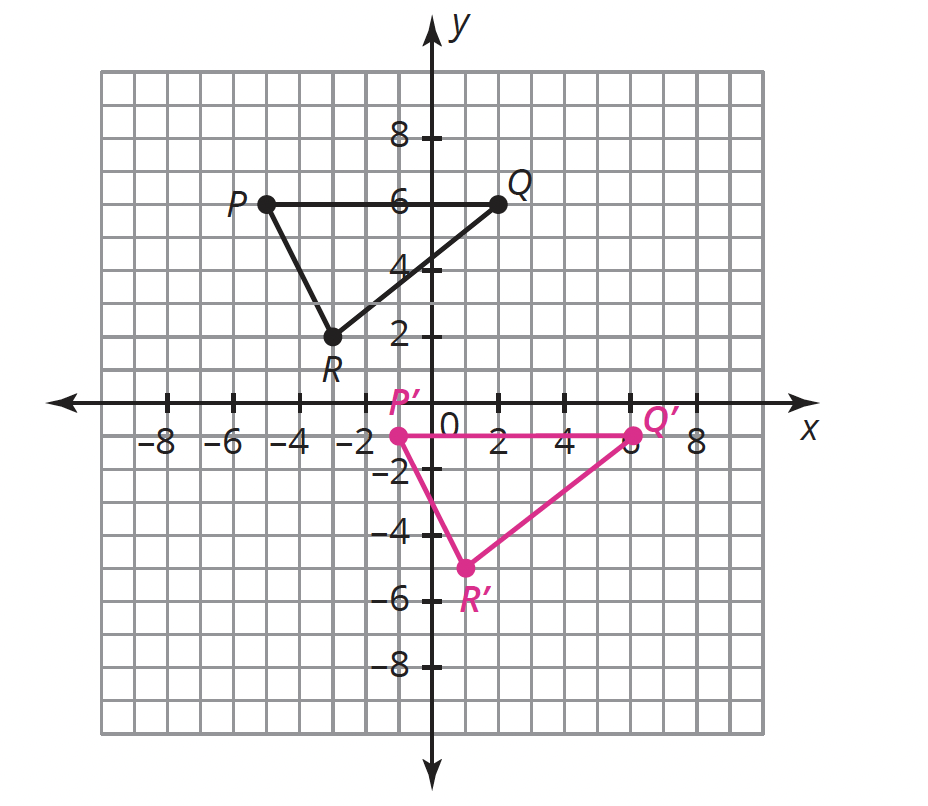
Look at the triangles shown on the coordinate plane.


What is the algebraic rule for the transformation pictured above?

Question 12
12.

Question 13
13.

Justify your answer.

Translations, Reflections, and Rotations preserve congruence.
True
False
Dianne drew a triangle with coordinates (1, 3), (3, 2), and (4, 2). She drew an image of the triangle with coordinates (−1, 3), (−3, 2), and (−4, 2).

Which rule describes the transformation?
(x, y) → (x − 2, y)
(x, y) → (−x, y)
(x, y) → (x, −y)
(x, y) → (x, y − 2)
John draws a square on a coordinate plane. Then, he draws an image of the square 3 units to the right of the original square.

Which statement below is true?
Each side length of the image is 3 times the corresponding side length of the original figure.
The area of the image is larger than the area of the original figure.
The corresponding angle measures of the original figure and the image are equal.
The sum of the angle measures of the original figure is 180 degrees less than the sum of the angle measures of the image.
Which rule best describes the transformation?
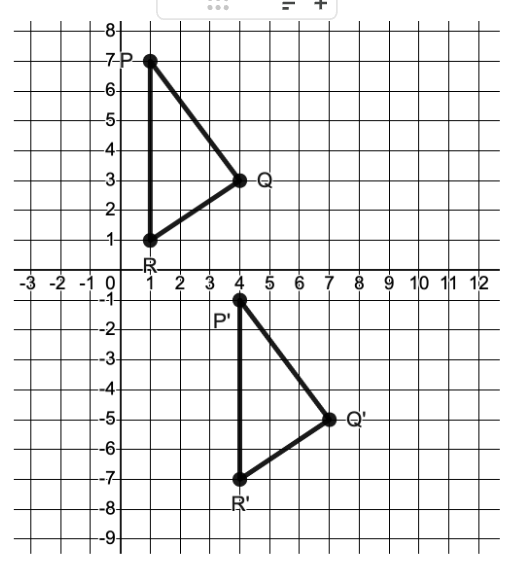
(x, y) → (x, −y)
(x, y) → (x + 3, y − 8)
(x, y) → (x - 8, y + 3)
(x, y) → (x + 8, y − 3)
A trapezoid was transformed on a coordinate grid using the rule (x, y) → (–x, y). Which of the following describes this transformation?
A reflection across the y-axis
A 90° clockwise rotation about the origin
A reflection across the x-axis
A 180° clockwise rotation about the origin
Look at the congruent triangles shown on the coordinate plane.
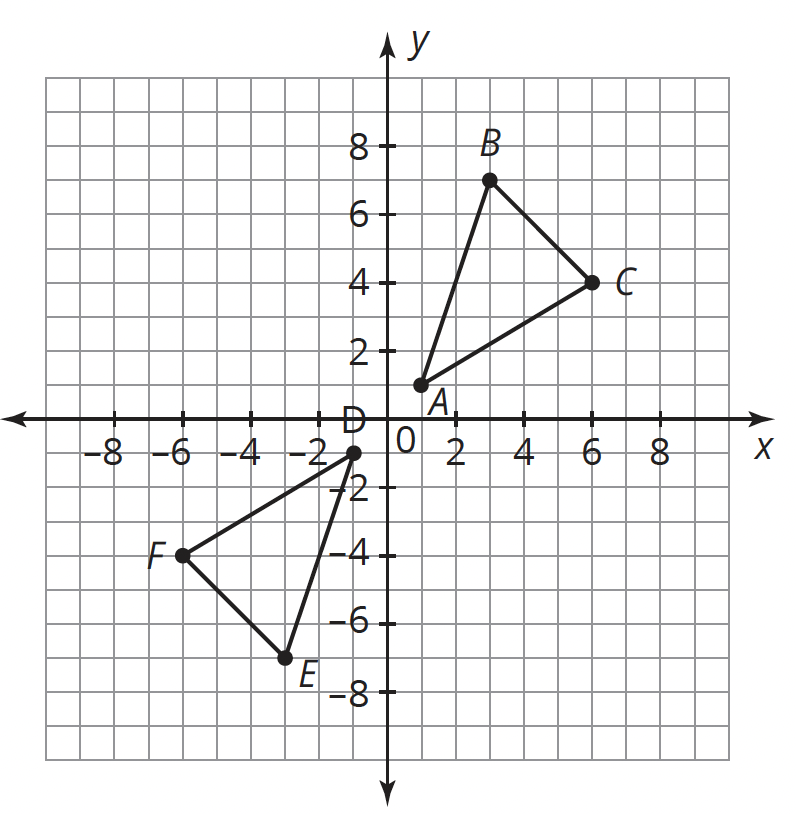


Which statement best describes the transformation and gives the proper algebraic rule used to create triangle DEF from triangle ABC?
Triangle ABC is reflected across the y-axis to create triangle DEF using ( x, y ) → ( –x, y )
Triangle ABC is rotated 180 degrees about the origin to create triangle DEF using ( x, y ) → ( –x, –y )
Triangle ABC is reflected across the x-axis to create triangle DEF using ( x, y ) → ( x, – y )
Triangle ABC is rotated 180 degrees about the origin to create triangle DEF using ( x, y ) → ( –y, –x)
Triangle HJK is graphed on the coordinate grid. Triangle HJK will be transformed using the rule (x, y) → (x, −y) to create triangle H′J′K′.
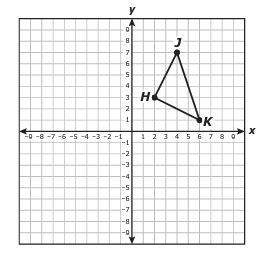


Which graph represents triangle H′J′K′?
A circle is graphed on a coordinate grid with its center at (−4, 7). The circle will be translated p units to the right and v units down. Which rule describes the center of the new circle after this translation?
(x, y) → (−4 + p, 7 + v)
(x, y) → (−4 + p, 7 − v)
(x, y) → (−4 − p, 7 − v)
(x, y) → (−4 − p, 7 + v)