Log in
Sign up for FREE
arrow_back
Library

Practice Test 1.3 Chi Square Test for Goodness of Fit

star
star
star
star
star
Last updated over 2 years ago
10 questions
Required
1
Required
1
Required
1
Required
1
Required
1
Required
1
Required
1
Required
1
Required
1
Required
1
A poker-dealing machine is supposed to deal cards at random, as if from an infinite deck. You suspect that the machine is rigged! In a test, you counted 1600 cards, and observed the following:

Spades = 404, Hearts = 420, Diamonds = 400, Clubs = 376
Question 1
1.

Which of the following is the null hypothesis for this experiment?

Question 2
2.

Which of the following is the null hypothesis for this experiment? (again)

Question 3
3.

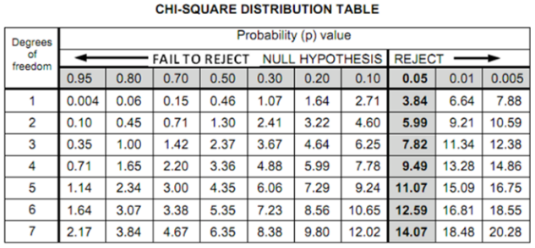
How many degrees of freedom are there?

Question 4
4.

What is the level of significance (α) that we will always use in this class?

Question 5
5.

What is the critical value?

Question 6
6.

What is the decision rule?

Question 7
7.

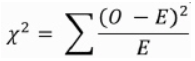
Calculate χ2. Use 2 decimal places.

Question 8
8.

Question 9
9.

Which of the following is the best conclusion?

Question 10
10.

Which of the following is an accurate statement. Insert your calculated value for "<p-value>".

If the chi-square value is greater than the critical value, accept the null hypothesis.
Based on the chi square value, which of the following is the corresponding p-value?
p<0.005
0.005<p<0.01
0.01<p<0.05
0.05<p<0.10
0.10<p<0.20
0.20<p<0.30
0.30<p<0.50
0.50<p<0.70
0.70<p<0.80
0.08<p<0.95
p>0.95
Fail to reject the null hypothesis
Fail to reject the hypothesis
Reject the hypothesis
Accept the hypothesis
Accept the null hypothesis
Reject the null hypothesis
If the hypothesis is true, there is a probability of <p-value> of obtaining results at least as extreme as our results.
If the null hypothesis is true, there is a probability of <p-value> of obtaining results at least as extreme as our results.
There isn't a <p-value> chance that the hypothesis isn't not false.