John Snow Cases of Cholera

Last updated over 1 year ago
15 questions
In the early 19th century, medical statistics for England and Wales were carefully kept by the Office of the Registrar General of England and Wales. The physician, William Farr, published annual reports from this data and recognized that this information could be used to learn about human illness. In the mid-19th century, cholera epidemics were hitting London in waves.

Cholera is a disease that is characterized by watery diarrhea, vomiting, cramps, dehydration, and death. Farr and the physician John Snow set about using data collected about these epidemics to find out what was causing the cholera in the hopes of preventing future epidemics. In the early 1800s, it was not known that microbes caused disease.

John Snow’s first study of cholera was conducted in 1848 when an epidemic of cholera occurred in the area of Golden Square in London. At this time, most of the people in London obtained their water from a community hand pump that drew water from a well from an underground source. These communal pumps were usually located in a square or on a street corner. People would bring buckets or containers and pump the water into the bucket and carry it home for use by their families.

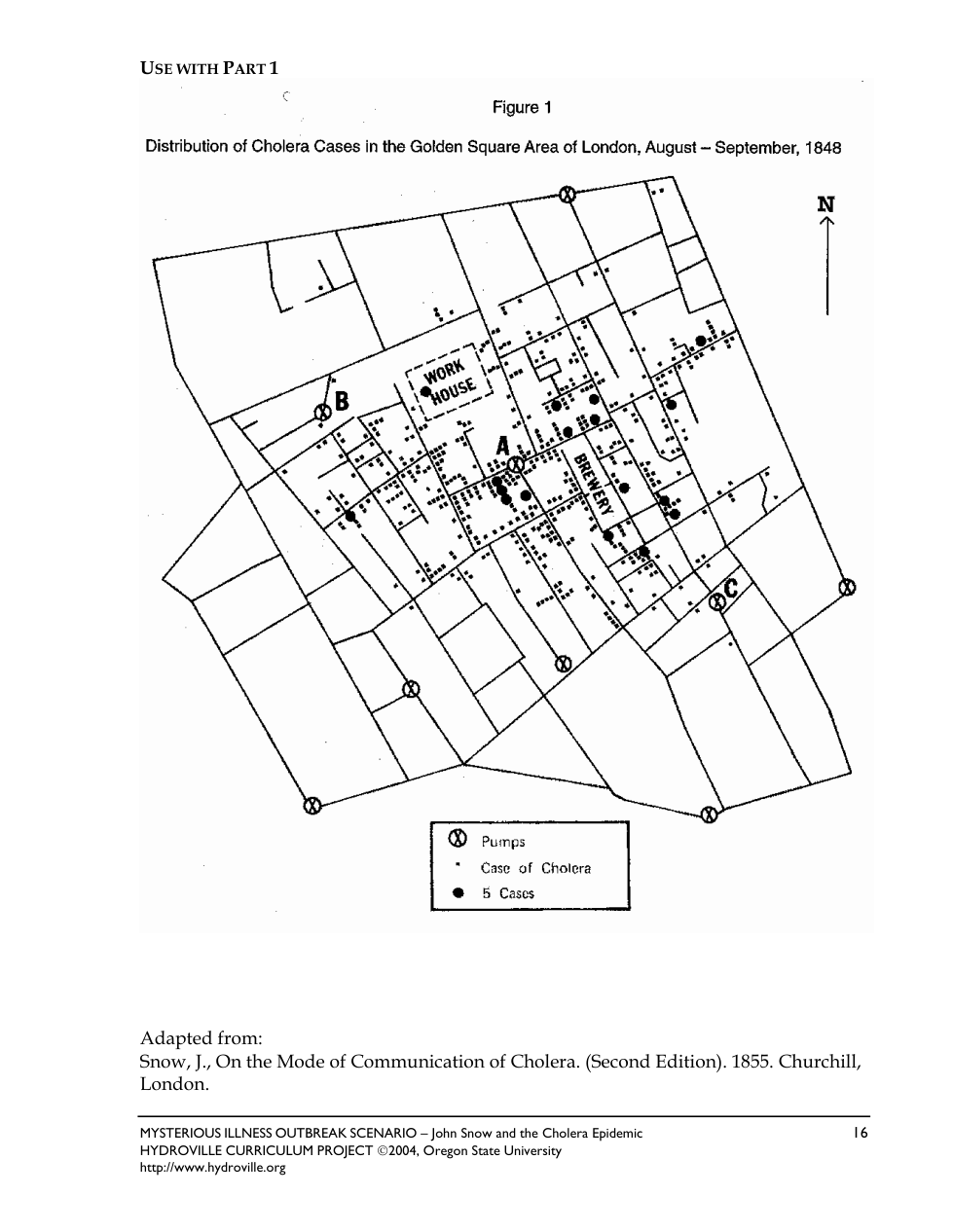
To study the cholera epidemic, Snow acquired information about the location of each case and used this data to create a spot map. Refer to Figure 1, Distribution of Cholera Cases in the Golden Square Area of London, August to September 1848 on the following page. This map is from Snow’s book, On the Mode of Communication of Cholera, published in 1855. The circled X’s are the locations of the pumps that supplied water to this area of London. Snow labeled three of these pumps A, B, and C
1

Cholera is a disease that is characterized by what symptoms?

1

Where was John Snow's first study of cholera conducted?

This map is from Snow's book, on the Mode of Communication of Cholera published in 1855. The circled Xs are the locations of the pumps that supplied water to this area in London. Snow labeled three of these pumps A, B, and C.
2

Looking at the map, what observations can you make about the distribution of the cholera cases?

1

Which well would you pick as the most likely source of contaminated water?

1

Why wouldn't you identify pump C as a possible source?

2

What reasons could explain why there were no cases of cholera in the people living in the two block area around the brewery east of pump A?

Because of the clustering of cases around Public Water Pump A, Snow concentrated on this pump as the source of the cause of the cholera. The absence of clusters around pumps B and C indicated that they were less likely to be the source. Snow found that the water from pump B was so grossly contaminated that residents avoided it and got their water from pump A. Pump C was in a location that made if difficult for the majority of cases to use it.
2

What could Snow do to test his hypothesis that the epidemic was caused by water from pump A? (Remember that he could not actually test the water for bacteria)

Snow went to the homes with cases of cholera and interviewed people about their source of drinking water. The consumption of water obtained from pump A proved to be the one factor common among these cases. The brewery workers got their water from a deep well on the premises and were also allotted a daily quota of beer so they did not drink water from any of the pumps. Snow’s detailed study of the outbreak convinced the vestrymen of the St. James parish of London to remove the pump handle from pump A, which stopped the cholera epidemic.
2

What did John Snow do to prove that pump A was the source of the cholera?

1

How did your plan differ from what Snow actually did (Question 7)?

In the 1850’s London residents began to obtain their water in their homes rather than from communal pumps. They signed up with one of the many water supply companies competing to supply home water. The water intakes for the water supply companies were in a much polluted part of the Thames River. Sometime between 1849 and 1854, one of the companies, the Lambeth Company, moved its water source to an area of the Thames where the water was relatively free from the sewage of London.

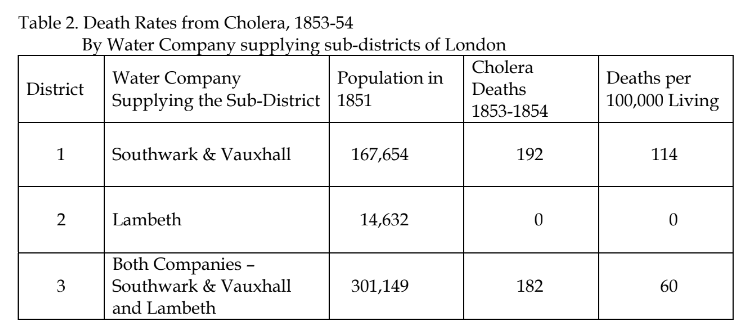
In 1854, Snow noted that a terrible outbreak of cholera occurred in a few square blocks of an area of London. “Within two hundred and fifty yards of the spot where Cambridge Street joins Broad Street, there were upwards of five hundred fatal attacks of cholera in ten days.” Snow wondered what the cause of this outbreak could be. Using data from the Office of the Registrar General of England and Wales, Snow tabulated the number of deaths from cholera in 1853-1854 according to the two water companies supplying the various sub-districts of London.


3

Refer to Table 2. Does this data support Snow's hypothesis that polluted water caused cholera? Why or why not?

2

Is is conclusive proof that Snow's hypothesis is correct? Why or why not?

1

What other factors might be causing the difference in cholera rates in the different London districts?

4

Design (briefly outline) an investigation that would confirm Snow’s hypothesis that polluted water, and not some other factor, was causing the cholera epidemic?

Snow also recognized that many factors in these London districts other than the water supplier were different and could be the reason for the difference in cholera rates.

Snow’s unique contribution to epidemiology was to recognize a way to test his hypothesis that the water supply caused the cholera epidemic. Snow outlined his
investigation in the book On the Mode of Communication of Cholera, published in 1855:

In sub-districts enumerated in the above table as being supplied by both Companies, the mixing of the supply is of the most intimate kind. The pipes of each Company go down all the streets, and into nearly all the courts and alleys. A few houses are supplied by one Company and a few by the other, according to the decision of the owner or occupier at the time when the Water Companies were in active competition. In many cases a single house has a supply different from that on either side. Each company supplies both rich and poor, both large houses and small; there is not any difference either in the condition or occupation of the persons receiving the water of different Companies.

The experiment, too, was on the grandest scale. No fewer than three hundred thousand people of both sexes, of every age and occupation, and of every rank and station, from gentle folk down to the very poor, were divided into two groups without their choice, and, in most cases, without their knowledge...

To turn this grand experiment to account, all that was required was to learn the supply of water to each individual house where a fatal attack of cholera might occur.

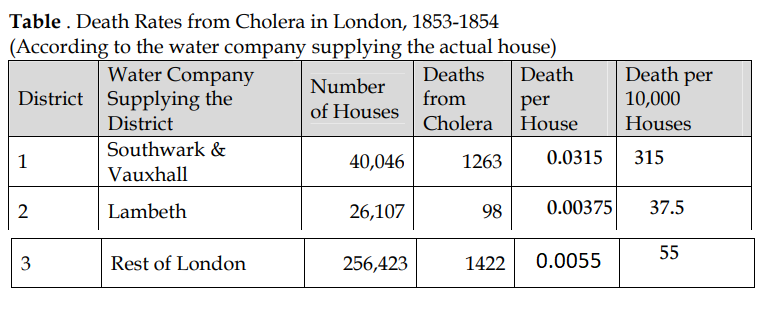
Therefore, Snow walked the London district supplied by both water companies, District 1 (Southwark and Vauxhall) and District 2 (Lambeth). He went from house to house and for every dwelling in which a cholera death had occurred, he asked questions to determine the source of the water.
1

The italics writing is from Snow's book On the Mode of Communication of Cholera. List three alternative explanations Snow considered when testing his hypothesis.

1

Looking at the table. Which data is more meaningful when comparing deaths in the three districts? Why?