1.5 Graphing a Function 9/18/23

Last updated 10 months ago
26 questions
Note from the author:
OBJECTIVES & STANDARDS
Math Objectives
  • Graph ordered pairs on a coordinate plane
  • Describe a situation using words, equations, tables and graphs
  • State the domain and range of a function using inequality notation
Common Core Math Standards
  • Link to all CCSS Math
  • CCSS.PRACTICE.MP4
  • CCSS.HSF.IF.B.4
  • CCSS.HSF.IF.B.5
Personal Finance Objectives
  • Calculate gross and net pay
National Standards for Personal Financial Education
Earning Income
  • 7c: Differentiate between gross, net, and taxable income
DISTRIBUTION & PLANNING
Distribute to students
  • 1.5 HFL: Student Activity PacketGraphing a Function 9/18/23
  • 1.5 HFL: Application Problems
OBJECTIVES & STANDARDS
Math Objectives
  • Graph ordered pairs on a coordinate plane
  • Describe a situation using words, equations, tables and graphs
  • State the domain and range of a function using inequality notation
Common Core Math Standards
  • Link to all CCSS Math
  • CCSS.PRACTICE.MP4
  • CCSS.HSF.IF.B.4
  • CCSS.HSF.IF.B.5
Personal Finance Objectives
  • Calculate gross and net pay
National Standards for Personal Financial Education
Earning Income
  • 7c: Differentiate between gross, net, and taxable income
DISTRIBUTION & PLANNING
Distribute to students
  • 1.5 HFL: Student Activity PacketGraphing a Function 9/18/23
  • 1.5 HFL: Application Problems
Intro
VIDEO: BrainPop - Graphing
This lesson is going to introduce you to graphing.  Watch the video about graphing and answer the questions.
1

After watching the video, why do you think graphs are important?

1

Describe a way that one of the graphs in the video could be used to understand taxes better.

Learn It 1:
One important way that we represent a function’s inputs and outputs is with ordered pairs (also known as coordinates when we graph them).  Let’s take a look at what ordered pairs are, how they relate to functions, and how we can graph them to give a visual representation of our data.
An ordered pair is a set of two numbers written in the form (x, y) where x represents the input of a function and y represents the output after plugging x into the function.
Example
Given f(x) = 2x - 1, represent f(3) as an ordered pair.
1
Substitute for x then simplify:
f(3) means that you are going to find x on the other side of the equation and substitute a 3, then simplify as much as you can
f(3) = 2(3) - 1
f(3) = 6 - 1
f(3) = 5
2
Rewrite as an ordered pair:
If 3 represents the input and 5 represents the output, you can rewrite these numbers in the form (x, y)
f(3) = 5 can be written as (3, 5)

We can also represent a bunch of ordered pairs on a table.  This list represents many different inputs for the function f(x) = 2x + 6 along with their corresponding outputs.
Example
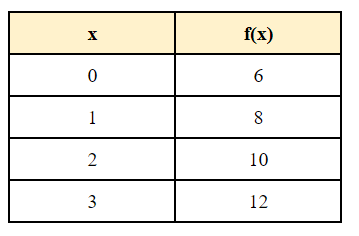

This table represents the points (0, 6), (1, 8), (2, 10), and (3, 12)

Now that we know what ordered pairs are and how to write them, let’s graph them on a coordinate plane.
Here’s a standard XY coordinate plane (sometimes called the Cartesian plane!).
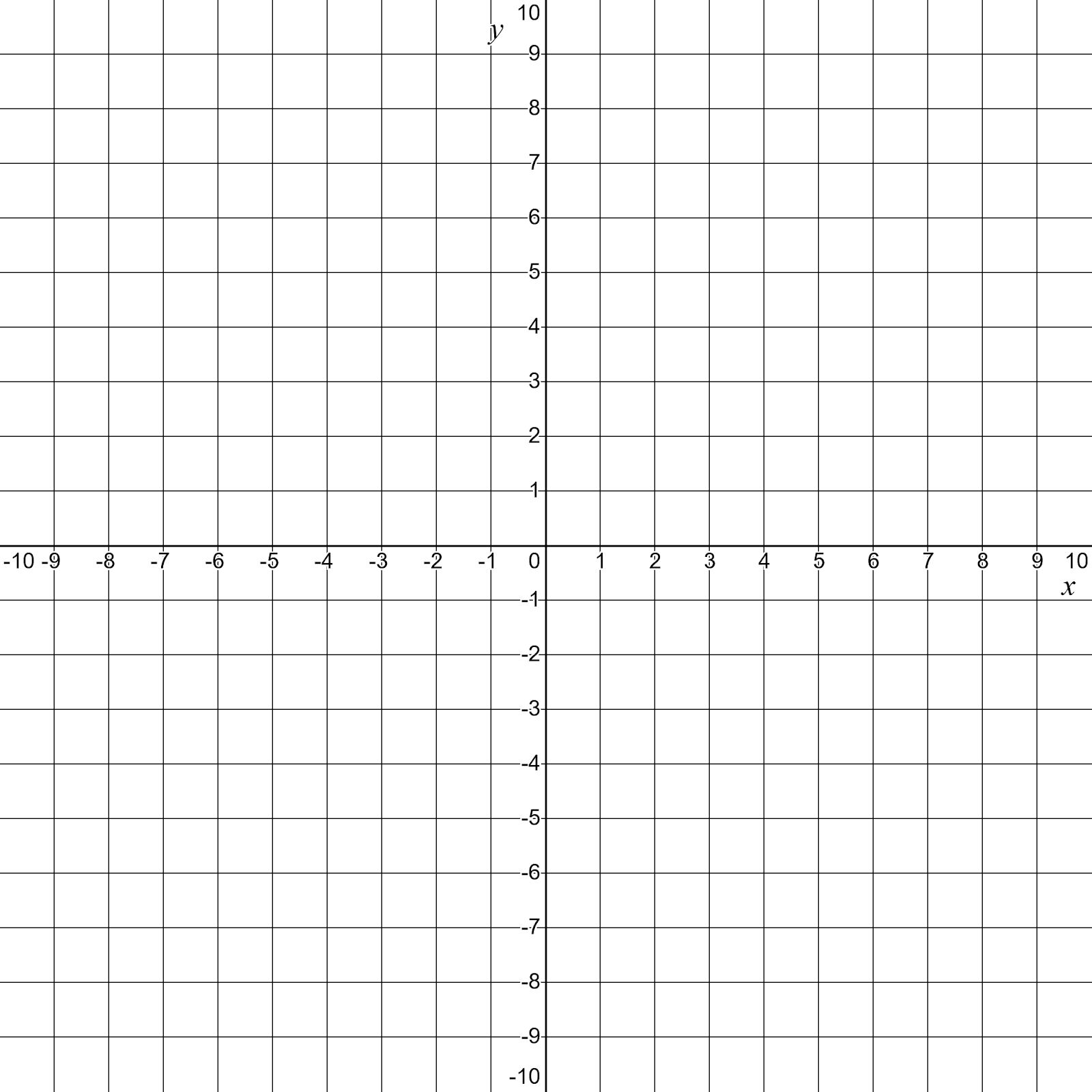

  • The center of the graph where the two axes intersect is the point (0, 0) and is called the origin.  Whenever we graph, we’ll start moving from this point.
  • The horizontal axis is called the x-axis and it’s used to represent the first number in the ordered pair.
  • Move to the right for positive numbers
  • Move to the left for negative numbers.
  • The vertical axis is called the y-axis and it’s used to represent the second number in the ordered pair.
  • Move up for positive numbers
  • Move down for negative numbers.
Example
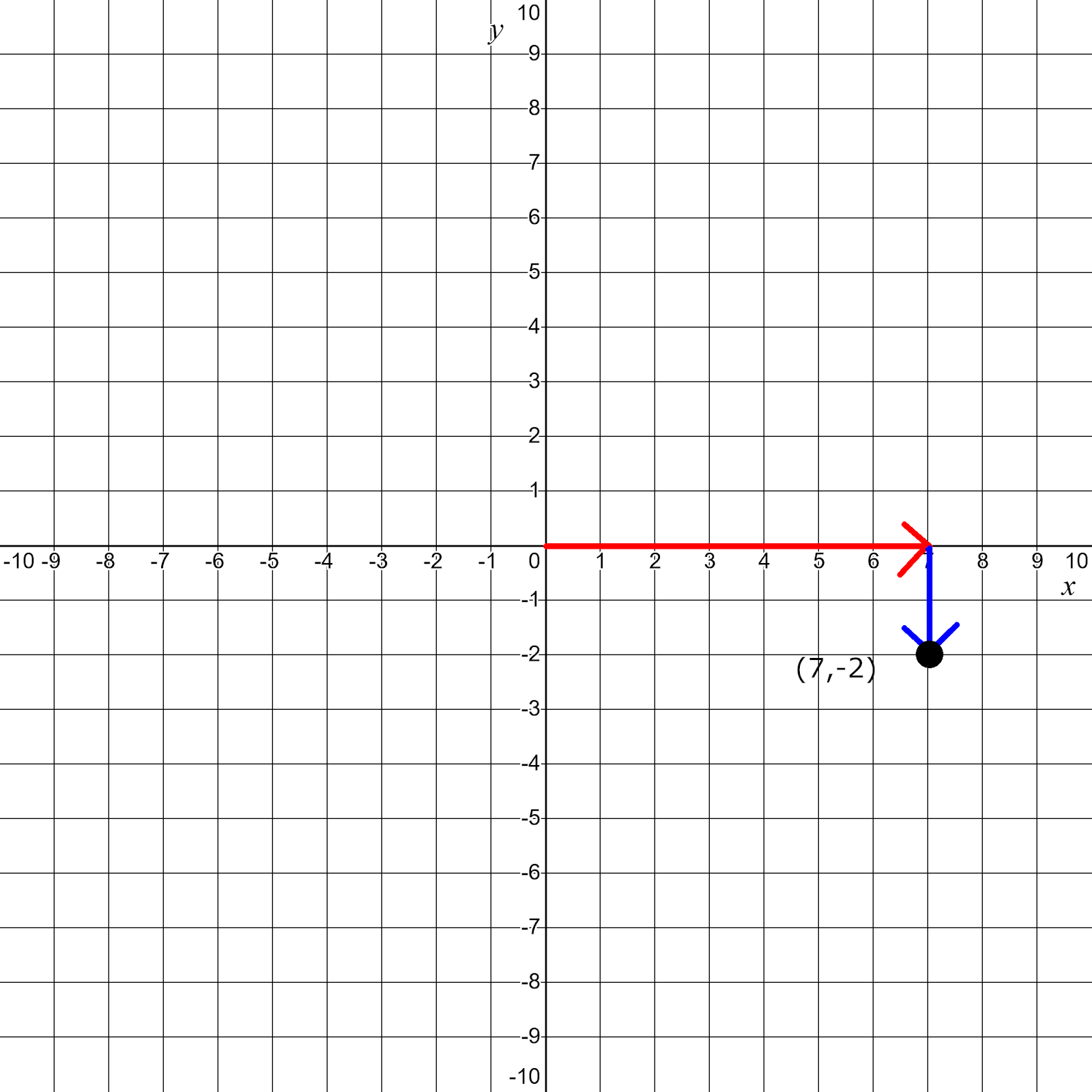
If we want to graph (-5, 2), we’ll start at (0, 0) move 5 units LEFT then two units UP.
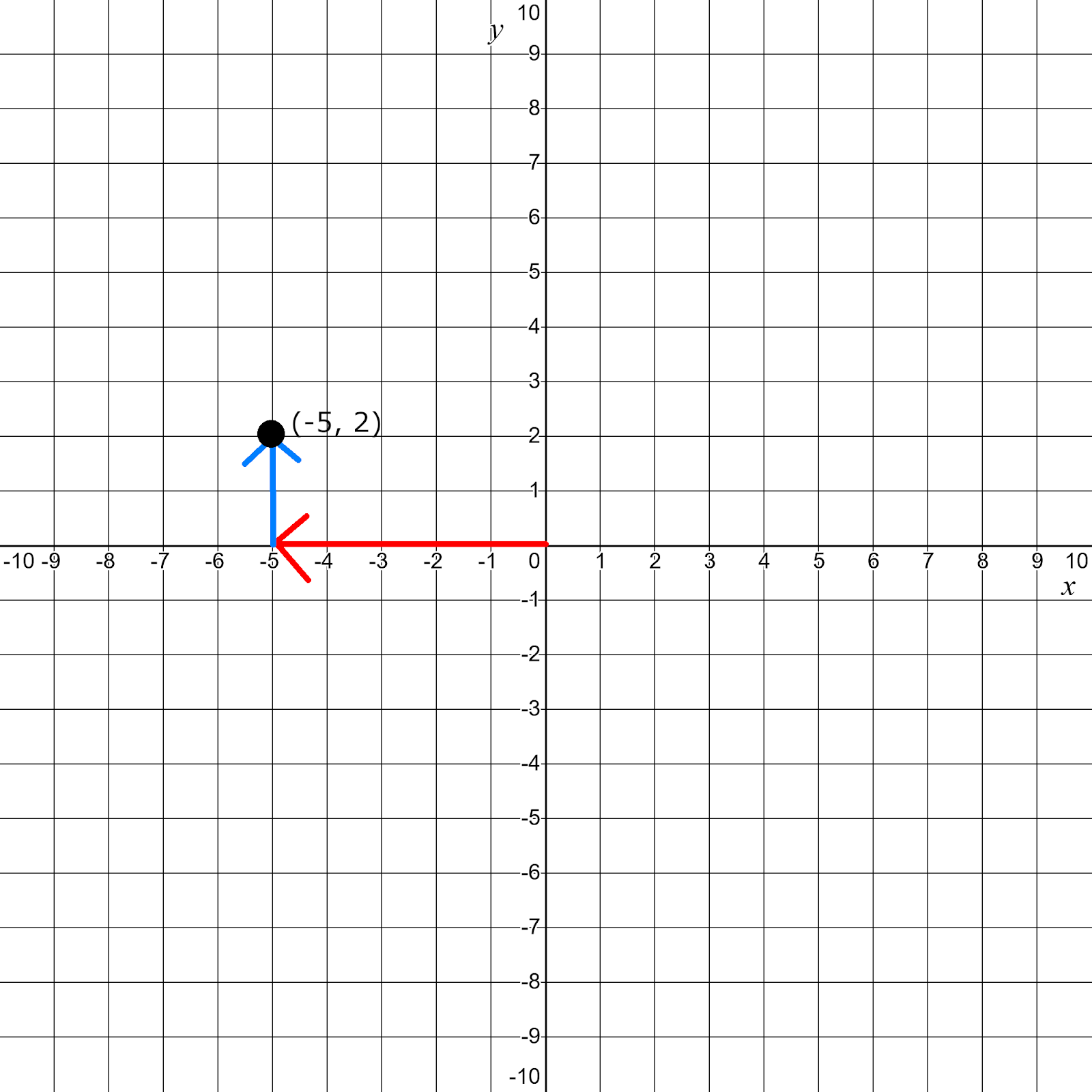
If we want to graph (7, -2), we’ll start at (0, 0) move 7 units to the RIGHT then two units DOWN.
0

DESMOS: The (Awesome) Coordinate Plane Activity (Link in Google Classroom)
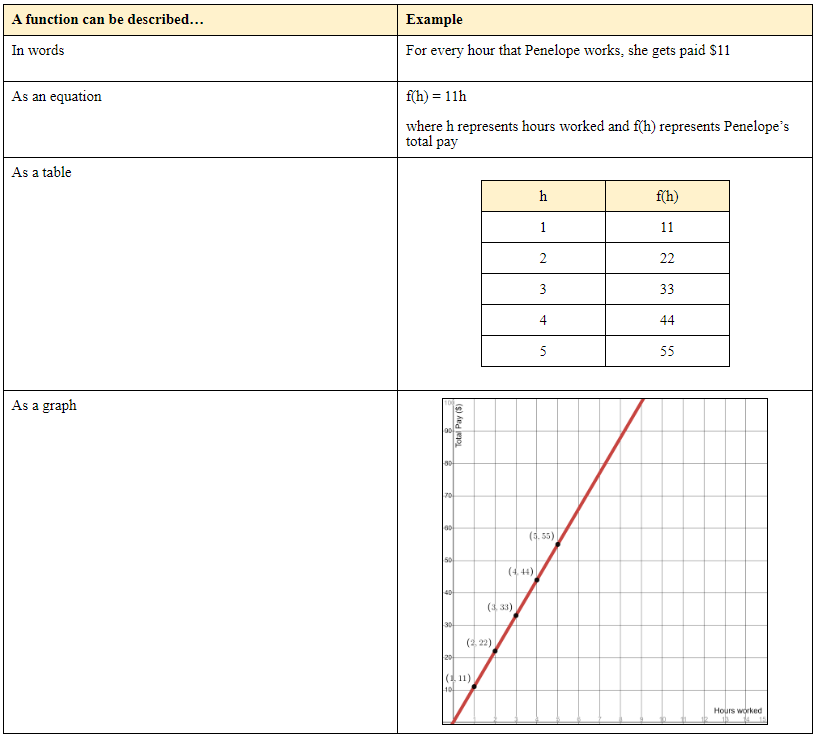
We’ve just seen that we can represent a function by writing an equation, listing its ordered pairs as either  (x, y) or on a table, and graphing it.  There is a fourth way to describe a function’s relationship:  using words.  Let’s put these four representations together and see how we can view a function and its relationship in many different ways.
0

CARD SORT: Four Views of a Function
Follow your teacher’s instructions to complete this activity. (1.5 Desmos 2 in Google Classroom)

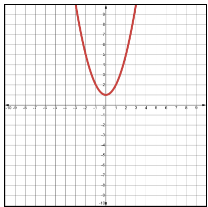
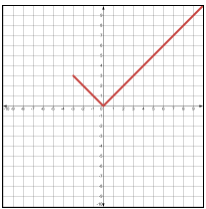
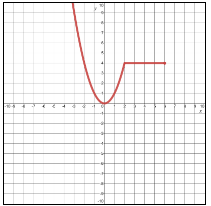
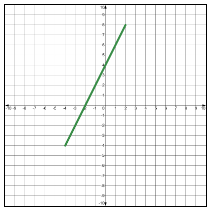
In lesson 1.3, you were introduced to domain (all of the numbers that you can input into a function) and range (all of the numbers that can come out of a function).  Because the 4 views of a function are all different ways of representing the same situation, that means that we can find the domain and range of graphs and word situations!
Example
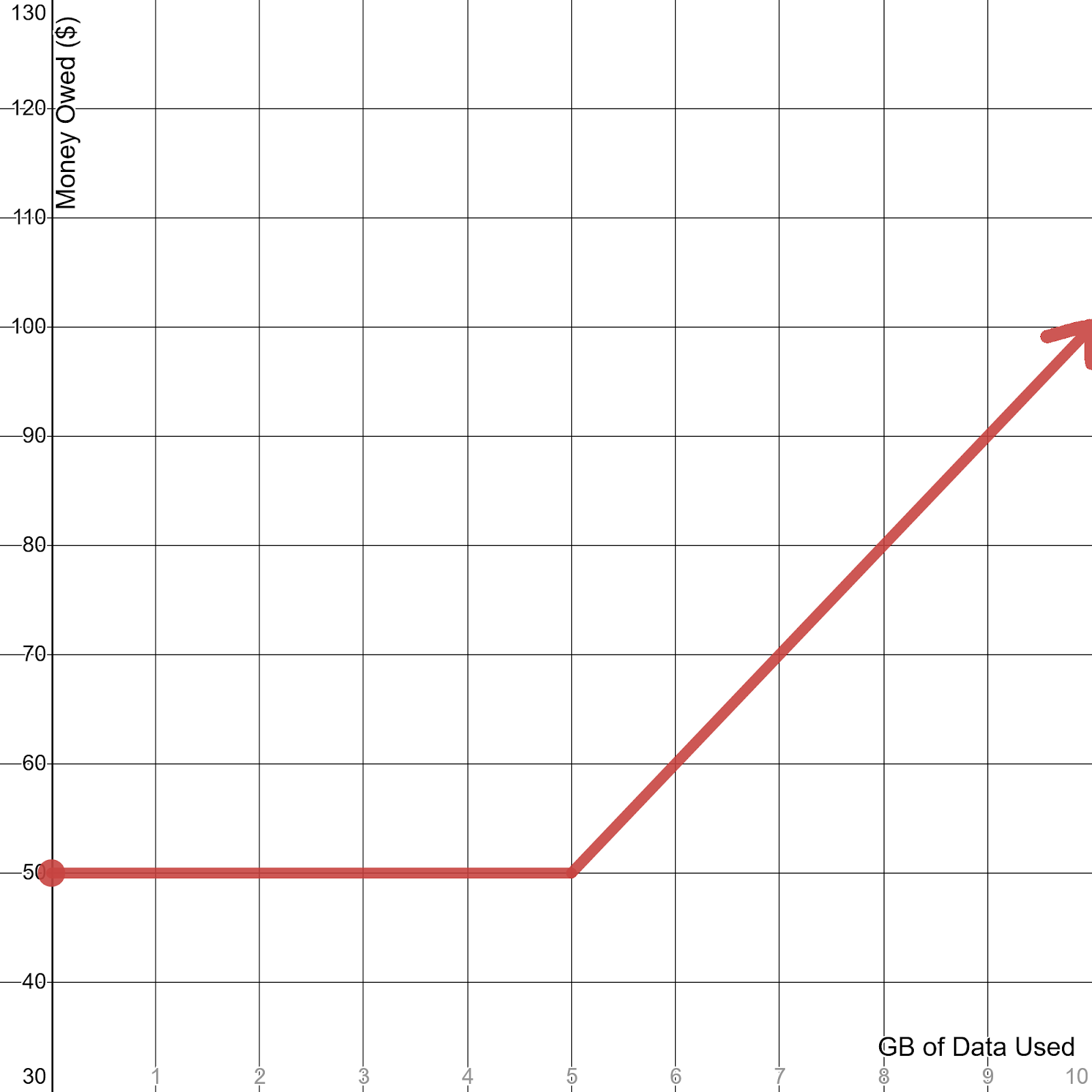
Maryellen pays $50 per month for up to 5GB of data on her cell phone.  After 5GB, she is charged $10 per GB for any additional data that she uses.  What is the domain and range of this function?
1
Determine the input and output variables:
There are two unknown or changing quantities: GB used and total dollars spent.  Maryellen is choosing how much data she uses, so this is the input variable (domain).
Her total dollars spent (range) will be determined based on the input variable.
The input variable is total GB used (Domain)
The output variable is Dollars Spent (Range)
2
Think about the lowest and highest possible input based on the situation:
Consider what make sense for this situation and describe it with words
Maryellen can’t have negative data used.  She can have zero data or anything positive
3
Write your domain using inequality notation.
If x represents the amount of data, the domain is x > 0
4
Repeat the above steps for the output of this situation:
Maryellen is going to pay at least $50 for her data and can pay any amount above that depending on how much data she uses.  If y represents the amount of money paid for data, y > 50

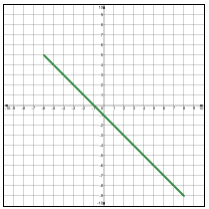
You can also do the same thing graphically.  Here is a graph of Maryellen’s data plan.


The graph starts at 0 on the x-axis and travels to the right forever (x > 0).  It also goes as low as $50 and goes up forever  (y > 50).

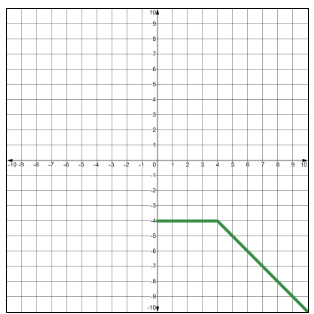
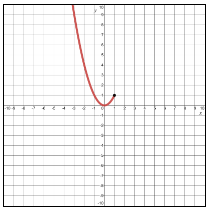
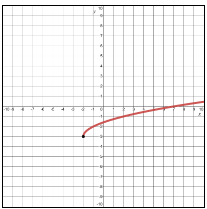
****Practice It 1.5 Graphing a Function on Paper!!!****
2
Fill in the blanks below:
Hint:
Domain is your x value
Range is your y value
Domain:_______
Range:_______
2
Fill in the blanks below:
Hint:
Domain is your x value
Range is your y value
Domain:_______
Range: _______
2
Fill in the blanks below:
Hint:
Domain is your x value
Range is your y value


Domain:_______
Range: _______
2
Fill in the blanks below:
Hint:
Domain is your x value
Range is your y value

Domain:_______
Range: _______
2
Fill in the blanks below:
Hint:
Domain is your x value
Range is your y value


Domain:_______
Range: _______
2
Fill in the blanks below:
Hint:
Domain is your x value
Range is your y value

Domain:_______
Range: _______
4
Fill in the blanks below:
Hint:
Domain is your x value
Range is your y value

Domain:_______
Range: _______
4
Fill in the blanks below:
Hint:
Domain is your x value
Range is your y value


Domain:_______
Range: _______
APPLICATION: Graphing Functions to Analyze a Paycheck
Level 1
Sabah was able to model her current voluntary deductions for retirement and health insurance using the function f(x) = 0.10x + 375 where x represents her gross income every two weeks. Sabah always makes at least $500 in gross income during each two week pay period.
5
Create 5 ordered pairs by completing the table using Sabah’s function
f(x) = 0.10x + 375
x f(x)
$1125_______
$1250_______
$1300_______
$1575_______
$1600_______
2

Graph your ordered pairs on the coordinate plane then draw a straight line through the points.

1

If x represents Sabah’s gross income every two weeks, what would the domain be?

1

If f(x) represents Sabah’s total deductions, what would a reasonable range be?  (Hint: Think about what would happen if she made her minimum amount of gross income) Use f(x) for the range.

Level 2
Austin makes $10 per hour working as a cashier at a bookstore.  His employer requires him to work at least 10 hours per week and his current school schedule limits him to a maximum of 25 hours per week.
1

Write an equation that represents Austin’s gross pay where x represents the number of hours he works per week and f(x) represents his gross pay.

2
What is the domain x_______ and range f(x) _______ of this situation?
5
Create a list of 5 ordered pairs by completing the table below using your equation.
x f(x)
10_______
13_______
16_______
19_______
25_______
1

Explain what one of your ordered pairs means in the context of Austin’s paycheck.

1

Graph your 5 points on the coordinate plane below.

Level 3

Jerimiah is looking at his most recent paycheck. He knows that FICA taxes account for a 7.65% deduction in his gross pay. In addition, he has post-tax deductions for retirement and insurance premiums that total $950.
1

Write an equation that represents Jeremiah's paycheck after ONLY FICA taxes are deducted. Use x to represent his gross salary and f(x) to represent his paycheck after deductions.

1

Expand your equation from part a to create an equation that represents Jerimah’s paycheck after BOTH FICA taxes and post-tax deductions have been deducted.

1
Use your equation to calculate Jerimiah’s net pay after all deductions if he makes $2,600 this pay period._______
2
Jeremiah calculates that if he works all of the hours that he is offered, he can earn a maximum gross pay of $2,850 per pay period.  His employer has also guaranteed him a minimum of $1,500 per pay period.  State the domain_______ and range_______ of your equation.
0

Bonus: Generate a table of 5 ordered pairs using appropriate domain values then use those points to create a graph of Jeremiah’s gross vs net pay. Be sure to include domain and range restrictions!

The End! :)