Log in
Sign up for FREE
arrow_back
Library

Wk 4 and 5- grade 9-ADV-Topics 2.3 Cell Transport (9/16/2023)

star
star
star
star
star
Last updated over 2 years ago
23 questions
1
1
1
1
1
1
1
1
1
1
1
1
1
1
1
1
1
1
1
1
1
1
1
  1. BLOCK 1
Question 1
1.

Differentiate between passive and active transport (Group/pair discussion)
Question 2
2.

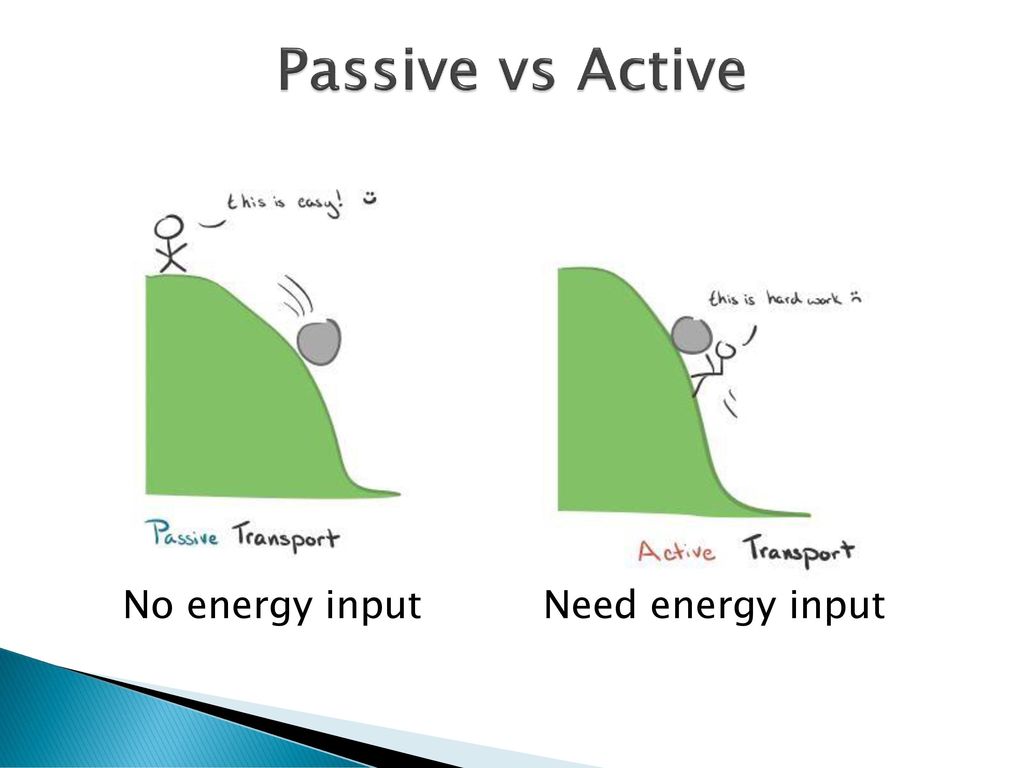
Using a diagram of a hill and a ball above to differentiate between active and passive transport

Question 3
3.

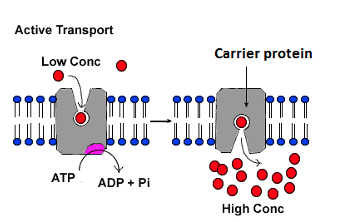
Identify the process pictured as active or passive transport and explain why.
Question 4
4.

a. Define diffusion
b. Give example

Question 5
5.

Describe facilitated diffusion

Question 6
6.

a. Define osmosis

Question 7
7.

Question 8
8.

Solve the worksheet
post your result

https://www.liveworksheets.com/av1648904vo

Question 9
9.

Question 10
10.

Which atom in a water molecule has a negative charge?

Question 11
11.

What name is given to the bonds that are formed between neighbouring water molecules?

WEEK 5
Question 12
12.

Question 13
13.

Question 14
14.

Question 15
15.

Question 16
16.

Question 17
17.
Question 18
18.

Solve worksheet
post your result

https://www.liveworksheets.com/w/en/biology/1508521

Question 19
19.

Define exocytosis and endocytosis

Question 20
20.

Question 21
21.

Draw to show the two processes: exocytosis and endocytosis

Question 22
22.

Solve the sheet
post your result

https://www.liveworksheets.com/ss1221851ft

EXTENSION ACTIVITY
Question 23
23.

What conclusion could you get from the experiment above? Give reasons for this conclusion

Which 2 conclusion can be reached from this experiment
Water moves in or out of the egg through difussion
The sac around the egg acts as a semi prearmeable membrane
Water always moves from the more concentrated to the less concentrated solution during Osmosis
Water always moves from the less concentrated to the more concentrated solution during Osmosis
How many hydrogen atoms are there in a water molecule?
1
2
3
5
What was the role of the plastic bag in the experiment above?
it acted as a semi-pearmeable membrane allowing some molecules to pass through
it acted as a non-pearmeable membrane making sure no molecules passed through it
it was there to prevent the movement of starch and iodine out of/into the bag
it had no purpose
When a cell is placed in a hypotonic solution, _____.
solute exits the cell to equalize the concentration on both sides of the membrane
water enters the cell toward the area of higher solute concentration
water enters the cell toward the area of lower solute concentration
solute and water enters the cell
An ISOTONIC solution has a(n) ______________ concentration of solute (dissolved stuff) than inside the cell.
same
higher
equal
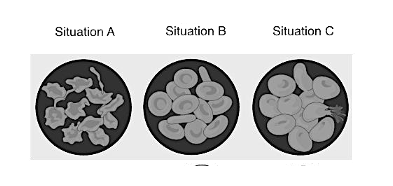
Which of the following situations as shown in the diagram shows cells in an isotonic solution?
Solution A only
Solution B only
Solution A and B only
Solution B and C only
An animal cell placed in a hypotonic solution will
stay thesame
get bigger
get smaller
What process do cells use to get large substances inside the cell?
Osmosis
Diffusion
Exocytosis
Endocytosis